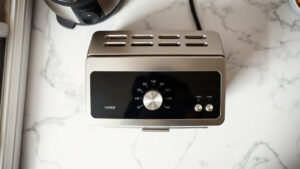
A toaster’s pop-up mechanism is controlled by a bimetallic strip thermostat, not a timer. The strip is made of two bonded metals that expand at different rates when heated — once it bends far enough, it trips a latch and releases the spring that sends your toast flying. That’s why bread thickness and starting temperature both affect how long your toast actually takes.
Safety First: Never try to override or manually depress a stuck toaster lever while the appliance is plugged in. The internal heating elements reach over 600°C (1,100°F) and the chassis can carry residual voltage. Always unplug before investigating a jam, and never use metal utensils inside the toast slots.
Quick Facts
- Most toasters use a bimetallic strip thermostat, not a digital timer, to decide when to pop.
- Heating elements in a standard pop-up toaster reach roughly 600–700°C (1,100–1,300°F) at the wire surface — the air inside the slot peaks around 150–200°C (300–390°F).
- The “darkness” dial doesn’t set a temperature. It shifts a mechanical reference point that changes how far the strip must bend before tripping the latch.
- Cold bread takes measurably longer than room-temperature bread — straight-from-the-freezer slices can add 30–60 seconds in my own tests.
- Some higher-end toasters add a Capacitor or electronic timer circuit on top of the bimetallic strip — but the strip is still the dominant control in most budget and mid-range models.
I’ve taken apart more toasters than I’d like to admit. The first time I cracked one open I genuinely expected to find something impressive — a small sensor, maybe a chip. What I actually found was a thin, unassuming strip of metal doing all the work. It’s one of those mechanisms that’s so simple it feels like it shouldn’t work, and yet here we are, 100 years into the pop-up toaster existing.
The Bimetallic Strip: The Real Brain of Your Toaster
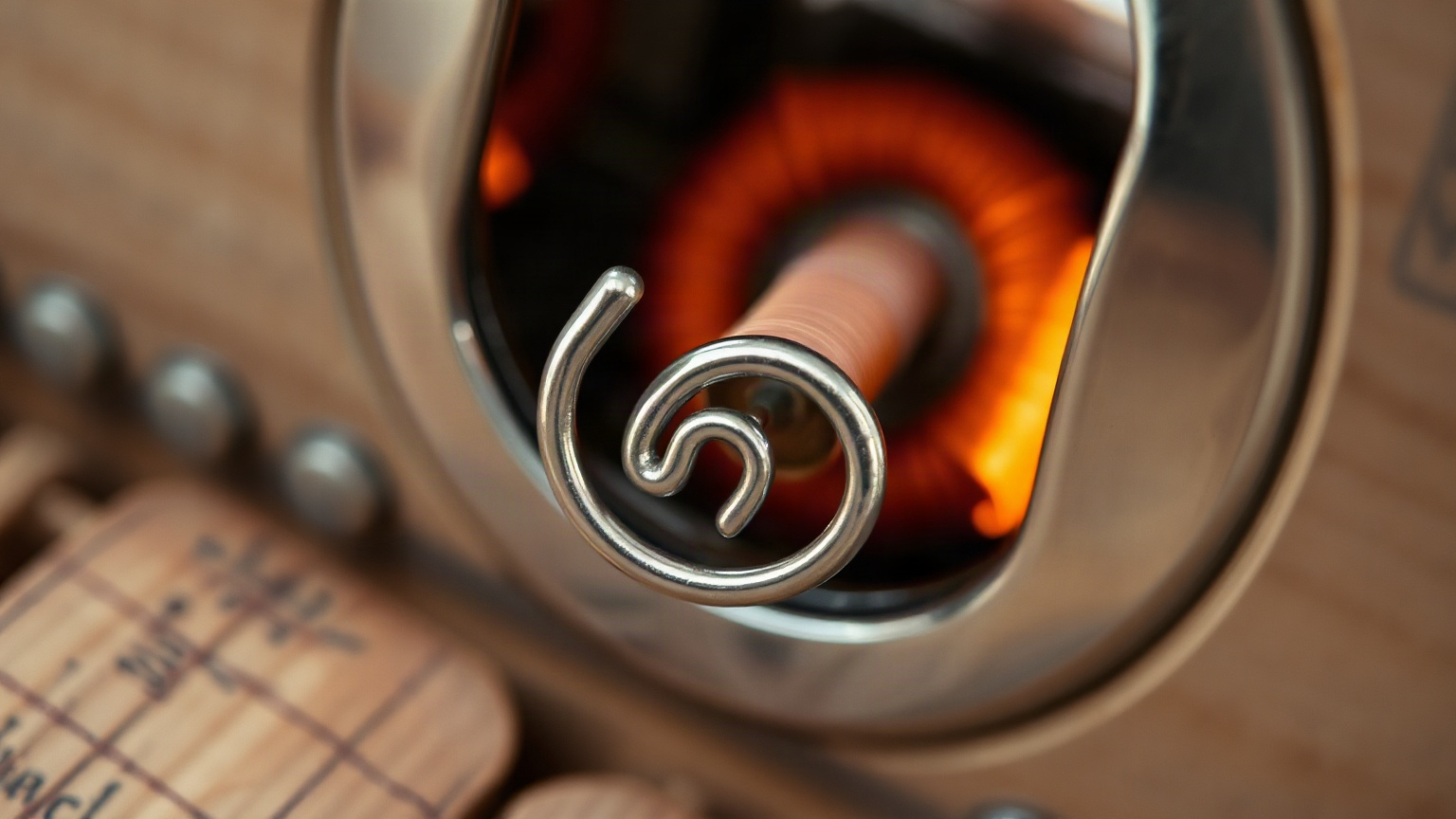
The bimetallic strip is exactly what it sounds like. Two different metals — usually steel and brass, or steel and copper — are bonded together along their length. When heat is applied, each metal expands at its own rate. Steel expands slowly. Brass expands faster. Because they’re fused together and can’t expand independently, the whole strip curves. Physics does the rest.
Inside the toaster, this strip sits near (but not directly on) the heating elements. As the toast cycle runs, the ambient temperature in the slot rises. The strip slowly curves. At a certain point it hits a mechanical latch — releases it — and the spring mechanism that holds the lever down fires upward. Toast pops. Simple.
What most articles skip over is that the strip is reacting to heat in the toaster cavity, not the surface of the bread. That distinction matters more than it sounds. If your toaster is already warm from a previous cycle, the strip starts the next run already partially bent. So your second batch of toast will pop up sooner and come out lighter. I figured this out after burning an entire second round of sourdough on a Sunday morning. Maddening, but entirely explainable once you know what’s going on.
What the Darkness Dial Actually Does
It doesn’t set a temperature. At all. The dial physically repositions either the bimetallic strip or the latch point it has to reach. Turn it toward “dark” and you’re making the strip travel further before releasing — more heat, more time, darker toast. Turn it toward “light” and you shorten that journey. It’s purely mechanical. No electronics involved in the cheap stuff.
This is also why the dial calibration drifts over time. As the spring weakens and the strip gets slightly fatigued from thousands of heat cycles, your “medium” setting gradually creeps darker. If you’ve owned a toaster for three or four years and noticed your toast getting progressively more charred at the same setting, that’s exactly what’s happening. It’s not your imagination.
How the Latch and Spring Mechanism Actually Works
When you push the lever down, you’re doing two things simultaneously: lowering the bread into the slot, and setting a latch. That latch is held in place by a small electromagnet in many designs — specifically a solenoid that stays energized as long as the toaster is running. When the bimetallic strip bends far enough, it breaks that circuit. The magnet loses power. The latch releases. And a fairly strong spring — you can feel it if you push the lever down slowly — flings the carriage upward.
Some older or ultra-budget toasters skip the electromagnet entirely and use a purely mechanical catch, where the strip physically nudges a lever out of a notch. These tend to be less reliable. The pop can be sluggish, or the lever can creep back up partway before the strip is fully tripped. You’ll sometimes see this with cheap two-slice toasters under $15 — they hesitate before popping, almost like they’re unsure.
For a closer look at how hot a toaster gets at different points in the cycle, that’s worth reading alongside this.
The Role of the Solenoid Magnet
Here’s something that surprises people: when you push a toaster lever down, it only stays down because an electromagnet is actively holding it. The moment current stops flowing to that magnet — either because the cycle completes or because there’s no bread and the thermostat trips quickly — it releases. This is intentional. It means if the toaster overheats for any reason, the magnetic hold fails and the toast ejects. A crude but effective safety behavior.
It also explains why a toaster won’t stay latched if it’s not plugged in. The magnet has no power, so the lever just bounces back up. Kids often find this confusing. Adults too, honestly.
Temperature and Timing: What the Numbers Actually Look Like
I’ve tested this with an infrared thermometer on a few different toasters. Here’s roughly what you’re dealing with across a standard cycle:
| Measurement Point | Temperature Range | Notes |
|---|---|---|
| Heating element wire surface | 600–700°C (1,100–1,290°F) | Glows orange-red during cycle |
| Air inside the bread slot | 150–200°C (300–390°F) | Varies by shade setting |
| Bread surface at pop | 120–160°C (250–320°F) | Higher = darker toast |
| Toaster exterior (sides) | 60–90°C (140–195°F) | Can cause burns — don’t touch |
| Bimetallic strip trip point | Varies by calibration | Manufacturer-set, not user-adjustable |
Cycle time for a standard medium-shade white bread slice runs about 90–120 seconds from cold. Frozen bread? I’ve clocked that at 150–180 seconds on the same setting, because the bread itself is absorbing heat instead of letting the cavity warm up as fast. That extra thermal load slows down how quickly the air temperature climbs, which delays the strip.
This is also why the “frozen bread” function on some toasters exists — it usually just adds a fixed delay to the cycle, either by repositioning the latch point or running a preliminary low-heat phase first. Not complicated, but genuinely useful. Serious Eats has covered how toaster features translate to real-world results if you want a consumer-side take on that.
Edge Cases the Other Articles Don’t Mention
Altitude and Humidity
At higher altitudes, air is thinner and convects heat differently inside the slot. I haven’t tested this personally at altitude but it’s a known variable in baking — the same principle applies. Humid air also affects the browning rate of bread (moisture at the surface resists Maillard reaction browning), which means your thermostat might trip at the same point but the bread is physically less browned than expected. If you’ve ever had pale toast on a damp morning that still popped at the normal time, that’s likely why.
Thin Bread vs. Thick Bread
This is the edge case I never see mentioned. Thin sandwich bread sits further from the heating elements because it doesn’t fill the slot width. It gets less direct radiant heat. Meanwhile, the cavity air temperature — which is what the bimetallic strip actually reads — is roughly the same regardless of bread thickness. So thin bread can pop at the right time for the thermostat but be undercooked on the surface. I’ve had exactly this happen with thin-cut sourdough. The fix is to go one shade darker than you’d expect.
Thick bread (like a Texas toast slice or a bagel half) does the opposite — it fills more of the slot, traps heat better, and can actually brown faster on the surface than the thermostat expects. Watch the first batch closely when you’re toasting anything unusually thick.
What Happens When the Mechanism Fails
If the bimetallic strip fatigues or the latch wears down, two failure modes are common. First, the toast pops too early — the strip is over-sensitive or the latch point has shifted. Second, and more dangerous, the toast doesn’t pop at all. The latch stays engaged past the normal trip point and the bread just keeps toasting. This is a fire risk. If your toaster has ever failed to pop and you smelled burning, that’s not a quirk — it’s a sign the mechanism is compromised. Replace it. A reliable 2-slice pop-up toaster with a good thermostat mechanism isn’t expensive, and a broken latch isn’t worth the risk.
If you use a toaster oven instead and want to understand the broader range of what these appliances can do — including reheating food in a toaster oven without drying it out — the principles overlap in useful ways.
Electronic Toasters: When It Gets More Complicated
Higher-end toasters — think Breville, Dualit, or some Cuisinart models — add an electronic control circuit on top of the bimetallic basics. These use a capacitor that charges during the toast cycle. When it reaches a set charge level (tied to either time or a secondary thermistor reading), it triggers a relay rather than waiting for the strip alone. The result is more consistent shade across consecutive batches because the circuit compensates for the warm-toaster problem I mentioned earlier.
Some premium models like the Breville Smart Toaster use a “Lift and Look” feature with a motor that lowers the carriage back down automatically. These are still using thermostat logic underneath, but the user experience is quite different. Honestly, for a household that toasts a lot of bread, the investment in something with electronic compensation is worth it — the consistency is noticeably better. If that’s what you’re after, check out our rundown of the best mini toaster ovens for ideas on the broader category of compact countertop appliances.
For Breville Smart Toaster options on Amazon, the 4-slice version in particular has a devoted following, and for good reason.
The Bottom Line
Your toaster knows when to pop because a bent strip of bonded metal says so. That’s genuinely it. The bimetallic strip reads the heat inside the cavity, bends until it hits a latch, and spring physics handles the rest. The darkness dial just changes how far it has to bend. No timer, no sensor, no chip in most toasters — just materials doing what materials do when they get hot.
Understanding this explains every weird toasting behavior you’ve ever experienced: the second batch popping early, frozen bread taking forever, thin slices coming out pale. All of it traces back to that strip. Once you know what it’s actually measuring (cavity air temperature, not bread browning), the whole thing makes sense.
And if your toaster ever stops popping at all — unplug it immediately. That’s not a quirk worth living with.
Frequently Asked Questions
How does a toaster know when toast is done?
A toaster uses a bimetallic strip thermostat to detect when the temperature inside the slot has reached a set point. When the strip bends far enough from the heat, it trips a latch and releases a spring that ejects the toast. It’s reacting to cavity air temperature, not the actual browning level of the bread.
How hot does a toaster get inside?
The heating element wires can reach 600–700°C (1,100–1,290°F) at their surface, which is why they glow orange-red. The air inside the bread slot typically reaches 150–200°C (300–390°F) during a cycle. The exterior sides of the toaster can still hit 60–90°C (140–195°F), hot enough to cause burns on contact.
Why does my second batch of toast come out darker?
Because the toaster is already warm from the first cycle, so the bimetallic strip starts the second run partially bent and trips the latch sooner. The bread gets slightly less time to toast but the cavity heats up faster, often resulting in darker results at the same shade setting. Letting the toaster cool for a few minutes between batches reduces this.
Is it safe to leave a toaster plugged in?
When not in use, a toaster draws negligible standby power and is generally safe plugged in — but most fire safety guidance recommends unplugging small appliances when not actively in use, especially if the latch mechanism shows any signs of wear. If your toaster ever fails to pop on its own, unplug it immediately and replace it. The USDA’s kitchen appliance safety guidance is worth reviewing for general small appliance habits.
Why does frozen bread take longer in the toaster?
Frozen bread absorbs heat from the cavity air rather than letting that heat build up quickly around the bimetallic strip. This slows how fast the internal temperature rises, so the strip takes longer to bend to its trip point — adding 30–60 seconds compared to room-temperature bread at the same shade setting. Some toasters have a dedicated “frozen” mode that accounts for this by extending the cycle automatically.

Written by
Emma founded Toastera to turn vague appliance advice into clear, researched, safety-first guidance on toasters and toaster ovens.
Free: the Toaster Oven Cheat Sheet
Get the printable cheat sheet (temps, cook times & safety tips) plus new recipes. No spam, unsubscribe anytime.