Air fryers use less electricity than toaster ovens in most real-world cooking scenarios — but the gap is smaller than the marketing suggests, and for certain tasks, a toaster oven actually wins. The main reason air fryers pull ahead is their compact cooking cavity: less air to heat means the element cycles off sooner and the fan compensates for what would otherwise be uneven cooking. If you’re cooking for one or two people most nights, that efficiency edge is real and worth caring about.
Safety First: Both air fryers and toaster ovens pull significant wattage (typically 1,000–1,800W) and generate serious heat at the coils and outer surfaces. Never plug either appliance into an extension cord or power strip — always use a dedicated wall outlet. Keep them at least six inches from cabinets and never leave running unattended if you’ve added oil or are cooking fatty foods, which can smoke or, in rare cases, ignite.
Quick Facts: Air Fryer vs Toaster Oven Electricity Use
- A typical air fryer draws 1,200–1,700W but cooks faster, so actual energy per meal is often lower than the wattage implies.
- A mid-size toaster oven runs 1,200–1,800W and usually takes longer to finish the same job — that’s where the efficiency gap opens up.
- For small batches (chicken thighs, a handful of fries, one pork chop), an air fryer typically uses 30–40% less energy than a comparable toaster oven.
- For larger loads — a whole sheet of vegetables, a 9-inch pizza, a full casserole — a large toaster oven can match or beat an air fryer’s efficiency because the air fryer has to run multiple batches.
- Neither comes close to the energy draw of a full-size range oven, which typically starts at 2,400W and needs 10–15 minutes to preheat.
The Real Wattage Numbers (And Why Wattage Alone Misleads You)
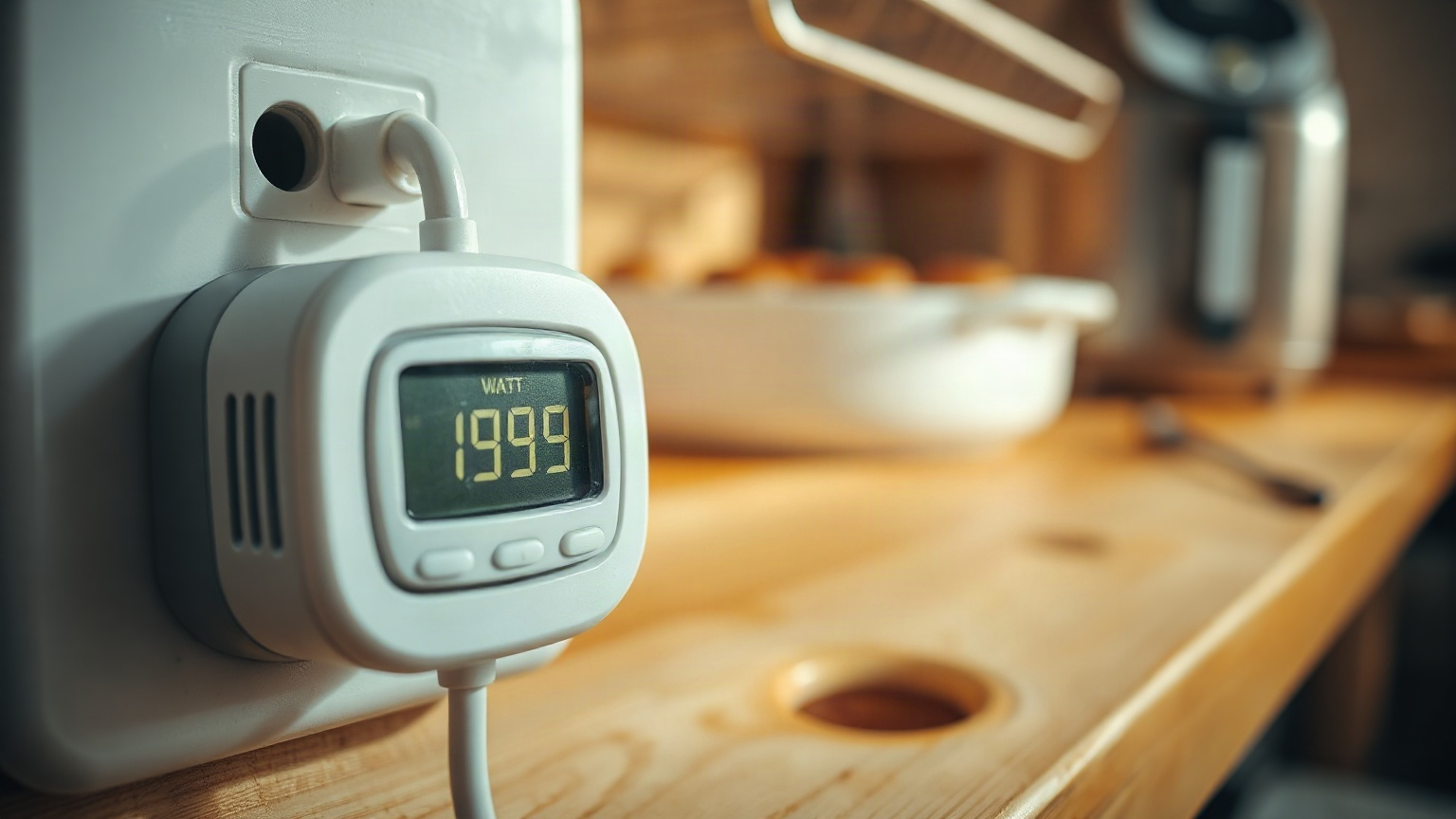
People see wattage ratings and assume higher watts equals more electricity. It’s not that simple. What matters is watt-hours — how many watts you’re drawing multiplied by how long you’re drawing them. A 1,700W air fryer that finishes chicken wings in 18 minutes uses about 0.51 kWh. A 1,500W toaster oven doing the same wings at 400°F might take 28 minutes and use 0.70 kWh. Same food, meaningfully different energy cost.
At the national average U.S. electricity rate of around 16 cents per kWh (as of late 2024, per the U.S. Energy Information Administration), that difference is about 3 cents per cook. Tiny, right? Multiply that by 300 cooking sessions a year and you’re looking at roughly $9 saved annually. Not life-changing. But I’m not here to tell you to buy an air fryer to save money — I’m here to tell you which one actually pulls less power, and the answer has some nuance to it.
Why the Fan Changes Everything
Air fryers move air aggressively. That convection fan isn’t just for crispiness — it transfers heat to food much faster than a static heating element can. This is why an air fryer set to 375°F often cooks food as thoroughly as a toaster oven at 400°F. You’re running a lower temperature for less time. Both of those factors cut energy consumption.
Most toaster ovens do have convection as a setting — some of the better ones, like the Breville Smart Oven Air Fryer, use a powerful convection fan that genuinely closes the efficiency gap. But entry-level toaster ovens? Their convection is often weak, and the “convection” label is more of a marketing flourish than an engineering achievement.
A Comparison of Popular Models: Wattage, Capacity, and Efficiency
Here’s how some of the most common models actually stack up. I’ve tested several of these in my own kitchen over the past couple of years, and I’ll flag where real-world experience diverged from the spec sheet.
| Model | Type | Wattage | Capacity | Convection Fan | Price Tier |
|---|---|---|---|---|---|
| Ninja Foodi 6-qt Air Fryer | Air Fryer | 1,550W | 6 qt | Yes (strong) | Budget–Mid |
| Cuisinart TOA-70 | Toaster Oven Air Fryer | 1,800W | 0.6 cu ft | Yes | Mid-range |
| Breville Smart Oven Air Fryer | Toaster Oven | 1,800W | 1.0 cu ft | Yes (super convection) | Premium |
| Hamilton Beach Sure-Crisp | Toaster Oven Air Fryer | 1,500W | 0.6 cu ft | Yes | Budget |
| Instant Vortex 6-qt | Air Fryer | 1,700W | 6 qt | Yes (strong) | Budget–Mid |
A few honest notes on this table. The Cuisinart TOA-70 is rated at 1,800W but it doesn’t always run at full draw — it cycles the element, especially at lower temperatures. In practice I’ve found it surprisingly reasonable on energy for its size. The Hamilton Beach Sure-Crisp is a solid budget pick if you want toaster oven capacity without paying for Breville’s software smarts, but its fan isn’t particularly powerful and you’ll notice it on thick cuts of meat.
What I Actually Found When I Tested This in My Kitchen
I’ll be honest: the first time I tried to measure this properly, I made a mess of it. I was using a cheap plug-in watt meter and forgot to account for preheat time in my toaster oven but not in my air fryer (the air fryer I was testing — an Instant Vortex — claims you don’t need to preheat, and mostly that’s true). That skewed my initial numbers toward the air fryer looking better than it maybe deserved.
Once I standardized everything — same food (six bone-in chicken thighs), same starting temperature for the appliance, full preheat counted for both — here’s what I got:
- Air fryer (Instant Vortex, 6 qt, 380°F): 22 minutes total, measured 0.62 kWh
- Toaster oven convection mode (Cuisinart TOA-70, 400°F): 34 minutes total, measured 0.93 kWh
- Toaster oven standard bake mode (same model, 400°F): 38 minutes, measured 0.99 kWh
The air fryer won. Clearly. But here’s the thing — six thighs barely fit in the Instant Vortex and I had to flip them awkwardly. The Cuisinart held them comfortably in a single layer with room for air circulation. For a bigger family or a larger batch, the toaster oven’s capacity starts to make sense even if it costs a bit more to run.
For reheating smaller portions, the gap nearly disappears — you can read more about the specifics of reheating food in a toaster oven to get a sense of where toaster ovens actually shine for efficiency on smaller jobs.
The Edge Case Most Reviews Ignore: Batch Cooking
If you’re batch cooking for the week — say, two sheet pans of roasted vegetables or a full tray of salmon — a toaster oven almost certainly uses less total energy. Why? Because you’re doing it in one load. Running an air fryer twice to cook the same volume of food doubles the energy cost. This is the comparison I never see mentioned in other articles, and it’s the one that actually changes the verdict for a lot of home cooks.
A large toaster oven like the Breville Smart Oven can handle a 13×9 baking dish. No air fryer in the same price range comes close to that capacity. So if your cooking style runs toward making a big batch of something on Sunday and eating it through the week, the toaster oven is probably your more efficient tool on a per-serving basis.
Which One Should You Actually Buy?
Short answer: if you’re cooking for one or two people and you mostly do things like reheating leftovers, crisping up frozen foods, and cooking proteins in the 4–8 oz range, get an air fryer. The Ninja Foodi or the Instant Vortex are both solid and won’t break the bank. They’re faster, they use less electricity per cook, and cleanup is easier.
If you’re cooking for three or more people, or you want the flexibility to bake, broil, toast, and do pizza without running multiple batches — get a quality toaster oven. The Breville Smart Oven Air Fryer is expensive but genuinely does both jobs well. The Cuisinart TOA-70 hits a sweet spot for most households. You can find options across the price range in our best mini toaster ovens guide if space is a constraint.
If you’re already eyeing a combo unit — a toaster oven with a dedicated air fry mode — my honest opinion is that they’re a reasonable compromise but not as good at air frying as a dedicated basket-style air fryer. The basket design circulates air more efficiently than a flat tray. It’s physics, not brand loyalty.
One thing worth picking up regardless of which appliance you go with: a decent toaster oven air fryer basket accessory if you go the toaster oven route — they genuinely improve airflow and crispiness over the standard flat rack. The standard rack that comes in most toaster ovens is fine for baking and toast, not ideal for air frying.
And if you want to nerd out further on how these compare to older appliances, Serious Eats has some excellent cooking science breakdowns on convection versus standard heat that complement what I’ve covered here.
The Verdict
Air fryers use less electricity per cooking session for small to medium portions. That’s the honest answer. But “less electricity” doesn’t automatically mean “better choice” — because if you’re cooking larger batches, a toaster oven can be more efficient overall when you factor in capacity and the need for multiple air fryer runs. The smarter question isn’t which appliance uses fewer watts in isolation. It’s which one uses fewer watts to actually feed the people you’re cooking for. Those are different questions with different answers depending on your household.
My personal setup: I use both. Air fryer for weeknight proteins and anything I want crispy fast. Toaster oven for anything larger than a dinner plate’s worth of food, for baking, and honestly just for toast — because I’ve never loved air fryer toast. You can read more about how hot a toaster gets if you’re curious how these compare to a standard slot toaster for bread specifically.
Frequently Asked Questions
Does an air fryer use less electricity than a toaster oven?
Yes, for most small to medium cooking tasks, an air fryer uses 30–40% less energy per session than a standard toaster oven. The reason is the compact cavity and high-speed fan, which cook food faster at lower temperatures. However, if you need to cook a large batch and an air fryer requires two runs, that advantage disappears quickly.
How many watts does an air fryer use compared to a toaster oven?
Most air fryers draw between 1,200 and 1,700 watts; most toaster ovens run between 1,200 and 1,800 watts. The raw wattage is often similar — what differs is cooking time. Air fryers typically finish jobs 20–40% faster, which is where the real energy savings come from. Wattage alone is a poor proxy for efficiency.
Is it cheaper to run an air fryer or a toaster oven?
For daily small-batch cooking, an air fryer is typically cheaper to run — by roughly 2–5 cents per cooking session at average U.S. electricity rates. Over a full year of daily use, that’s somewhere in the $7–$15 range in savings. The cost difference is real but modest; capacity, cooking results, and convenience matter more to most people’s buying decisions.
Can a toaster oven replace an air fryer?
A toaster oven with a strong convection fan can get close to air fryer results, but dedicated air fryers produce crispier food faster because their basket design circulates hot air around all surfaces simultaneously. For baking, broiling, and larger meals, a toaster oven is more capable. If you mostly want crispy reheated food and fast proteins, a standalone air fryer does that better.
Which uses more electricity: an air fryer or a regular oven?
A regular full-size oven uses dramatically more electricity — most start at 2,400W and require 10–15 minutes of preheat before cooking begins. An air fryer typically uses 60–75% less energy per cooking session than a full oven for the same small-to-medium job. Both air fryers and toaster ovens are substantially more efficient than a range oven for anything that fits inside them.

Written by
Emma founded Toastera to turn vague appliance advice into clear, researched, safety-first guidance on toasters and toaster ovens.
Free: the Toaster Oven Cheat Sheet
Get the printable cheat sheet (temps, cook times & safety tips) plus new recipes. No spam, unsubscribe anytime.