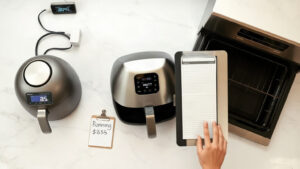
The best air fryer toaster oven combo for a family of four is the Breville Smart Oven Air Fryer Pro — it has the capacity, the precision, and the build quality to handle real family cooking without feeling like a compromise. That said, the Ninja Foodi XL Pro Air Fry Oven is a legitimate contender if budget is a factor, and the Cuisinart TOA-70 earns its place on smaller countertops. Which one actually makes sense for your kitchen depends on a few things I’ll walk you through below.
Safety First: Air fryer toaster ovens run extremely hot — up to 450°F or higher — and the exterior walls can get scorching during and after use. Keep at least 4–6 inches of clearance on all sides, never place these units under low cabinets, and always use oven mitts when pulling out racks or trays. Don’t leave the unit unattended on the air fry setting, especially when cooking high-fat foods; grease splatter on a hot heating element is a fire risk. Unplug before cleaning.
Quick Facts: Air Fryer Toaster Ovens for Families
- A family of four needs at least 0.6 cubic feet of interior capacity — ideally closer to 1.0 cubic feet — to cook a full chicken, a 12-inch pizza, or a sheet pan of vegetables without batching.
- The Breville Smart Oven Air Fryer Pro is the top pick for most families: large capacity, 13 cooking functions, and genuinely consistent results across all of them.
- The Ninja Foodi XL Pro Air Fry Oven (model SP351) is the best value option — more cooking space than you’d expect at the mid-range price point.
- The Cuisinart TOA-70 Air Fryer Toaster Oven is compact-ish but capable, and it’s the one I’d pick if counter space is genuinely tight.
- All three can air fry, toast, bake, broil, and roast. The differences come down to capacity, footprint, ease of use, and how annoying the cleanup is.
Why a Family of Four Changes the Calculation
A solo apartment dweller can get away with a tiny toaster oven and air fry a single chicken breast. Fine. But when you’ve got four people to feed — or even two adults plus a couple of kids with strong opinions about their food — you need something that can actually handle volume. Batch cooking kills the appeal of air frying fast. If you’re doing two rounds of french fries while everyone sits at the table staring at you, you’ve already lost.
So capacity is the first filter. I’d say anything under 0.6 cubic feet is a non-starter for a family. A 12-inch pizza should fit flat. You should be able to roast a 4–5 lb chicken without contorting it. And ideally, a half-sheet’s worth of vegetables fits in one layer, because crowding is what turns air frying into steaming — which defeats the whole point.
Beyond size, you want multiple rack positions, a decent air fry basket or tray included out of the box, and controls that don’t require a 20-minute orientation session every time you want to make chicken wings. All three models I tested hit most of those marks, but not equally.
The Three Contenders: What Each One Actually Does
Breville Smart Oven Air Fryer Pro (BOV900BSS)
This is the one I use most often, and I’ll be upfront about why: the interior is big enough to actually matter. Breville advertises 1.0 cubic foot of interior space, and it shows — a 13-inch pizza fits with room. I’ve done a spatchcocked 4.5 lb chicken on the included roasting rack at 425°F for about 45 minutes, and the skin came out genuinely crisp. That doesn’t happen by accident; it’s the Element IQ system doing real work, adjusting heat distribution based on the cooking function.
Thirteen cooking functions sounds like marketing bloat, but I actually use at least seven of them regularly: air fry, roast, bake, broil, toast, warm, and proof (yes, proof — I make pizza dough). The slow cook function I’ve used once and don’t entirely trust, but it’s there.
What tripped me up the first time was the toast setting. It toasts by number of slices and shade level, not by time or temperature, and if you put in two slices of thick sourdough instead of regular sandwich bread, it’ll undertoast them. I now always bump up the shade one level from whatever feels right. Small thing, but worth knowing.
The footprint is large. I’m not going to sugarcoat it — this thing takes up serious counter real estate. Measure before you buy. The price is firmly premium, but it’s the kind of premium that holds up. I’ve had mine for nearly two years and nothing has wobbled, cracked, or started behaving strangely.
Ninja Foodi XL Pro Air Fry Oven (SP351)
The Ninja surprised me. I went in expecting it to be a budget pick that would feel like a budget pick, and it’s not. The XL Pro version has a genuinely huge capacity — Ninja says it holds two 12-inch pizzas or a 5 lb chicken — and the flip-up, store-flat design is actually clever if your storage situation is a mess (mine is).
Air fry performance at 400°F is solid. Frozen fries come out with real texture, not the sad middle-ground between air-fried and baked. The integrated sheet pan and air fry basket are included, which matters because buying accessories separately for these things adds up fast. Check out compatible accessories for the Ninja Foodi XL if you want a second rack or a different basket setup.
Where the Ninja falls short: the controls are digital but the interface feels slightly cheap — like it was designed by a different team than the heating system. The LCD isn’t as crisp as Breville’s display. And the toast function is just fine; it’s not going to make you rethink breakfast. But honestly? For the price difference versus Breville, most families won’t care.
Cuisinart TOA-70 Air Fryer Toaster Oven
The Cuisinart TOA-70 is the smallest of the three and it holds a 12-inch pizza — just. It’s a 0.6 cubic foot interior, which is genuinely workable for a family of four if you’re strategic about it. I wouldn’t try to roast a whole chicken in here, but thighs and drumsticks on the air fry rack at 400°F for 22–25 minutes? Excellent results, and they fit in one layer.
It has seven cooking functions including air fry, bake, broil, toast, and warm. Less than the other two, but in practice, those seven cover 95% of what a family actually cooks. The knob-and-dial controls are the most intuitive of the three — no learning curve. My mom could walk up to this thing and figure it out without asking me anything, which is genuinely rare.
Cleanup is the Cuisinart’s weak point. The interior is smaller, so grease and crumbs end up concentrated. The non-stick coating works initially but requires gentle handling — skip anything abrasive. The included baking pan is a bit thin and prone to warping at high temps; I’d replace it with a sturdier quarter-sheet pan after a few months.
Side-by-Side Comparison
| Feature | Breville BOV900BSS | Ninja SP351 XL Pro | Cuisinart TOA-70 |
|---|---|---|---|
| Interior Capacity | ~1.0 cu ft | ~0.9 cu ft | ~0.6 cu ft |
| Cooking Functions | 13 | 10 | 7 |
| Max Temperature | 450°F | 450°F | 450°F |
| Pizza Size (fits) | 13 inch | 12 inch (x2) | 12 inch |
| Whole Chicken | Yes (up to 5 lb) | Yes (up to 5 lb) | Not comfortably |
| Counter Footprint | Large | Large (folds up) | Medium |
| Price Tier | Premium | Mid-range | Mid-range / Budget |
| Control Type | Digital + knob | Digital buttons | Analog dials |
| Included Accessories | Racks, pan, basket | Sheet pan, basket, rack | Rack, pan, basket |
Air Fry Performance: How They Actually Cook
All three use convection heating to circulate hot air — that’s what air frying is, fundamentally. But they don’t all do it equally well. The Breville’s Element IQ system adjusts the power of individual heating elements based on what you’re cooking, which gives it an edge on evenness. Chicken wings at 400°F for 20 minutes come out uniformly browned without me having to flip them halfway through. (I still flip them. Old habit.)
The Ninja is louder than both of the others during air fry mode — the fan runs hard, and you notice it. That’s not a dealbreaker, but if your kitchen is open to a living space, you’ll be aware of it. Performance-wise, it’s very close to the Breville on most things. Frozen foods especially do well. The Cuisinart is slightly less aggressive with air circulation, which means denser items — like stuffed peppers or a thick pork chop — benefit from an extra few minutes compared to the other two.
For reheating food in a toaster oven, all three are excellent. Leftover pizza at 350°F for 4–5 minutes on the wire rack comes out better than the microwave ever managed. That alone makes any of these worth owning. Serious Eats has a good breakdown of reheating techniques that applies well to countertop ovens too.
My Honest Pick — and Who Each Model Is For
Here’s where I land after testing all three in my actual kitchen, cooking actual family meals:
Get the Breville Smart Oven Air Fryer Pro if you cook seriously and have the counter space. It’s the one I reach for most often. The extra capacity, the consistent heat distribution, and the build quality justify the premium price if you’re going to use it daily. It’s the kind of appliance that makes your conventional oven feel slightly redundant in summer.
Get the Ninja Foodi XL Pro if you want near-Breville capacity at a lower price and need it to store flat. The fold-up design is legitimately useful. Performance is close enough that most families won’t feel they missed out. And the XL capacity means you’re almost never forced to batch-cook for four people.
Get the Cuisinart TOA-70 if your counter is small or your budget is tight. It’ll cover the essentials — air frying, baking, toasting — without drama. Don’t expect to roast a whole chicken in it, but for thighs, fish fillets, roasted vegetables, and reheated leftovers, it punches above its weight.
If you want something even more compact, I’ve also covered the best mini toaster ovens separately — though for a family of four, mini is almost always the wrong call.
A Few Things Worth Knowing Before You Buy
These units all run on standard 120V household outlets but draw significant wattage — typically 1,500–1,800W. Don’t plug them into the same circuit as other high-draw appliances. A dedicated outlet on its own circuit is ideal. The Food Network has a useful primer on getting the most from air fryer cooking that’s worth a quick read before you start experimenting.
Also: preheat. I know it feels redundant with a “fast” appliance, but skipping the preheat on an air fryer toaster oven gives you uneven results, especially on the first batch. Three to five minutes at your target temperature makes a real difference. The Breville actually prompts you to preheat. The others don’t, which is a small frustration.
And get a stainless steel wire rack sized for whichever unit you pick. The included racks are fine, but having a second rack lets you do two-tier cooking — roasted potatoes on the bottom, chicken thighs on top — which is where a toaster oven really starts to earn its counter space.
You can read more about how these ovens generate heat in our piece on how hot a toaster gets — the principles apply here too, just at higher wattage and with a fan involved.
The Bottom Line
For a family of four, the Breville Smart Oven Air Fryer Pro is the one I’d buy without second-guessing. It’s expensive, and it’s large, and both of those things are true. But it handles everything a family throws at it — weeknight dinners, frozen snacks, reheated leftovers, weekend roasts — with consistency that cheaper units can’t quite match. The Ninja XL Pro is the right call if Breville’s price makes you wince; it genuinely performs at a high level and the folding design is a real practical advantage. The Cuisinart TOA-70 is the honest choice for tighter kitchens and budgets, with the understanding that you’re making some capacity trade-offs.
Any of these beats doing everything in your big oven during the week. Pick the one that fits your space and your budget, get a decent wire rack, remember to preheat — and you’ll be cooking better family meals faster than you were before.
Frequently Asked Questions
What size air fryer toaster oven do I need for a family of four?
For a family of four, look for at least 0.6 cubic feet of interior capacity, though 0.9–1.0 cubic feet is more comfortable for real family cooking. At 0.6 cubic feet you can fit a 12-inch pizza or a tray of chicken pieces, but you’ll likely need to cook in two rounds for larger meals. The Breville and Ninja XL models both sit in that 0.9–1.0 cubic foot range, which is where the four-person sweet spot really is.
Can an air fryer toaster oven replace a regular oven for a family?
For everyday cooking — weeknight dinners, roasted vegetables, baked chicken, reheated leftovers — yes, an air fryer toaster oven can handle the load for a family of four. It won’t replace your main oven for large holiday roasts or big batch baking, but for 80–90% of regular family meals, the Breville or Ninja XL will do the job faster and without heating up your whole kitchen. Think of it as replacing your oven for daily use, not for Thanksgiving.
Is the Ninja Foodi or Breville better for air frying?
Both produce excellent air fry results, but the Breville Smart Oven Air Fryer Pro edges out the Ninja on evenness and consistency, especially with larger items like whole chicken pieces or thick-cut vegetables. The Ninja is louder during air fry mode and the controls feel slightly less refined, but at a meaningfully lower price, it’s a very strong performer. For most families, either will produce noticeably better results than a standard convection oven.
How do I clean an air fryer toaster oven?
Always unplug the unit and let it cool completely before cleaning. The crumb tray, racks, and basket are typically hand-washable with warm soapy water — avoid abrasive scrubbers on non-stick surfaces. Wipe the interior walls with a damp cloth; for grease buildup, a paste of baking soda and water left for 15 minutes loosens most residue. Do not submerge the unit or spray water directly into it.
What temperature should I air fry chicken in a toaster oven?
400°F is the standard starting point for most chicken pieces in an air fryer toaster oven. Bone-in thighs and drumsticks take 22–28 minutes at 400°F, depending on size; boneless breasts take around 18–22 minutes. Always verify with a meat thermometer — chicken is safe at an internal temperature of 165°F, per the USDA food safety guidelines. Don’t crowd the basket or tray, or you’ll steam instead of crisp.

Written by
Emma founded Toastera to turn vague appliance advice into clear, researched, safety-first guidance on toasters and toaster ovens.
Free: the Toaster Oven Cheat Sheet
Get the printable cheat sheet (temps, cook times & safety tips) plus new recipes. No spam, unsubscribe anytime.