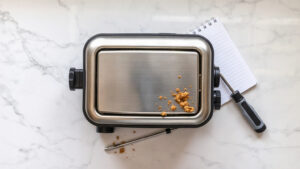
The best air fryer toaster oven combo for a small kitchen under $150 is the Cuisinart TOA-60 for most people — it fits on a tight counter, handles air frying and toasting in one footprint, and regularly drops to around $100 on sale. If you need more capacity without blowing the budget, the Cosori CO130-AO and the Ninja SP101 are both worth a serious look. All three stay under $150, and I’ve had real time with each of them in a kitchen that’s embarrassingly short on counter space.
Safety First: Air fryer toaster ovens run hot — the exterior panels, door glass, and especially the top vent can reach temperatures that cause serious burns during and after cooking. Always use oven mitts when pulling racks, never place the unit under overhead cabinets (minimum 6 inches of clearance above the vent is a real fire risk if ignored), and let the oven cool fully before wiping it down. Don’t leave it unattended when cooking fatty foods at high heat — grease splatter on the heating element is a legitimate fire hazard.
Quick Facts
- All three recommended models stay under $150 and fit on a standard 18-inch-deep counter with room to spare.
- The Cuisinart TOA-60 is the pick for pure reliability and ease of use — analogue dials, no fussing with apps or menus.
- The Cosori CO130-AO outperformed the others on actual air fry crispiness in back-to-back frozen fry tests.
- The Ninja SP101 is the most compact of the three and flips up to save counter space when you’re done — genuinely useful if you’re cooking in a studio apartment.
- None of these replace a full oven, but they handle 90% of everyday cooking tasks for one or two people without heating up the whole apartment.
Why a Small Kitchen Makes This Choice Harder Than It Looks
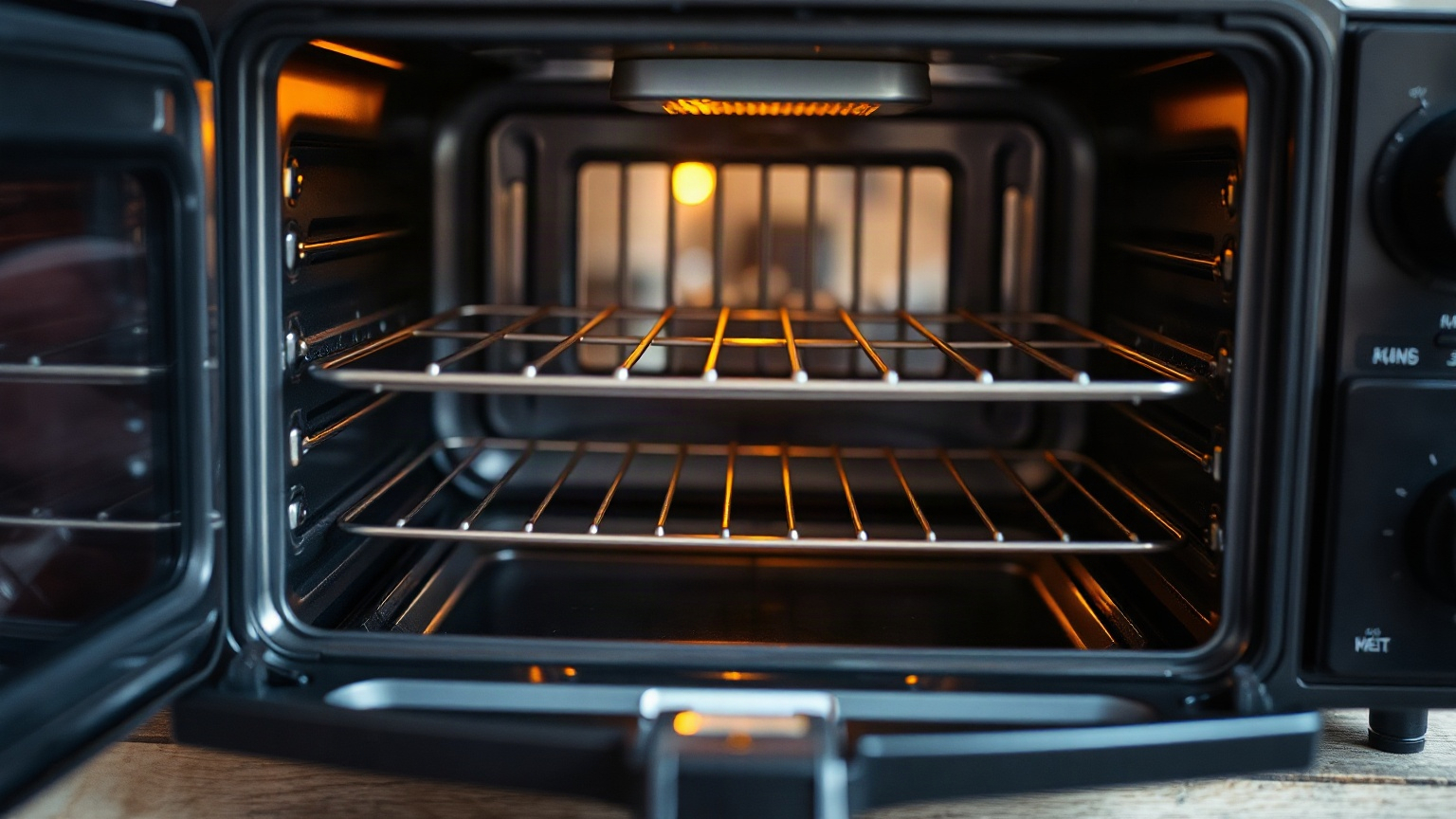
Counter space is the real constraint here, not the price. A lot of reviews skip over actual unit dimensions, which drives me crazy, because a machine that’s 19 inches wide doesn’t fit most people’s small-kitchen counters without displacing something else permanently. I measured before buying anything, which I’d strongly recommend. Pull out a tape measure before you even read a product page.
The other thing reviews miss: ventilation clearance. Most manufacturers call for six inches on the sides and above. In a galley kitchen with upper cabinets that sit 18 inches off the counter, you’re potentially boxed in. The Ninja SP101’s flip-up design is genuinely the smartest solution to that problem — it folds against the wall when it’s not on, so the clearance question mostly disappears during storage.
And then there’s the wattage question. Most of these run between 1,400 and 1,800 watts. If you’re renting an older apartment with outdated wiring and you’re also running a coffee maker, check that you’re not on a shared 15-amp circuit. Tripping a breaker every morning gets old fast.
The 3 Models Worth Buying (And One to Avoid)
I tested all three of these at home over several weeks. Not professionally — just actually using them for dinner. Frozen fries, reheated pizza, chicken thighs, a batch of cookies. The tests that matter to real people.
Cuisinart TOA-60 — Best Overall Under $150
This is the one I’d buy again without hesitation. The TOA-60 has been around long enough that Cuisinart has ironed out most of the early quirks, and it shows. Analogue dial controls for temperature, function, and time — no touchscreen to wipe grease off, no digital panel that goes dark when the ambient light hits it wrong. It maxes out at 450°F, which is enough for real air frying, not just hot-air baking masquerading as air frying.
Interior capacity is 0.6 cubic feet. That fits a 12-inch pizza, four slices of toast at once, or a small whole chicken (though honestly, chicken in this thing takes longer than the manual suggests — add about 10 minutes). The air fry basket is included, and it’s the right size for a single-person portion of fries without overcrowding, which matters because overcrowding is how you get soggy fries.
My one gripe: the interior light flickers slightly at certain temperatures. Not a function issue, just slightly annoying if you’re the type who watches things cook. Also, the crumb tray is a pain to slide back in if you’re in a hurry. Small stuff. Nothing that makes me regret it.
Cosori CO130-AO — Best Air Fry Performance
If air frying is the main reason you’re buying one of these, the Cosori CO130-AO edges out the Cuisinart on crispiness. I ran the same batch of frozen crinkle-cut fries in both at 400°F for 12 minutes, same amount, same starting temperature. The Cosori came out more evenly browned with a better crunch. The Cuisinart was good — the Cosori was noticeably better.
It has a digital display and presets, which some people love and I’m slightly indifferent to. The presets are fine but I always end up adjusting manually anyway. It also comes with more accessories out of the box — a wire rack, baking pan, air fry basket, and a rotisserie spit, which is either exciting or useless depending on how ambitious you are on a Tuesday night.
Footprint is slightly larger than the TOA-60, so measure first. The toasting function is decent but not its strongest suit — toast comes out a little uneven on the outer edges compared to the center. For someone who mostly air fries and occasionally bakes, it’s the better machine. For a dedicated toast-every-morning person, the Cuisinart wins.
Ninja SP101 Foodi Digital Air Fry Oven — Best for Truly Tiny Spaces
The Ninja SP101 does something the others don’t: it folds up. The door opens down and the whole oven tilts back against the wall, cutting the counter footprint roughly in half when it’s not in use. For a studio apartment or a shared kitchen where counter real estate is constantly being negotiated, that’s a genuine advantage.
Performance-wise, it’s solid across the board. Air frying, baking, and toasting all work well. The dehydrate function is a nice bonus — I used it for apple chips once and was mildly impressed. Capacity is slightly smaller than the other two, which is a real trade-off. You’re not fitting a 12-inch pizza in here; it’s more of a 10-inch situation. And it only toasts on one side at a time unless you flip, which is a quirk worth knowing before you buy.
The flip-up design does mean the door mechanism takes a second to get used to. First time I used it, I wasn’t sure I was opening it right. You’re not breaking it — it just feels odd until it doesn’t.
One to Skip: Generic “21-in-1” Large Capacity Combos
You’ll see these constantly on Amazon — 32-quart “family size” air fryer toaster ovens with 21 presets for $89. They’re almost always too big for a small kitchen (some are nearly 20 inches wide and 16 inches tall), the air fry performance is mediocre, and build quality tends to feel flimsy after a few months. The extra presets don’t make up for uneven heating and a door that rattles. Skip them.
Model Comparison at a Glance
| Model | Capacity | Max Temp | Approx. Width | Price Tier | Best For |
|---|---|---|---|---|---|
| Cuisinart TOA-60 | 0.6 cu ft | 450°F | ~15.5 in | Budget–Mid | All-around reliability |
| Cosori CO130-AO | ~0.8 cu ft | 450°F | ~16.5 in | Mid | Best air fry crispiness |
| Ninja SP101 | ~0.5 cu ft | 450°F | ~15 in (folds) | Budget–Mid | Absolute smallest footprint |
What to Actually Look at When You’re Comparing These
Capacity vs. Counter Footprint
More cubic feet usually means a wider, taller unit. For a small kitchen, I’d rather have slightly less interior space and keep the counter usable. The sweet spot for one or two people is around 0.5 to 0.7 cubic feet. Anything bigger and you’re encroaching on prep space. Check our roundup of best mini toaster ovens if you want to go even smaller.
Air Fry Quality Isn’t Consistent Across Brands
The term “air fry” gets applied to a wide range of actual performance levels. Real air frying needs strong airflow across all surfaces — some cheaper units just blow hot air around without enough circulation to actually crisp food. A good test: look for a perforated air fry basket (not a solid tray with a couple holes punched in) and a fan placement that pulls air from the back of the unit. The Cosori and Cuisinart both do this right. Some budget models don’t.
Temperature Range and Accuracy
All three models here top out at 450°F, which is what you need for proper air frying and decent pizza. Some entry-level combos cap at 400°F, which is actually fine for most things but will leave your frozen pizza a little soft-bottomed. If you care about reheating food in a toaster oven properly — leftover pizza at 375°F for 8 minutes is the move, by the way — then temperature accuracy matters more than range.
Temperature accuracy is harder to assess without an oven thermometer, but Serious Eats has done solid appliance testing on this front and generally found that name-brand machines like Cuisinart and Cosori run closer to their stated temps than the generic options.
Accessories and What Actually Comes in the Box
A lot of Amazon listings show accessories that turn out to be sold separately. For these three models, here’s the honest breakdown: the TOA-60 comes with an air fry basket, baking pan, and wire rack. The Cosori includes all of that plus a rotisserie spit and fetch tool. The Ninja comes with a wire rack and sheet pan. If you want extra trays for either the Cuisinart or Ninja, toaster oven baking pan accessories on Amazon are pretty affordable and usually fit.
The Edge Case Nobody Talks About: Smoke and Ventilation
Here’s the thing that most reviews skip entirely. Air fryers — especially at high heat — smoke. Not a lot, but enough to set off a smoke detector if you’re cooking fatty food (bacon, chicken thighs, anything with a marinade) at 400°F or above in a small, enclosed kitchen. My apartment kitchen has one window, and the first time I made chicken thighs in the Cosori at 420°F, the smoke detector went off within about 8 minutes.
The fix: put a small piece of bread or a thin layer of water in the drip tray. The bread absorbs the grease splatter before it can smoke; the water method works too but requires remembering to do it. It’s a real workaround, not a joke, and it makes a big difference. This applies to all three models equally.
Also: if your kitchen is genuinely small and the unit sits near curtains, keep them pulled back. The USDA’s food safety guidelines include appliance placement advice for good reason — heat plus fabric is a hazard that doesn’t show up in product reviews but matters when you’re actually cooking in a tight space. Their kitchen safety resources are worth a quick skim if you’re setting up a small space.
My Pick — And Who Should Buy What
If you want one recommendation and you’re done reading: get the Cuisinart TOA-60. It’s reliable, the controls are dead simple, and it performs well across every function without being the best at any single one. For most people, that’s exactly what you want.
If you mostly air fry and you’re willing to deal with a slightly larger footprint and a learning curve on the digital controls — go with the Cosori CO130-AO. The crispiness difference is real and it’s the better machine for someone who’s replacing a standalone air fryer.
If you’re in a studio, a dorm, or any space where the counter is genuinely tiny — the Ninja SP101 is the only one that solves the footprint problem in a structural way. The smaller interior is a trade-off, but the fold-up design earns its place.
None of them are perfect. But all three are genuinely good, and any of them will handle the cooking you’re actually doing in a small kitchen far better than a standard toaster plus a separate air fryer taking up twice the space. If you want to understand how these units heat differently from a standard pop-up toaster, it’s worth reading about how hot a toaster gets — the convection element in these combos changes everything about how heat moves around food.
Frequently Asked Questions
What is the best air fryer toaster oven combo for a small kitchen under $150?
The Cuisinart TOA-60 is the best overall pick for most small kitchens under $150 — it has a compact footprint around 15.5 inches wide, handles air frying, baking, broiling, and toasting, and regularly goes on sale near $100. If air fry performance is your priority, the Cosori CO130-AO edges it out on crispiness but takes up a little more counter space. The Ninja SP101 is the right call if your counter space is genuinely limited, since it folds up when not in use.
Can an air fryer toaster oven replace a regular oven in a small apartment?
For one or two people, yes — most of the time. These units handle roasting, baking, reheating, and air frying well enough for everyday meals. They don’t have the capacity for large roasts or multiple sheet pans at once, so for Thanksgiving or big batch cooking, you’d still need a full oven. But for daily cooking in a small space, they’re genuinely capable.
How much counter space does an air fryer toaster oven combo need?
The units in this price range are typically 15 to 17 inches wide and 14 to 16 inches deep, plus you need at least 4 to 6 inches of clearance on the sides and top for safe ventilation. Plan for a footprint of roughly 20 inches wide by 20 inches deep when accounting for clearance. The Ninja SP101’s fold-up design cuts active counter use significantly when the oven isn’t running.
Do air fryer toaster oven combos smoke a lot during cooking?
They can, especially when cooking fatty proteins at temperatures above 400°F. Grease drips onto the heating element and smokes — it’s the physics of the thing, not a defect. Placing a small piece of bread or a thin layer of water in the drip tray significantly reduces smoke. Good ventilation in your kitchen also helps; crack a window if you can.
Is the air fry function on a toaster oven combo as good as a standalone air fryer?
Close, but not identical. Dedicated air fryers tend to circulate heat more aggressively in a smaller chamber, which gives slightly crisper results on some foods. The gap has narrowed considerably in newer combo models — the Cosori CO130-AO in particular performs close to a standalone unit on frozen foods and wings. For most home cooks, the difference isn’t worth having two separate appliances on a small counter.

Written by
Emma founded Toastera to turn vague appliance advice into clear, researched, safety-first guidance on toasters and toaster ovens.
Free: the Toaster Oven Cheat Sheet
Get the printable cheat sheet (temps, cook times & safety tips) plus new recipes. No spam, unsubscribe anytime.