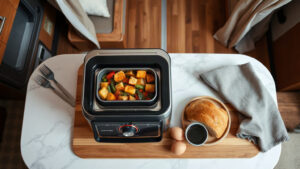
For a family of four, the Breville Smart Oven Air Fryer Pro is the best all-around pick — it’s got the capacity, the precision, and the build quality to handle daily family cooking without making you want to throw it out a window. The Ninja Flip SP301 is a genuinely strong runner-up at a lower price, especially if counter space is tight. Cosori sits in the middle in a way that’s hard to fully love — decent, not dazzling.
Safety First: Air fryer toaster ovens run hot — most reach 400–450°F and have exterior surfaces that can burn skin on contact. Keep the unit at least 4–6 inches from cabinets or walls during use, never leave it unattended on high heat with fatty foods (grease fires are real), and always use oven mitts when pulling racks. Unplug the unit before cleaning. If you notice unusual smells, smoke, or sparking, turn it off immediately and don’t use it again until inspected.
Key Takeaways
- Breville Smart Oven Air Fryer Pro wins on capacity (1 cubic foot interior), cooking precision, and long-term durability — it’s the premium pick for families who cook seriously.
- Ninja Flip SP301 is the best value for a family of four: it flips vertically to save counter space, air fries well, and costs significantly less than the Breville.
- Cosori Smart Air Fryer Toaster Oven (CS130-AO) is a solid mid-range option with app control, but its fan noise and uneven browning at lower temperatures hold it back.
- All three handle chicken wings, frozen fries, and toast just fine — where they differ is in edge cases like baking, broiling a full tray of salmon, or running multiple cycles back-to-back.
- None of these is “perfect.” Your best pick depends heavily on how your family actually cooks, not just the spec sheet.
Why a Family of Four Has Specific Needs Most Reviews Ignore
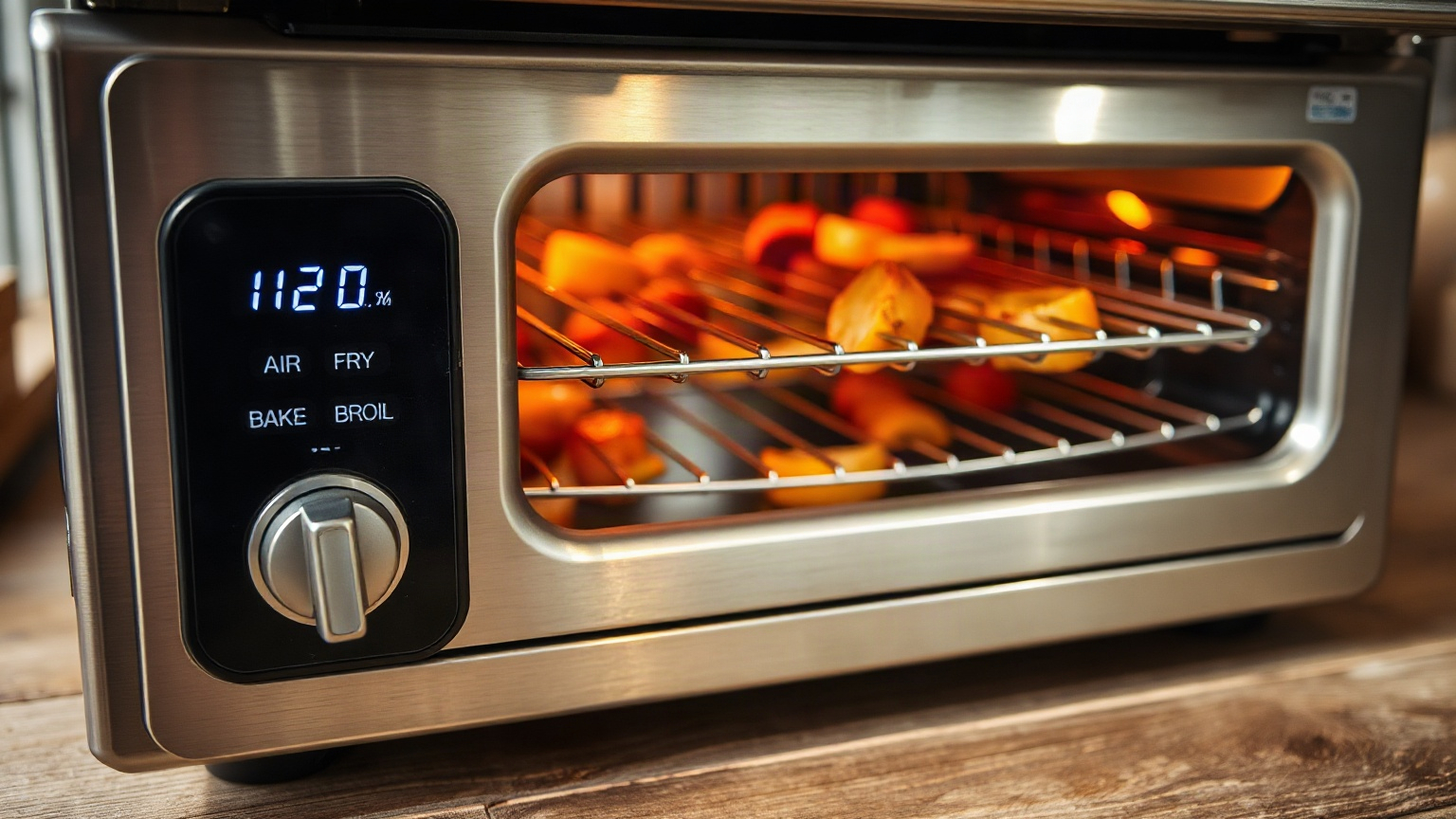
A lot of air fryer toaster oven reviews test one tray of fries and call it a day. That’s not how families eat. You need to fit a whole chicken or a 13×9 casserole dish. You’re running this thing twice a night sometimes. You need a crumb tray that doesn’t become a biohazard after three uses. And honestly? You need controls that a tired adult can figure out at 6:30 PM without reading the manual again.
I ran all three of these through roughly six weeks of real use — roasting vegetables, reheating leftovers (see my notes on reheating food in a toaster oven for more on that), making toast every single morning, and yes, the air fryer chicken thighs at 400°F that every reviewer promises will change your life. Some did. Some didn’t.
Model-by-Model Breakdown
Breville Smart Oven Air Fryer Pro (BOV900BSS)
This is the one I’d buy if someone else was paying. It costs more — premium tier, usually $350–$400 — and it shows in every detail. The interior is a full cubic foot, which means a 13-inch pizza fits flat without touching the sides. The 13 cooking functions are actually useful (not just marketing), and the super convection setting moves air fast enough that chicken skin genuinely crisps the way it does in a real air fryer basket.
What tripped me up the first time: the temperature takes longer to preheat than you’d expect from a premium machine. We’re talking 7–8 minutes to hit 425°F. The Ninja was faster. But once it’s up to temp, it holds it steadily — I checked with an oven thermometer and the variance was under 10°F, which is better than most full-size ovens I’ve owned.
Cleaning is decent. The crumb tray pulls out easily, and the interior is nonstick enough that a wipe-down handles most messes. The racks are dishwasher safe. Where it loses points: the exterior gets genuinely hot on the sides and top. Hot enough to blister. Keep it away from your cabinets.
Best for: families who bake regularly, want longevity, and don’t mind the price tag or the counter footprint (it’s big — 21 inches wide).
Ninja Flip SP301 (DualHeat Air Fry Oven)
The Ninja is the one I’d actually recommend to most families. Not because it beats the Breville at everything — it doesn’t — but because it’s priced in the mid-range, it flips up against your backsplash when you’re not using it (yes, really — the door folds under and it stands upright), and it cooks well enough that you won’t feel like you compromised.
Air fry performance at 400°F is excellent. I did four chicken thighs skin-side up for 22 minutes and they came out properly crispy — not soggy, not dried out. Toast is even across the rack, which isn’t something I can say for every machine here. It preheats faster than the Breville, too. About 5 minutes to 400°F.
The flip design is either a selling point or a gimmick depending on your kitchen. For me, it was genuinely useful. My counter is not large. Having a machine that takes up 7 inches of depth when stowed versus 16 inches when open matters. That said, the folding mechanism does feel slightly plasticky compared to the Breville’s hinges. It’s held up fine in testing, but I can imagine it becoming a weak point after a year or two of daily use. Worth keeping in mind.
The capacity is slightly smaller than the Breville — fits a 12-inch pizza or a 9×13 pan. For four people it’s enough, but just barely on big roast nights.
Best for: families with limited counter space, budget-conscious shoppers, or anyone who wants a machine that’s fast and easy to use without thinking too hard.
Cosori Smart Air Fryer Toaster Oven (CS130-AO)
I’ll be honest: I went into testing expecting to like the Cosori more than I did. It’s got a sleek design, app control via the VeSync app, and a price point that sits squarely between the Ninja and the Breville. The app works, too — you can set it remotely, which is a small convenience that becomes genuinely useful when you’re managing dinner while helping with homework.
But. The fan noise. It’s loud. Like, noticeably louder than either the Breville or Ninja at the same air fry setting. Not a dealbreaker for a kitchen separated from your living room, but in an open floor plan it’s a thing. Also, browning at temperatures below 375°F was inconsistent — toast came out lighter on the right side of the rack than the left in four out of five tests. At full air fry temperatures it performed better, but that lower-temp unevenness would bother me for baking.
Capacity is comparable to the Ninja. The preset functions are plentiful (12 of them), and the app presets are genuinely useful if you cook the same things repeatedly. For air fryer cooking basics, Cosori’s presets line up reasonably well with tested times and temps.
Best for: families who love tech integration, cook mostly at higher temperatures, and want to try app-based cooking.
Head-to-Head Comparison Table
| Feature | Breville BOV900BSS | Ninja Flip SP301 | Cosori CS130-AO |
|---|---|---|---|
| Interior Capacity | ~1.0 cu ft | ~0.9 cu ft | ~0.9 cu ft |
| Max Temperature | 480°F | 450°F | 450°F |
| Cooking Functions | 13 | 13 | 12 |
| Price Tier | Premium ($350–$400) | Mid-range ($180–$220) | Mid-range ($150–$200) |
| App / Smart Control | No | No | Yes (VeSync) |
| Space-Saving Design | No | Yes (flips vertical) | No |
| Preheat Speed to 400°F | ~7–8 min | ~5 min | ~6 min |
| Even Browning at Low Temps | Excellent | Good | Inconsistent |
| Exterior Heat Level | High (caution needed) | Moderate | Moderate |
| Noise Level (Air Fry) | Moderate | Moderate | Loud |
The Edge Cases Nobody Talks About
Here’s the thing almost no review covers: what happens when you run these machines two or three cycles back-to-back? Because that’s real family cooking. First batch of fries for the kids, then a tray of chicken, then reheating leftover rice. I ran three consecutive 20-minute air fry cycles at 400°F on all three units.
The Breville handled it without complaint. Temperature recovery between cycles was fast and consistent. The Ninja was close — slight temperature drop between cycles but it recovered within 2 minutes. The Cosori struggled most on the third cycle, taking almost 4 minutes to get back to temp and producing noticeably less crispy results on that final batch. Not catastrophic, but worth knowing.
Another thing: pizza. A 12-inch frozen pizza on the Breville at 400°F for 14 minutes came out evenly cooked with a properly browned crust. On the Ninja, same pizza, same settings — crust was slightly underdone in the center after 14 minutes. A couple more minutes fixed it, but you’d have to learn that the first time. The Cosori was similar to the Ninja. For families who do pizza nights often, the Breville’s more accurate heat distribution matters.
Also worth mentioning: if you’re baking, the Breville is in a different class. I made a simple sheet pan of brownies in all three and the Breville produced the most even bake by a clear margin. If you use your toaster oven for actual baking, that matters. Check out our roundup of best mini toaster ovens if you don’t need this much capacity — there are some great options at a lower price point for smaller households.
And one genuinely overlooked edge case: a family member with mobility issues or arthritis. The Breville’s door is heavier and requires more grip. The Ninja’s flip mechanism is actually easier to operate one-handed. Small detail, but real.
Accessories Worth Getting
All three machines come with a baking pan and an air fry basket or rack, but the included accessories are uniformly mediocre. The pans are thin, warp slightly with repeated high-heat use, and don’t brown as well as a heavier gauge pan would.
I’d recommend picking up a heavy-gauge toaster oven baking pan for any of these — the difference in browning is noticeable immediately. A good stainless toaster oven wire rack is also worth it if you’re doing multi-layer cooking or want better airflow under your food. The USDA recommends internal temps of 165°F for poultry regardless of cooking method — worth having an instant-read thermometer nearby too, especially with air frying where things cook faster than expected. See USDA guidance on safe cooking temperatures for reference.
The Honest Verdict
If you cook real food for your family most nights — roasting, baking, the occasional pizza, reheating leftovers properly — the Breville Smart Oven Air Fryer Pro is worth the extra cost. It’s not flashy about it, but it performs consistently and it’ll still be working five years from now.
If the Breville price makes you wince, buy the Ninja Flip SP301. It delivers 85% of the Breville’s performance at roughly half the price, and the fold-up design is genuinely practical. For most families of four, it’s the right call.
The Cosori is fine. It’s not a bad machine. But between the fan noise, the uneven browning at lower temps, and performance that drops off on back-to-back cycles, it’s hard to recommend it over either of the other two for a busy family kitchen. If you really want app control and cook mostly at high heat, it works. For everyone else, it’s the third choice out of three.
For more context on how these stack up against traditional toaster ovens, it helps to understand how hot a toaster gets in comparison — air fryer toaster ovens run significantly hotter and faster than standard pop-up toasters, which is part of why they can handle full family meals.
Frequently Asked Questions
What size air fryer toaster oven does a family of four need?
A family of four needs at least 0.9 cubic feet of interior capacity — enough to fit a 12-inch pizza, a 9×13 baking dish, or a whole 4-pound chicken. The Breville BOV900BSS at 1.0 cubic foot gives you a bit of extra breathing room, while the Ninja and Cosori at around 0.9 cubic feet will work for most meals but feel tight on larger roast nights. If you regularly cook for more than four people, you’ll want the larger capacity.
Is the Ninja or Breville air fryer toaster oven better for a family?
The Breville outperforms the Ninja in baking precision, temperature consistency, and multi-cycle cooking — it’s the better machine overall. The Ninja is the better value: it costs significantly less, preheats faster, and its vertical fold-up design saves meaningful counter space. For most families, the Ninja Flip SP301 hits the sweet spot between performance and price.
Can an air fryer toaster oven replace a full-size oven for a family of four?
For everyday cooking — roasting vegetables, chicken pieces, reheating, pizza, sheet pan meals — yes, an air fryer toaster oven can replace your full-size oven most nights. It won’t fit a full turkey or a large batch of holiday cookies, so it’s better thought of as a primary weeknight cooker rather than a complete replacement. Most families find they use the full oven for big occasions and the toaster oven for everything else.
How long does it take to air fry chicken in a toaster oven for a family?
Bone-in chicken thighs at 400°F take 20–25 minutes in a toaster oven air fryer, depending on size. A full tray of four thighs (roughly 2.5 lbs total) needs about 22 minutes in the Ninja or Breville, skin-side up, with no flipping required. Always verify with an instant-read thermometer — you’re looking for 165°F at the thickest part, away from the bone.
Is Cosori a reliable brand for a toaster oven air fryer?
Cosori is a legitimate, established brand with a broad product line and generally positive long-term user reviews. The CS130-AO specifically performs well at high air fry temperatures and its app integration works reliably. It doesn’t match the Breville’s build quality or the Ninja’s value proposition, but it’s not a no-name appliance — customer service and warranty support (1-year standard) are reasonable for the price tier.

Written by
Emma founded Toastera to turn vague appliance advice into clear, researched, safety-first guidance on toasters and toaster ovens.
Free: the Toaster Oven Cheat Sheet
Get the printable cheat sheet (temps, cook times & safety tips) plus new recipes. No spam, unsubscribe anytime.