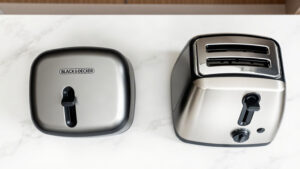
The best toaster oven for RV living is the Cuisinart TOA-28 for most people — it pulls around 1,800 watts, fits a 12-inch pizza, and won’t eat your entire counter. If you’re on shore power with a 30-amp hookup you’ll be fine running it; on a 20-amp circuit or a generator, you’ll want to look at something under 1,500 watts instead. The three models below cover all those situations.
Safety First: Toaster ovens draw significant wattage — running one on an RV circuit that’s already loaded with an air conditioner, microwave, or electric water heater can trip a breaker or, worse, overheat wiring. Always check the total amp draw on your RV’s circuit before plugging in any countertop appliance. Keep at least 4 inches of clearance on all sides of the unit, never use it on a slide-out table that isn’t rated for heat, and don’t leave it running unattended — especially in a moving or unleveled vehicle.
Quick Facts: Toaster Ovens in an RV
- Most compact toaster ovens run between 1,200 and 1,800 watts — that’s 10 to 15 amps on a standard 120V circuit.
- A 30-amp RV shore hookup can handle a toaster oven, but not if you’re simultaneously running the AC or microwave.
- The smallest useful footprint for a real toaster oven (not a glorified Easy-Bake) is roughly 16 inches wide by 14 inches deep.
- Look for models under 1,500 watts if you frequently run on a 20-amp hookup or a portable generator.
- Convection makes a bigger difference in small ovens than in full-size ones — heat distribution in a tiny cavity is uneven without it.
Why RV Counter Space Changes Everything

I’ve used toaster ovens in apartments, small beach rentals, and my own kitchen for years. But nothing made me think harder about footprint than trying to fit one into an RV galley that also had to hold a coffee maker, a two-burner propane stove, and a cutting board. The counter was about 28 inches wide. Total.
The problem isn’t just width. It’s depth. Most toaster ovens sit 14 to 17 inches front to back, which means they either hang over the edge of a narrow RV counter or they block the cabinet above. And you still need to open the door — which swings out another 10 or 12 inches. So you’re planning around a 25-inch swing radius for an appliance that sits on 15 inches of counter. That math gets tight fast.
The other thing RV life forces you to think about is wattage. Not in a vague “use less power” way, but specifically: what else is running when you turn this on? If you’re plugged into a 30-amp pedestal at a campground, you’ve got roughly 3,600 watts to work with across the whole rig. An 1,800-watt toaster oven uses half that budget instantly. Run the AC at the same time and you’re in breaker territory. I learned this the hard way in a campground in New Mexico. It wasn’t fun.
The 3 Models Worth Considering
I’m not going to list eight options and tell you they’re all great. Here are three specific models that solve the actual problem, each for a slightly different situation.
1. Cuisinart TOA-28 — Best Overall for Most RV Setups
This is my top pick. It’s compact — about 16 inches wide and 15 inches deep — pulls 1,800 watts, and includes an air fryer function that genuinely works. The interior holds a 12-inch pizza or a small sheet pan, which covers about 90% of what you’d actually want to cook in an RV. Toast, roasted vegetables, frozen fries, reheated leftovers. All of it done well.
The convection fan is real and makes a noticeable difference. First time I used it I forgot to account for the faster cook time — my chicken thighs were done about 8 minutes early. Set it about 25°F lower than a recipe calls for if you’re coming from a conventional oven.
My only complaint: the dial controls feel a little cheap compared to the price. They work fine, but they have that loose, rattly feel that makes you wonder. It hasn’t caused any actual problems in testing, just something that would annoy me over years of use. For RV life specifically, I’d rather have a unit with fewer digital components that could fail from vibration anyway, so the analog dials end up being a feature, not a flaw.
The TOA-28 is mid-range priced — you’re not paying Breville money, but it’s not a budget buy either. Worth every dollar for a full-time RVer.
2. Hamilton Beach 31123D — Best for Generator or 20-Amp Power
If your power situation is limited — 20-amp hookups, a small generator, solar with a modest inverter — the Hamilton Beach 31123D is worth a serious look. It draws about 1,200 watts, which is meaningfully lower than most of the competition. You can run it alongside a single other appliance without stressing the circuit.
It’s not as capable as the Cuisinart. The interior is smaller, the cooking is a bit less even, and there’s no air fry mode. But it toasts well, it bakes a small baking pan of food reliably, and the footprint is genuinely small — around 14.5 inches wide. That extra inch and a half matters when your counter is 28 inches total.
It’s also budget-priced, which I respect. Not everything needs to be premium. If you’re weekend camping twice a month and just want reliable toast and a way to heat up a casserole, this does the job without drama.
3. Breville BOV450XL Mini Smart Oven — Best If You Cook Seriously
The Breville Mini Smart Oven is the one I’d pick if cooking real food — not just reheating stuff — is a priority. It has Element IQ, which adjusts heating element power based on what you’re doing. The toast is genuinely the best I’ve gotten from any countertop oven of this size. Even browning, no burnt edges on the back slices.
The footprint is manageable: about 16.5 inches wide and 14 inches deep. Not the smallest on this list, but not dramatically bigger than the Cuisinart. It runs at 1,800 watts, so the power math is the same as the TOA-28.
It’s premium-priced. That’s the honest reality. If you’re living in an RV full-time by choice and you care about food, the Breville is worth the investment. If you’re on a tight budget or you’re not sure how much you’ll actually use it, start with the Cuisinart and see how it goes. You can always upgrade. For more options in a similar size class, the best mini toaster ovens guide covers several I’ve looked at.
Model Comparison: The Numbers That Matter
| Model | Wattage | Width (approx) | Interior Capacity | Air Fry? | Price Tier |
|---|---|---|---|---|---|
| Cuisinart TOA-28 | 1,800W | ~16 in | Up to 12″ pizza | Yes | Mid-range |
| Hamilton Beach 31123D | 1,200W | ~14.5 in | Up to 9″ pizza | No | Budget |
| Breville BOV450XL | 1,800W | ~16.5 in | Up to 11″ pizza | No | Premium |
What to Actually Look for (Beyond Just Size)
Wattage First, Always
I can’t stress this enough. The footprint matters, but getting the wattage wrong can trip a breaker mid-cook or — in a worse situation — stress older RV wiring that isn’t in great shape. Check the circuit amperage on your rig before you buy anything. If you don’t know, assume 20 amps and stay under 1,500 watts. You can learn more about how hot a toaster gets and how that relates to draw if you want to get into the details.
Convection vs. No Convection
In a small oven, convection isn’t a luxury. Hot spots are much worse in compact cavities — without a fan moving air around, you’ll get burnt tops and raw middles on anything thicker than a slice of bread. Both the Cuisinart and the Breville have convection. The Hamilton Beach doesn’t, which is fine for simple tasks but limits you if you’re baking or roasting anything substantial.
Door Swing and Placement
Think about where this is going in your rig before you order. The door swings down and out on most models, which means you need clear space in front of the unit when it’s in use. A slide-out shelf or a pull-out drawer below the counter can help — but make sure whatever surface it sits on won’t overheat. Manufacturer clearance guidelines exist for a reason, and RV cabinets are often made from materials that don’t handle sustained heat well.
Serious Eats has a good breakdown of what makes a toaster oven worth using if you want a second opinion on these general principles.
Actual Cooking Use Cases
Think about what you’ll actually make. Toast and frozen foods? The Hamilton Beach is plenty. Roasted chicken thighs, baked sweet potatoes, actual baked goods? You want convection, which means the Cuisinart or Breville. Reheating food in a toaster oven is one of the things these units genuinely do better than a microwave — the texture stays right — and for RV cooking that matters a lot when fridge leftovers are a regular meal.
My Actual Pick
For most people living in or traveling in an RV, get the Cuisinart TOA-28. It handles real cooking, fits a reasonable counter, includes air frying which is genuinely useful in a small space (no stovetop splatter, no waiting for propane), and it’s priced where it doesn’t feel like a painful commitment.
If your power is limited — generator life, solar, 20-amp hookups only — get the Hamilton Beach 31123D instead. Don’t fight the power situation. Work with it.
And if you cook seriously and the Breville price doesn’t hurt? Get the Breville. The toast alone is worth talking about. You can find it through this search on Amazon — just confirm the model number before buying since Breville occasionally refreshes the line.
Don’t overthink it. Pick the one that matches your power situation and how much you actually cook. Any of these three beats using a propane burner for everything, especially in summer when you don’t want to heat the whole rig.
Frequently Asked Questions
Can you use a toaster oven in an RV on a 30-amp hookup?
Yes, a 30-amp hookup at 120V gives you about 3,600 watts total for the whole rig. A toaster oven running at 1,800 watts uses half that, so it’s workable as long as you’re not simultaneously running a high-draw appliance like a window AC unit or a microwave. Turn off whatever you can before you run the oven, and you’ll be fine.
What wattage toaster oven is best for an RV?
If you’re regularly on 30-amp shore power, 1,500 to 1,800 watts gives you good performance without being reckless. On a 20-amp hookup or a generator under 2,000 watts, stay at 1,200 to 1,400 watts — the Hamilton Beach 31123D at 1,200W is a solid pick for those situations. Going lower than 1,200 watts usually means the oven is too underpowered to cook anything well.
What is the smallest toaster oven that still cooks well?
The Hamilton Beach 31123D at around 14.5 inches wide is about as small as you can go while still getting a functional cooking appliance. Anything marketed as a “personal” toaster oven smaller than that tends to have a cavity so tiny it’s more like a big toaster — fine for bread, not much else. If footprint is the absolute priority, the Hamilton Beach is the floor.
Is it safe to use a toaster oven while the RV is moving?
No — don’t run a toaster oven while driving or while the RV is in motion. A moving vehicle shifts and tilts, which can cause the oven to slide, tip, or bring food into contact with the heating elements. Always use it parked and, ideally, leveled. Unplug it and stow it before you move the vehicle.
Can a toaster oven replace a microwave in an RV?
For most tasks, yes — and in some ways it’s better. A toaster oven reheats leftovers with better texture than a microwave (no soggy pizza, no rubbery chicken), and it can bake and roast in ways a microwave can’t. The one thing it won’t match a microwave on is speed for liquid heating — boiling water or warming soup takes longer. But for actual food, a toaster oven is a reasonable swap.

Written by
Emma founded Toastera to turn vague appliance advice into clear, researched, safety-first guidance on toasters and toaster ovens.
Free: the Toaster Oven Cheat Sheet
Get the printable cheat sheet (temps, cook times & safety tips) plus new recipes. No spam, unsubscribe anytime.