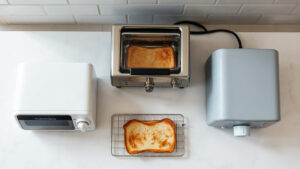
The best toaster oven under $150 that’s actually worth buying is the Cuisinart TOA-70 — it hits the sweet spot between real convection performance, air frying capability, and a build quality that doesn’t feel like it’ll crack after six months. If that’s out of stock or over budget on a given day, the Ninja Foodi Digital Oven and the Hamilton Beach Sure-Crisp are both legitimate alternatives with clear trade-offs I’ll walk through below. All three have been on my counter at some point.
Safety First: Toaster ovens run heating elements at temperatures up to 450°F and draw significant wattage — never place them directly under cabinets or flush against walls. Keep at least 4 inches of clearance on all sides and the top. Always pull the plug before cleaning, and never leave one running unattended with greasy drip trays that haven’t been cleaned recently. Grease buildup is a genuine fire risk.
Key Takeaways
- The Cuisinart TOA-70 is the top pick under $150 — convection, air fry, 1800W, fits a 12-inch pizza
- The Ninja Foodi Digital Oven folds flat for storage, which genuinely matters in smaller kitchens
- The Hamilton Beach Sure-Crisp Air Fry is the budget-friendly backup when you need something closer to $80–$90
- For most people cooking for 1–4, any of these three will outperform a standard toaster oven at $50 by a wide margin
- Convection fan + air fry basket = the two features that separate a genuinely useful oven from a fancy pop-tart machine
Let me back up and explain how I got here, because I don’t think most buyer’s guides for this category are actually honest about what matters.
Why the $100–$150 Range Is the Right Place to Shop
There’s a weird dead zone in toaster oven pricing. Under $60, you get a glorified bread warmer — no real convection, flimsy racks, uneven heating that forces you to rotate everything halfway through. Above $200, you’re paying for Breville’s premium build and honestly, unless you’re baking soufflés regularly, it’s probably overkill.
The $100–$150 range is where manufacturers actually compete. You get real 1500–1800W heating power, convection fans that move air properly, digital controls with presets that work, and cavities big enough to fit a 12-inch pizza or a 9×13 baking dish. That last one matters more than people realize. I ruined a batch of sheet pan chicken thighs once trying to force them into a 10-inch oven — the edges sat too close to the element and charred before the center hit temperature.
If you want to understand how these units compare to a standard toaster in terms of heat output, my breakdown of how hot a toaster gets gives some useful context on heating elements in general.
The 3 Models Worth Considering
Cuisinart TOA-70: The One I’d Buy Again
The TOA-70 is a full convection toaster oven with an air fry function, and it’s the model I’ve recommended to the most people without regret. 1800 watts. Fits a 12-inch pizza flat or a 6-pound chicken (with some maneuvering — more on that in a second). The interior is 0.6 cubic feet, which sounds small until you realize most competitors at this price are 0.4 or less.
The air fry basket that comes with it actually works. I did a side-by-side with frozen fries — Cuisinart TOA-70 air fry mode at 400°F for 18 minutes versus my old basket-style air fryer. The results were nearly identical, with the toaster oven version having slightly more even browning across the full batch. The dedicated air fryer might edge it out on pure crispiness for things like wings, but not by enough to justify owning two appliances.
One thing that tripped me up the first time: the preheat is slow. About 5–6 minutes to hit 400°F versus the 3 minutes Cuisinart’s marketing suggests. Plan accordingly. Also, the interior light is dim — I basically can’t see anything without opening the door, which defeats the purpose. Small gripe, but a real one.
Find it on Amazon: Cuisinart TOA-70 air fryer toaster oven
Ninja Foodi Digital Oven (SP101/SP301): Best for Small Kitchens
This one has a party trick that sounds gimmicky until you actually need it: the whole oven flips up vertically and stores flat against the wall. In a kitchen with limited counter space, that’s actually a big deal. Folded, it takes up about 6 inches of depth. Most toaster ovens are 15–18 inches deep and just live on the counter permanently, which is fine if you have room.
Beyond the folding thing, it’s a capable oven. Eight cooking functions including air fry, roast, bake, and dehydrate. 1800W. The SP301 version adds a second rack position for more flexibility, which is worth the small price bump if you see it. Capacity is slightly smaller than the TOA-70 at around 0.45 cubic feet — it’ll fit a 13-inch pizza but a 9×13 pan is tight on the standard rack position.
My honest take: the Ninja’s controls are more intuitive out of the box. The Cuisinart’s dial system is faster once you learn it, but the Ninja’s digital interface makes more sense on day one. If you’re buying this for someone less comfortable with kitchen gadgets, Ninja wins on usability.
One edge case I haven’t seen other reviews address — the Ninja’s flip-up design means the door opening faces you at a slightly awkward angle when it’s positioned close to the wall. I bumped my forearm on the lower door edge pulling out a hot pan. Not a design flaw exactly, just something to be aware of if you’re positioning it right against a wall or backsplash. Give it a few inches of front clearance.
Hamilton Beach Sure-Crisp Air Fry Toaster Oven: The Honest Budget Pick
If $130–$150 is genuinely more than you want to spend, the Hamilton Beach Sure-Crisp comes in around $80–$90 and it’s not embarrassing. 1500W, convection + air fry, fits a 12-inch pizza. The build is more plastic-heavy than either of the above, and the rack positions are limited. But for someone moving into a first apartment or needing a secondary oven for a vacation rental? It does the job.
Air fry results are decent at 400°F but noticeably less crisp than the Cuisinart for things with skin or breading. Baking is fine — cookies, reheating leftovers, roasting vegetables. I wouldn’t use it as my primary oven for anything technically demanding. For simple everyday tasks like reheating food in a toaster oven, it handles it perfectly well.
Find it here: Hamilton Beach Sure-Crisp air fry toaster oven
Side-by-Side Comparison
| Model | Wattage | Capacity | Air Fry | Footprint | Price Tier | Best For |
|---|---|---|---|---|---|---|
| Cuisinart TOA-70 | 1800W | ~0.6 cu ft | Yes | Large (standard) | Mid-range (~$120–$150) | Most home cooks |
| Ninja Foodi SP101/SP301 | 1800W | ~0.45 cu ft | Yes | Compact (folds flat) | Mid-range (~$100–$140) | Small kitchens |
| Hamilton Beach Sure-Crisp | 1500W | ~0.5 cu ft | Yes | Standard | Budget (~$80–$95) | Casual use / first apartment |
What to Actually Look For (Beyond the Specs)
Marketing copy for toaster ovens is almost uniformly useless. Every model claims “even heating” and “fast preheat” and “crispy results.” Here’s what I’ve learned actually matters after testing several of these:
Wattage Matters More Than People Think
1800W is noticeably faster and more capable than 1200W. Not just in preheat time — in the ability to maintain temperature when you open the door and slide in a cold pan. A lower-wattage oven drops 30–50°F on that disturbance and takes a while to recover. 1800W snaps back in about 90 seconds. That matters for things like baking where temperature consistency actually affects the result. Serious Eats has a good breakdown of how toaster oven wattage affects cooking performance if you want the detailed version.
The Air Fry Basket vs. Rack Situation
A lot of cheaper ovens claim “air fry mode” but just turn on the convection fan at higher speed without an actual perforated basket. That’s not really air frying. The Cuisinart and Ninja both include proper perforated racks or baskets that let hot air circulate underneath the food, which is what actually crisps the bottom side. Check whether the basket is included or sold separately — for both the Cuisinart and Ninja it comes in the box. You can also grab an aftermarket one: toaster oven air fry perforated basket rack.
Interior Dimensions vs. “Fits a 12-inch Pizza” Claims
Manufacturers measure at the widest interior point. The usable rack space — where you can actually slide a pan without it touching the walls — is almost always 1–2 inches smaller. I’ve bought pans that technically “fit” but couldn’t be removed without burning my knuckles on the side elements. Measure your own pans and compare to the usable rack width, not the advertised cavity size. For the TOA-70, usable rack width is about 11.5 inches. The Ninja is close behind at roughly 11 inches.
If you’re cooking for a single person and counter space is your primary concern, you might also want to look at our guide to the best mini toaster ovens — some of them punch above their weight at this price point too.
The One Edge Case Nobody Mentions: High-Altitude Baking
If you’re in Denver, Salt Lake City, or anywhere above 5,000 feet, standard baking times and temperatures on toaster oven presets are calibrated for sea level. Convection baking at altitude already requires adjustments — typically reducing temperature by 15–25°F and sometimes shortening cook time. The Cuisinart TOA-70’s manual dial actually makes this easier to dial in than the Ninja’s preset-heavy interface. If you’re baking anything that requires precision at altitude, the Cuisinart’s analog-feeling controls are more forgiving. The USDA’s food safety guidelines at usda.gov are worth bookmarking for minimum internal temperatures regardless of what oven you’re using.
My Actual Pick
Buy the Cuisinart TOA-70 if it’s within your budget. Full stop. It’s bigger, more powerful, and the air fry results are genuinely better than the Hamilton Beach at a not-huge price difference. The Ninja is a real alternative if you’re squeezed for counter space and the flip-up design matters to you. I’d just be honest that you’re trading a bit of capacity and baking flexibility for the convenience of being able to store it upright.
The Hamilton Beach isn’t bad. It’s just clearly a tier below. If $80 vs. $130 is a meaningful difference for you right now, it won’t embarrass you. But you’ll notice the difference in crispiness and temperature recovery, and if you use it more than twice a week you’ll probably wish you’d spent the extra $40.
Frequently Asked Questions
What is the best toaster oven under $150 right now?
The Cuisinart TOA-70 is the best toaster oven under $150 for most people — it offers 1800W of power, a proper convection system, air fry capability with an included basket, and a cavity large enough to fit a 12-inch pizza. The Ninja Foodi Digital Oven is the better pick if you need to save counter space, since it folds vertically for storage. Both are meaningfully better than budget models in the $60–$80 range.
Is a convection toaster oven worth it under $150?
Yes — convection makes a real, practical difference in this price range. The circulating fan reduces hot spots and cuts cook times by roughly 20–25% compared to a standard toaster oven. For roasting vegetables, baking cookies, or air frying, you’ll notice the difference immediately. Any of the three models listed here include real convection, not just a marketing label.
Can a toaster oven replace a full-size oven for everyday cooking?
For 1–3 people cooking everyday meals, a good convection toaster oven handles the vast majority of tasks a full oven would — baking, roasting, broiling, and reheating. It won’t fit a full-size turkey or a large Thanksgiving casserole, and baking multiple trays at once isn’t realistic. But for daily use, it’s absolutely a capable substitute and uses significantly less energy than a full oven.
How long does a toaster oven last?
A mid-range toaster oven used regularly should last 3–5 years with proper maintenance. The main failure points are the heating elements and the control panel. Keeping the interior clean — especially the drip tray and crumb tray — extends element life significantly because grease buildup causes uneven heat and can burn onto elements permanently. The Cuisinart TOA-70 and Ninja both have accessible crumb trays that make cleaning easier than some competitors.
What size toaster oven do I need for a family of four?
For four people, you’ll want at least 0.5 cubic feet of interior capacity and the ability to fit a 9×13 baking pan — that’s the practical minimum for cooking a full meal in one go. The Cuisinart TOA-70 at 0.6 cubic feet handles this comfortably. The Ninja Foodi is workable but slightly tighter. Anything smaller than 0.45 cubic feet will frustrate you regularly if you’re cooking for more than two people at once.

Written by
Emma founded Toastera to turn vague appliance advice into clear, researched, safety-first guidance on toasters and toaster ovens.
Free: the Toaster Oven Cheat Sheet
Get the printable cheat sheet (temps, cook times & safety tips) plus new recipes. No spam, unsubscribe anytime.