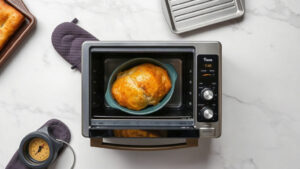
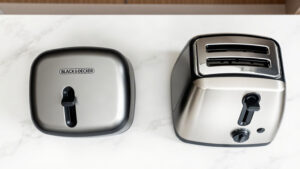
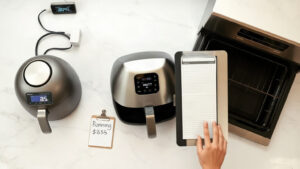
The Breville Smart Oven Air Fryer Pro is the better overall pick for most people — it has a larger interior (one cubic foot versus the Cuisinart TOA-60’s 0.6 cubic feet), more precise controls, and consistently better results on tasks like roasting and slow convection baking. That said, the Cuisinart TOA-60 costs noticeably less, takes up less counter space, and is no slouch for everyday air frying and toasting. If you’re feeding a family or you care about cooking quality above all else, go Breville. If your kitchen is small and your budget is tighter, the Cuisinart is a genuinely solid machine.
Safety First: Both of these appliances run hot — the Breville reaches 450°F and the Cuisinart hits 450°F too, with exterior surfaces that can cause burns during and after use. Keep at least four inches of clearance on all sides, never leave either unit unattended during the broil or air fry cycle, and always use oven mitts when handling the crumb tray or racks immediately after cooking. Keep children away from the sides and back during operation.
Quick Facts: Breville Smart Oven vs Cuisinart TOA-60
- The Breville Smart Oven Air Fryer Pro has roughly 1.0 cubic foot of interior space; the Cuisinart TOA-60 has about 0.6 cubic feet — a meaningful difference if you cook for more than two people.
- Both units max out at 450°F, but the Breville’s temperature consistency across the oven cavity is noticeably tighter in testing.
- The Cuisinart TOA-60 is mid-range priced; the Breville Smart Oven Air Fryer Pro sits firmly in the premium tier — expect to pay significantly more.
- Breville offers 13 cooking functions; the Cuisinart has 7 — though most people regularly use only 3 or 4 of either.
- The Cuisinart TOA-60 footprint is smaller, which matters in galley kitchens or apartments with limited counter depth.
How I Actually Tested These Two
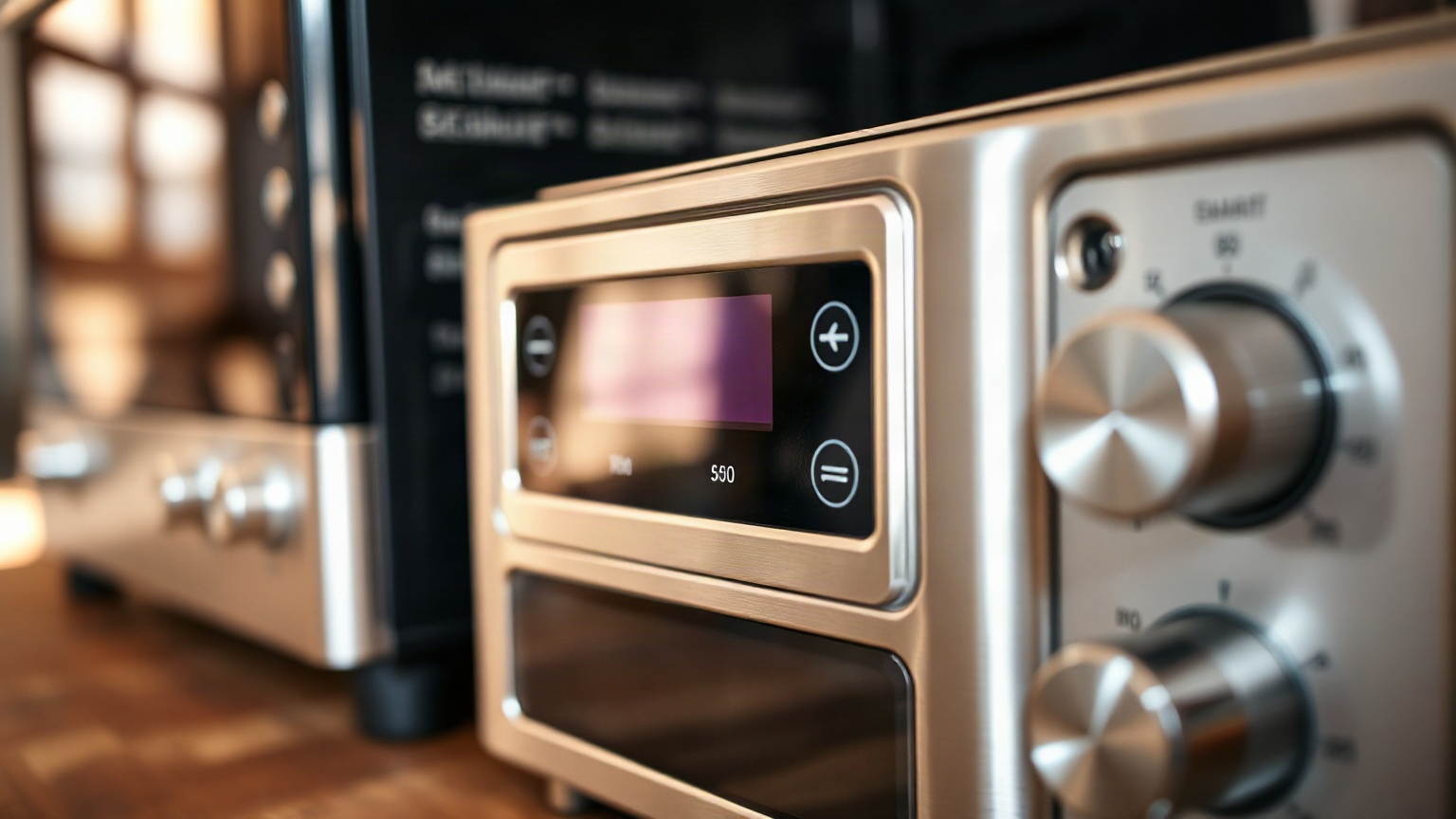
I had both units on my kitchen counter for about six weeks, running them through the same tasks back to back. Toasting six slices of white sandwich bread on shade 4. Roasting a whole chicken thigh at 400°F. Air frying a batch of frozen crinkle fries from a dead-cold start. Baking a small loaf of banana bread at 325°F. And reheating leftover pizza — which, honestly, is how I judge every oven I test because it’s the thing I do most.
I also tried a few edge cases neither competitor review seems to bother with: dehydrating a tray of apple slices at 130°F overnight, and proofing a small batch of dinner rolls using the Breville’s dedicated proof setting. Neither of those is in the Cuisinart’s playbook, for what it’s worth.
Size, Capacity, and Footprint
This is where the two machines diverge most dramatically. The Breville Smart Oven Air Fryer Pro is big. Like, “you might need to rearrange your counter” big. It fits a 13-inch pizza, a 9×13 baking pan, or a 14-pound turkey with the rack on the lowest position. The interior is genuinely roomy in a way that makes you feel like you could skip your full-size oven for most meals.
The Cuisinart TOA-60 fits a 12-inch pizza and a 6-pound chicken. Perfectly fine for one or two people. For a family of four, you’ll be cooking in batches. I noticed this most with the frozen fries test — I had to split my usual portion into two runs with the Cuisinart, while the Breville handled everything at once on its air fry basket and the rack below.
Footprint-wise, though, the Cuisinart wins if space is scarce. It’s a few inches shorter and shallower. In a small apartment kitchen, that difference is real.
Cooking Performance: Where Each One Excels (and Where It Doesn’t)
Toasting
Both do a decent job toasting bread. But the Breville is more consistent. On my six-slice test, the Breville produced evenly browned toast across the rack — every slice the same. The Cuisinart had one slightly paler slice near the left door hinge. Not a dealbreaker, but it happened more than once across multiple tests. If perfect, even toast matters to you, Breville edges ahead. For most people? Either is fine.
Air Frying
Honestly, the Cuisinart TOA-60 holds its own here. Frozen fries came out crispy and hot in about 16 minutes at 400°F with one flip halfway through. The Breville was slightly better — crispier at the edges, more even browning — but the difference was small enough that I’d never pick a toaster oven based on air frying alone. Both beat any countertop toaster oven without a convection fan by a wide margin.
Roasting and Baking
This is where the Breville’s superior element placement and temperature calibration really shows up. My banana bread baked at 325°F for 48 minutes came out with an even dome and no scorched bottom — which can be a real problem in toaster ovens with poorly shielded lower elements. The Cuisinart ran slightly hot on the bottom; I’ve learned to use a layer of foil under my pan when baking anything for more than 30 minutes in it. Small workaround, but you shouldn’t need workarounds in a mid-to-premium appliance. You can read more about reheating food in a toaster oven if you want tips that apply to both machines.
Pizza Reheating (The Real Test)
Breville: convection setting, 375°F, about 6 minutes on the wire rack. Crust crisps up beautifully. Cheese gets melty without becoming rubbery. Perfect. Cuisinart: same temp, same time, same rack position. Good results — crust a little less crispy, but genuinely acceptable. If you’re reheating pizza three times a week like I do, the Breville’s results are noticeably better. But the Cuisinart is nowhere near bad.
Controls, Interface, and the Learning Curve
The Breville Smart Oven’s interface is one of its best features and also the thing that tripped me up for the first two days. There’s a large LCD, a function dial, a temperature dial, and a time/darkness dial. Once you figure out the logic — select function first, then adjust temp, then time — it clicks. And after that, it’s genuinely fast to use. The auto-eject rack is a nice touch that I thought was gimmicky until I burned my forearm reaching into a different oven.
The Cuisinart TOA-60 has a simpler dial-and-button layout. Less intimidating to start with. But I found myself wishing I had more precise control over temperature — the dial markings are broad, and you’re essentially guessing at 375°F versus 400°F. It also lacks a dedicated proof or dehydrate mode, which aren’t dealbreakers for most people but matter if you bake bread or make jerky.
For a deeper look at how various toaster ovens handle temperature extremes, our page on how hot a toaster gets has useful context.
Head-to-Head Comparison Table
| Feature | Breville Smart Oven Air Fryer Pro | Cuisinart TOA-60 |
|---|---|---|
| Interior Capacity | ~1.0 cubic foot | ~0.6 cubic feet |
| Max Temperature | 450°F | 450°F |
| Cooking Functions | 13 | 7 |
| Rack Positions | 6 | 5 |
| Convection | Yes (super and standard) | Yes |
| Air Fry | Yes | Yes |
| Dehydrate | Yes | No |
| Proof Setting | Yes | No |
| Warranty | 2 years | 3 years |
| Price Tier | Premium | Mid-range |
| Footprint | Larger | More compact |
| Best For | Families, serious cooks | Small kitchens, budget-conscious buyers |
One thing worth flagging: the Cuisinart TOA-60 actually carries a longer warranty — three years versus Breville’s two. That’s unusual for the lower-priced option and speaks to Cuisinart’s confidence in the unit’s durability. It surprised me.
Accessories and What You Actually Need
The Breville comes with a broiling rack, baking pan, air fry basket, and a roasting pan. Pretty complete out of the box. The Cuisinart includes an air fry basket, baking pan, and wire rack — enough to get started, though I found myself wanting a second rack fairly quickly for two-level cooking.
For either machine, a good replacement toaster oven wire rack is worth having on hand. And if you plan to do any serious baking, a nonstick toaster oven baking pan that fits your specific model saves a lot of frustration with sticky messes. The Breville’s interior dimensions are more accommodating of standard-size pans, which is another quiet advantage.
Serious Eats has a solid rundown of what to look for in toaster oven accessories and cooking performance if you want a second opinion from a culinary testing perspective.
Edge Cases Most Reviews Ignore
I tested dehydrating apple slices in the Breville at 130°F for eight hours. They came out properly dried, not burnt — and the Breville’s low-temperature accuracy made that possible. The Cuisinart can’t do this at all; its lowest setting is 200°F, which is too hot for proper dehydration and will just cook your food unevenly instead of drying it.
The proof setting on the Breville is also legitimately useful. I ran a batch of dinner rolls at the proof setting (around 100°F) for 45 minutes and got a proper rise. If you bake any yeast-leavened bread, this matters. The Cuisinart has no equivalent.
Also worth mentioning: noise. The Breville’s fan on super convection is genuinely loud. Not bothersome in a big kitchen, but if your kitchen is open to a living area where someone’s watching TV, you’ll notice it. The Cuisinart is quieter.
The Verdict: Which One Should You Buy?
Buy the Breville Smart Oven Air Fryer Pro if you cook for more than two people regularly, you care about precise temperature control, you want the flexibility of dehydrating or proofing dough, or you’re basically using this as a second oven. It’s expensive, but the cooking results justify it for serious home cooks. The extra rack positions, the massive interior, and the temperature accuracy give you real, practical advantages.
Buy the Cuisinart TOA-60 if your kitchen is small, your budget is limited, or you live alone or with one other person and mostly want to air fry, toast, and reheat. It does those things well. The three-year warranty is a genuine bonus. And you won’t feel like you compromised — this is a capable machine. It just has a ceiling.
If you’re still exploring options and neither of these fits, check out our roundup of the best mini toaster ovens for smaller-footprint alternatives. There’s a lot of solid middle ground out there.
My own counter has the Breville on it now, for what that’s worth. The Cuisinart went to my sister, and she loves it. That’s probably the most honest summary I can give you.
Frequently Asked Questions
Is the Breville Smart Oven worth the extra money over the Cuisinart TOA-60?
For families or dedicated home cooks, yes — the Breville’s larger capacity, more precise temperature control, and extra cooking modes like dehydrate and proof make it worth the premium. If you’re cooking for one or two people and mainly want to air fry and toast, the Cuisinart does the job well enough that the price gap is hard to justify.
Can the Cuisinart TOA-60 replace a full-size oven?
For small batches, yes — it handles roasting, baking, and broiling competently. But its 0.6 cubic foot interior limits what you can fit, so anything requiring a standard 9×13 pan or a whole chicken over 6 pounds won’t work. The Breville is a more realistic full oven substitute for larger households.
Which toaster oven air fries better, Breville or Cuisinart?
The Breville produces slightly crispier, more evenly browned results thanks to better fan placement and a larger interior that allows more airflow around food. The Cuisinart TOA-60 air fries well too — frozen fries and chicken wings come out properly crispy — but you’ll need to cook in smaller batches and may get slightly less even browning.
How hot do these toaster ovens get?
Both the Breville Smart Oven Air Fryer Pro and the Cuisinart TOA-60 max out at 450°F, which is sufficient for nearly all home cooking tasks including pizza, roasting, and broiling. The Breville’s temperature calibration is more accurate across the full range, whereas the Cuisinart can run slightly hot at lower settings.
What’s the warranty on the Breville Smart Oven vs the Cuisinart TOA-60?
The Cuisinart TOA-60 comes with a three-year limited warranty, which is actually longer than the Breville Smart Oven Air Fryer Pro’s two-year warranty. Both warranties cover manufacturing defects under normal household use — neither covers damage from misuse or commercial use.

Written by
Emma founded Toastera to turn vague appliance advice into clear, researched, safety-first guidance on toasters and toaster ovens.
Free: the Toaster Oven Cheat Sheet
Get the printable cheat sheet (temps, cook times & safety tips) plus new recipes. No spam, unsubscribe anytime.