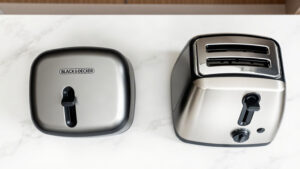
A toaster oven does not give you radiation like a microwave. Toaster ovens heat food using infrared radiation from electric heating elements — the same kind of heat you feel from the sun or a campfire — which is completely non-ionizing and poses no radiation health risk. Microwaves use a different type of non-ionizing radiation too, but the mechanisms are entirely separate, and neither appliance will expose you to the kind of radiation that damages DNA or causes cancer.
Safety First: Toaster ovens reach internal temperatures of 450°F or higher and their exterior surfaces can get dangerously hot during use. Keep the appliance at least 4 inches from walls or cabinets, never leave it unattended on high heat settings, and always use oven mitts when handling racks or pans. If you smell burning or see sparks, unplug immediately — do not just switch it off.
Quick Facts: Toaster Ovens, Microwaves, and Radiation
- Toaster ovens use infrared radiation (radiant heat) to cook food — not microwave radiation.
- Neither toaster ovens nor microwaves produce ionizing radiation (the dangerous kind, like X-rays or gamma rays).
- Microwave ovens operate at a frequency of 2.45 GHz; toaster oven heating elements produce heat in the infrared spectrum, roughly 700nm to 1mm wavelength.
- The FDA regulates microwave radiation leakage and sets a limit of 5 milliwatts per square centimeter at 5 cm from the appliance — an extremely conservative safety margin.
- The only real physical risk from a toaster oven is heat and fire — not radiation exposure.
What “Radiation” Actually Means (Because the Word Gets Misused Constantly)
People hear “radiation” and immediately picture Chernobyl. That’s understandable, honestly, but it’s also not how physics works. Radiation just means energy traveling through space. That’s it. The sun radiates heat. A candle radiates light. Your own body radiates infrared energy right now — you’re sitting there mildly glowing in a wavelength the human eye can’t see.
The type that causes actual biological harm is ionizing radiation. X-rays, gamma rays, alpha and beta particles — these carry enough energy to strip electrons from atoms, which can break DNA strands and eventually cause cancer. That’s the scary stuff, and it requires enormous energy levels to produce.
Everything else — radio waves, microwaves, infrared, visible light — is non-ionizing. Not energetic enough to ionize atoms. Your microwave sits in this category. So does your toaster oven, your WiFi router, your phone, and the overhead fluorescent light in your office. The FDA has addressed this directly, noting that microwave ovens do not produce ionizing radiation and have no known carcinogenic effect at normal exposure levels.
How a Toaster Oven Actually Heats Your Food
A toaster oven has nichrome wire heating elements — usually one on top, one on the bottom, sometimes a third for broiling. Run electric current through that wire and it glows red-hot, emitting infrared radiation. That radiant heat travels through the air and transfers directly to the surface of your food. Some toaster ovens also use convection fans to circulate hot air, adding conductive heating on top of the radiant heat.
No electromagnetic waves are being generated to excite water molecules. No magnetron is involved. The cooking mechanism is, fundamentally, the same as a conventional oven or a fireplace — just smaller and faster to preheat.
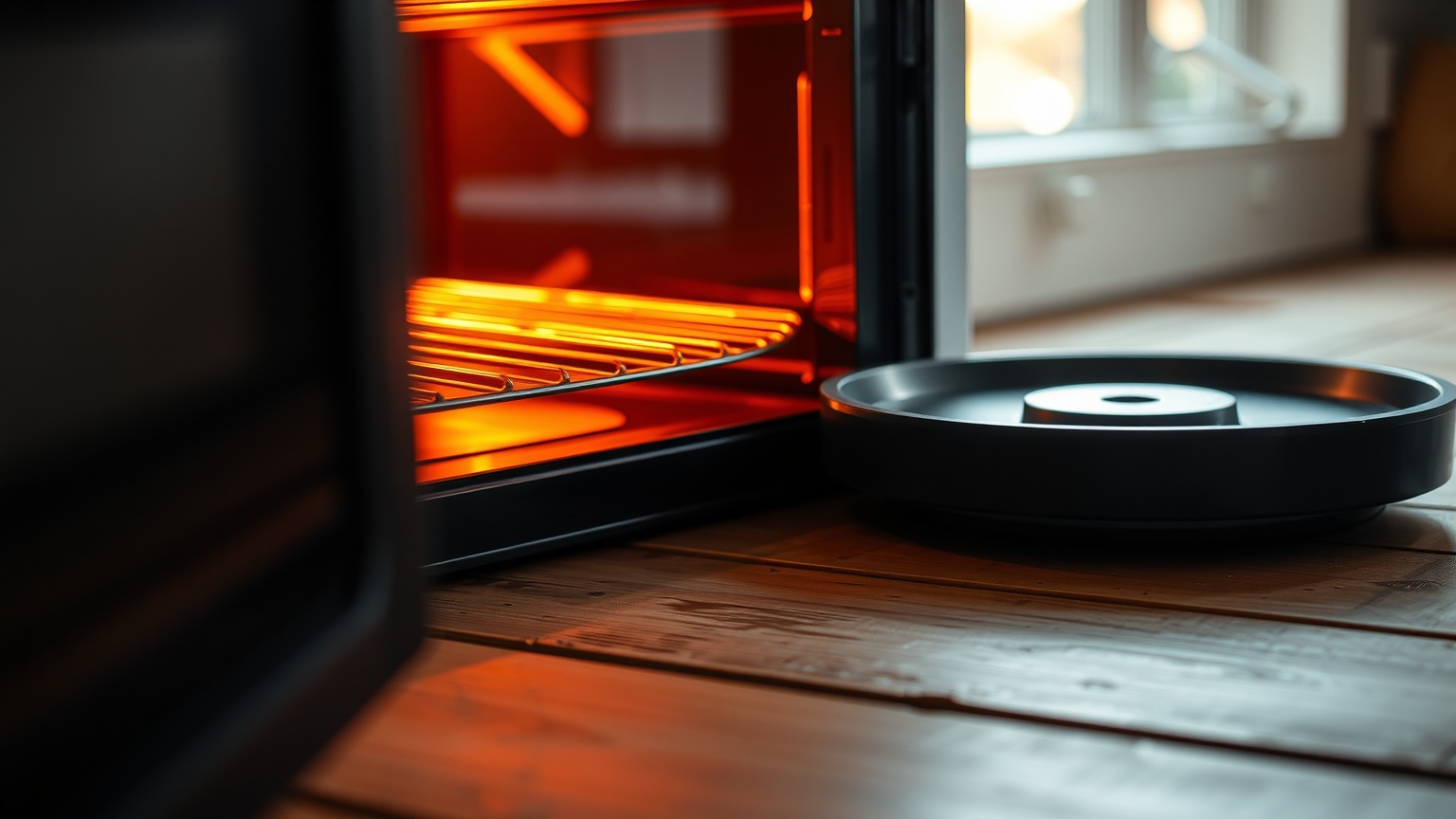
I’ve been using a Breville Smart Oven for a few years now, and one thing that always strikes me is how the top element glows visibly orange on the broil setting. You can see the infrared radiation happening. That visual is actually a useful reminder that what you’re dealing with is heat, not invisible electromagnetic waves penetrating your food from all directions the way a microwave does.
How Hot Do Those Elements Get?
The heating elements themselves can reach temperatures between 1,000°F and 1,800°F, depending on the setting. The internal cavity temperature is much lower — typically 200°F to 450°F for cooking, up to around 500°F on broil. If you’re curious about the specifics of internal temperatures, I’ve written about how hot a toaster gets in more detail elsewhere on the site. The short version: hot enough to cook food beautifully, not hot enough to do anything weird to your body if you’re just standing nearby.
How a Microwave Heats Food — And Why People Got Scared
Microwaves use a component called a magnetron to generate microwave-frequency electromagnetic radiation at 2.45 GHz. This specific frequency is very good at causing water molecules to rotate back and forth rapidly, which generates heat through friction. That’s why wet or moist foods heat faster in a microwave, and why a dry paper towel barely warms up.
The public fear around microwaves has a history. When they became widespread in the 1970s and 80s, people weren’t used to cooking without visible fire or heat — food got hot from the inside out, which felt unnatural. The word “radiation” on the manual didn’t help. Neither did some early, poorly conducted studies that suggested possible harm. Decades of subsequent research have consistently failed to support those concerns at normal residential exposure levels.
Microwave radiation leaks are regulated tightly. The FDA requires that any leakage at 5 centimeters from the appliance must be below 5 milliwatts per square centimeter — and microwaves attenuate extremely quickly with distance, dropping off with the square of that distance. By the time you’re standing at your counter two feet from the microwave, any theoretical leakage is thousands of times below the regulatory limit.
Toaster Oven vs. Microwave: Radiation Type Comparison
| Feature | Toaster Oven | Microwave Oven |
|---|---|---|
| Radiation type used | Infrared (radiant heat) | Microwave (2.45 GHz EMF) |
| Ionizing radiation? | No | No |
| Radiation leaves the appliance during use? | Minimal heat radiation from surfaces | Trace leakage, regulated by FDA |
| Cancer risk from radiation? | None established | None established |
| Primary cooking mechanism | Radiant heat + convection | Dielectric heating of water molecules |
| Typical operating frequency/wavelength | Infrared: ~700nm–1mm | Microwave: ~12.2 cm (2.45 GHz) |
| Real safety concern | Burns, fire risk | Superheating liquids, steam burns |
The Edge Case Nobody Talks About: Leaching from Cookware
Here’s something the competing articles on this topic tend to skip entirely. The radiation question is basically settled — toaster ovens don’t emit meaningful radiation and neither do microwaves. But there’s a real, underappreciated concern with both appliances that has nothing to do with electromagnetic radiation: cookware.
Some non-stick pans with PTFE coatings (Teflon and similar) begin to break down at temperatures above 500°F, releasing fumes that are mildly toxic to humans and genuinely dangerous to birds. In a toaster oven, which can hit 450°F during normal baking and exceed that on broil, an older or low-quality non-stick pan can easily get into that problematic range. The heating is also less even than in a full-size oven, so hot spots near the element can be significantly hotter than the set temperature.
I learned this the hard way with a cheap non-stick pan I used in my toaster oven on the broil setting. The coating started to bubble and discolor. Not a radiation issue at all — a coating degradation issue. The fix is simple: use stainless steel, cast iron, or ceramic-coated pans in your toaster oven, especially if you’re pushing high temperatures. A good toaster oven stainless steel baking pan is worth the modest investment.
Plastic containers are the equivalent concern in microwaves — not radiation, but chemical migration from plastics that aren’t rated for microwave use. The actual “radiation” issue in both appliances is far less of a worry than the cookware you put inside them.
My First-Hand Radiation “Test” — For What It’s Worth
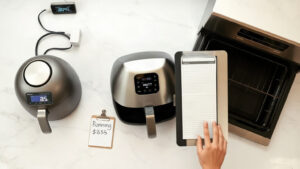
I’ll be honest: I’ve held an EMF meter near my toaster oven while it’s running. Mostly out of curiosity after a reader asked about this. The readings near the heating elements were consistent with normal background electromagnetic field levels — nothing spiked in any meaningful way. The meter did pick up a slightly elevated reading when I held it right against the power cord connection point, which is expected since any current-carrying wire produces a small electromagnetic field. That’s basic physics, not a health concern.
My microwave showed a much higher EMF reading right at the door seal when running, which is the expected leakage point. Still well within safe limits. Standing three feet away, readings dropped to essentially background levels. Neither appliance is doing anything alarming. And to be clear, EMF from appliances operating at these power levels is nowhere near the frequency or intensity needed to be ionizing radiation anyway.
If you use your toaster oven regularly for reheating leftovers, check out the guide on reheating food in a toaster oven — getting the temperature right matters more than any radiation concern. And if you’re in the market for a unit, the best mini toaster ovens roundup covers what I’d actually recommend.
Practical Takeaways for Everyday Use
Since radiation genuinely isn’t the issue here, it’s worth focusing on what is. A few things I’d tell anyone just starting to use a toaster oven:
- Don’t use cookware with PTFE non-stick coatings at temperatures above 400°F. Go with a ceramic-coated toaster oven baking pan or uncoated stainless steel instead.
- Keep the crumb tray clean. Accumulated crumbs are a legitimate fire hazard — not a minor one.
- Don’t put it in a cabinet or enclosed space. Toaster ovens need air circulation and their exterior surfaces get hot enough to scorch wood cabinets.
- Use a proper oven-safe rack if you’re adding accessories. A random baking rack not rated for toaster oven use can warp or cause uneven heating.
The Serious Eats guide to toaster oven cooking covers the practical cooking side well if you want more recipe-oriented advice once you’re past the safety basics.
The Bottom Line
Toaster ovens don’t give you radiation in any meaningful or dangerous sense. The word “radiation” in this context just means radiant heat — the same energy transfer mechanism as sunlight warming your face. It’s not ionizing, it doesn’t penetrate your body, and it doesn’t interact with you at all unless you physically touch the hot surfaces, which is where the actual injury risk lives.
Microwaves are also fine. They’ve been studied extensively for decades and the consensus is clear: normal residential use doesn’t present a radiation health risk. The real concerns with both appliances are mundane and preventable — burns, fire from accumulated grease, and cookware degradation at high heat. Those are worth taking seriously. The radiation fear? Not really.
If anything, I find the toaster oven more satisfying to use precisely because you can see the heat happening. The orange glow of the broil element, the smell of toast, the way cheese bubbles — it’s a very physical, visible cooking process. Nothing mysterious about it.
Frequently Asked Questions
Can a toaster oven give you radiation like a microwave?
No. A toaster oven uses infrared radiant heat from electric heating elements to cook food — it doesn’t produce microwave-frequency radiation or any form of ionizing radiation. Microwaves themselves are also non-ionizing and not harmful at normal use distances. The two appliances use entirely different heating mechanisms, and neither poses a radiation health risk.
Is it safe to stand next to a toaster oven while it’s on?
Yes, standing near a toaster oven while it’s running is safe from a radiation standpoint. The appliance emits heat from its surfaces, so you’d feel warmth if you’re very close, but there’s no harmful electromagnetic field being generated. The practical concern is avoiding contact with the hot exterior surfaces and keeping flammable materials away from the unit.
Does a toaster oven emit EMF?
A toaster oven produces a small electromagnetic field from its power cord and heating elements, as any electrical appliance does. These fields are at extremely low frequency (from the 60Hz AC power supply) and at intensities well below any established safety threshold. This is categorically different from the microwave-frequency EMF produced by a microwave oven, and neither type is ionizing radiation.
Which is safer to use — a toaster oven or a microwave?
Both are safe for normal kitchen use. Toaster ovens present more burn and fire risk because their surfaces and interiors reach very high temperatures and they’re open to the environment when you pull food out. Microwaves present a lower burn risk in general but can cause steam burns or superheating of liquids. Neither presents a meaningful radiation hazard.
Can toaster oven radiation cause cancer?
No. Toaster ovens emit infrared radiation, which is non-ionizing and has no established mechanism for causing cancer. Only ionizing radiation — X-rays, gamma rays, and similar high-energy forms — carries that risk, and household cooking appliances don’t produce it. Decades of research on both toaster ovens and microwave ovens have found no link to cancer at normal residential exposure levels.
—
Written by
Emma founded Toastera to turn vague appliance advice into clear, researched, safety-first guidance on toasters and toaster ovens.
Free: the Toaster Oven Cheat Sheet
Get the printable cheat sheet (temps, cook times & safety tips) plus new recipes. No spam, unsubscribe anytime.