No, you should not leave a toaster oven on when you’re not home. Toaster ovens reach internal temperatures between 300°F and 500°F, and their heating elements stay live the entire time they’re running — with no automatic shutoff on most models. An unattended unit can ignite crumbs, nearby dish towels, or even cabinetry if something goes wrong while you’re gone.
Safety First: Toaster ovens are a leading cause of kitchen fires when left unattended. Never leave one running in an empty house, and always position it at least 4 inches from walls, cabinets, and curtains. If your model doesn’t have an automatic shutoff timer, use an external outlet timer as a failsafe and clean the crumb tray after every use to reduce ignition risk.
Quick Facts
- Toaster ovens operate between 300°F and 500°F — hot enough to ignite paper, cloth, and accumulated grease.
- Most standard toaster ovens have no automatic shutoff; they’ll run until you turn them off or a timer trips the power.
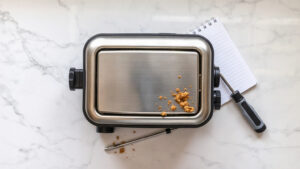
- Crumb trays are the single most common fire source in toaster ovens — a full tray under a 450°F broil is a real problem.
- Some newer models (Breville, Cuisinart) include auto shutoff after a set time, which meaningfully lowers unattended risk.
- Unplugging completely is the only guaranteed way to eliminate electrical risk when you leave the house.
Why Toaster Ovens Are Riskier Than You Think
I’ll be honest — I underestimated my first toaster oven. I had a mid-range Cuisinart sitting on my counter and I treated it roughly like a microwave: start it, wander off, come back. Then one afternoon I left it on the broil setting to finish a piece of toast while I ran to answer the door. By the time I came back (maybe four minutes, tops), the crumbs on the tray had started smoking and the bottom of my cabinet had a faint scorch mark I still haven’t fully painted over.
That was a wake-up call. The thing about toaster ovens is that their heating elements are exposed and close to everything — the food, the walls of the unit, whatever’s sitting on the rack. They get hot fast. And unlike a regular oven where the heat is more contained and there’s more mass to buffer it, a toaster oven is essentially a very efficient, very small hot box with thin walls and a crumb tray sitting about two inches from a glowing element.
You can read more about how hot a toaster gets if you want the full breakdown, but the short version is: these things mean business temperature-wise.
What Can Actually Go Wrong
Crumb Tray Fires
This is the big one. Crumbs and grease accumulate faster than most people expect, especially if you’re using the broil setting or cooking anything fatty. At 450°F, a neglected crumb tray isn’t just a fire hazard — it’s a pretty reliable one. I clean mine after every other use minimum. It’s annoying. Do it anyway.
Nearby Materials Catching Heat
Dish towels draped over the handle. A paper bag sitting too close. Plastic wrap from a previous meal that migrated toward the back. I’ve seen all of these become problems in real kitchens. The exterior of most toaster ovens gets surprisingly hot — the sides and top can hit 200°F+ on a long bake cycle. That’s enough to deform plastic, scorch wood, and ignite thin paper if the contact is direct.
Electrical Faults
Less common, but real. Older units with worn cords, loose connections, or faulty thermostats can malfunction silently. The thermostat is supposed to cycle the elements on and off to maintain temperature — if it fails, the element just… keeps going. That’s a runaway heat situation. There’s no drama or warning. It just gets hotter until something gives.
The U.S. Consumer Product Safety Commission consistently lists toaster ovens among small appliances implicated in home fires, particularly in cases where the unit was left unattended or placed too close to combustible materials.
Models With Auto Shutoff: Does It Help?
Yes, genuinely. If your toaster oven has a built-in timer that cuts power when the cycle ends, you’re in meaningfully better shape than someone with a basic dial model that stays on indefinitely. A few models worth knowing about:
| Model | Auto Shutoff? | Price Tier | Max Temp | My Take |
|---|---|---|---|---|
| Breville Smart Oven Air Fryer Pro | Yes (timer-based) | Premium | 450°F | Best overall safety features |
| Cuisinart TOA-70 | Yes (timer-based) | Mid-range | 450°F | Solid, reliable daily driver |
| Hamilton Beach 31127D | No | Budget | 450°F | Fine, but you need to babysit it |
| Ninja Foodi XL Pro | Yes (smart timer) | Mid-to-premium | 450°F | Great but bulky on the counter |
| Black+Decker TO3250XSB | Partial (some models) | Budget | 450°F | Check the specific model carefully |
Even with auto shutoff, I wouldn’t leave one running while I left the house for three hours. The timer is a safety net for “I forgot to check on it,” not a substitute for basic supervision. That said, if you’re in the shower or grabbing mail, a timer-equipped model is much less likely to become a problem than one that runs indefinitely.
If you’re shopping and safety is a priority, check out our picks for the best mini toaster ovens — we note which ones include auto shutoff in the reviews.
What You Should Actually Do Instead
Use It, Watch It, Turn It Off
Simple rule: if you’re not in the kitchen, the toaster oven is off. I know that sounds rigid. But it takes about 90 seconds to cool down enough that it’s not a live fire hazard, and it takes approximately zero effort to flip the knob off before you leave the room. I’ve started treating it like a gas burner — you just don’t leave it on unattended. That’s the habit.
Unplug It When You Leave the House
This one gets pushback — “but it’s off, why does unplugging matter?” Because thermostats fail. Wiring degrades. A unit that’s “off” but still plugged in with a faulty thermostat can, in rare cases, start drawing current. Unplugging is a one-second action that eliminates a class of risk entirely. Worth it.
Clean the Crumb Tray Regularly
Pull it out, wipe it down, put it back. Every few uses. Takes maybe 45 seconds. This single habit removes the most statistically likely ignition source. I use a toaster oven crumb tray liner now, which makes the whole process faster and I genuinely wish I’d started doing it sooner.
Check Clearance Around the Unit
Four inches minimum on the sides, six inches from anything above it. Most people don’t have this because counter space is tight — I get it. But if your toaster oven is wedged under a cabinet shelf with two inches of clearance, that’s a problem during a long bake cycle. The heat has to go somewhere.
Consider an Outlet Timer as a Failsafe
If you have an older model with no auto shutoff and you’re prone to forgetting, a basic mechanical outlet timer (the kind you’d use for a lamp) can physically cut power after a set window. It’s a clunky solution but it works. A heavy-duty outlet timer for appliances rated for the wattage of your unit (most toaster ovens are 1,200–1,800 watts, so check the label) is cheap and genuinely useful insurance.
Is It Ever Okay to Leave a Toaster Oven On Briefly?
There’s a difference between “leaving the house” and “leaving the room for two minutes.” I’m not going to pretend I stand rigidly in front of my toaster oven for every bagel. But there’s a spectrum here.
Stepping into the next room for a few minutes while something toasts? Lower risk, especially if the crumb tray is clean, clearances are fine, and the timer is set. Popping out to run errands for an hour? That’s where it gets genuinely dangerous. The longer the unit runs unattended, the more time any incipient problem has to develop into something worse.
I’d also add: if you’re doing something that requires monitoring — like reheating food in a toaster oven that has a lot of grease or sauce — be more vigilant, not less. High-fat foods can spatter and the drippings can smoke or flame up faster than you’d expect.
The honest answer is: brief, eyes-on-ish supervision for short cycles is a reasonable risk tolerance for most adults. Leaving it on while you leave the building is not.
The Bottom Line
Don’t leave your toaster oven on when you’re not home. That’s the whole answer, really. It runs hot, it stays hot, and if something goes wrong — a crumb tray fire, a thermostat glitch, a dish towel that drifted too close — there’s nobody there to catch it before it becomes a real problem.
Get a model with auto shutoff if you can. Clean the crumb tray. Give it adequate clearance. And when you leave? Turn it off and unplug it. It takes five seconds and it’s about as close to a guarantee as you’ll get with a kitchen appliance that runs at 450°F.
For what it’s worth, the National Fire Protection Association consistently identifies unattended cooking equipment as the leading cause of home cooking fires. Toaster ovens fall squarely in that category. The risk is real, it’s documented, and it’s almost entirely preventable with basic habits.
Also: get a small kitchen fire extinguisher if you don’t have one. Not because I think you’re about to have a fire, but because they’re cheap, they last years, and you’ll be glad it’s there the one time you need it.
Frequently Asked Questions
Is it safe to leave a toaster oven on overnight?
No, it’s not safe to leave a toaster oven on overnight. Toaster ovens can reach up to 500°F and most models have no automatic shutoff, meaning they’ll run indefinitely — and crumbs, grease, or nearby materials can ignite without warning. Always turn it off and unplug it before sleeping.
What happens if you leave a toaster oven on?
If left on, a toaster oven continues running at full temperature, which can ignite accumulated crumbs in the tray, scorch nearby cabinet surfaces, or — in the case of a faulty thermostat — continue heating past its intended setting. In worst-case scenarios this leads to a kitchen fire. Most incidents are preventable with a clean crumb tray and adequate counter clearance.
Do toaster ovens turn off automatically?
Some do, some don’t. Higher-end models from brands like Breville and Cuisinart typically include a timer-based auto shutoff that cuts power when the cooking cycle ends. Budget models often have no such feature and will run continuously until manually switched off. Check your model’s manual to confirm whether yours has this function.
Is it safe to leave a toaster plugged in?
Leaving a toaster or toaster oven plugged in but switched off is generally low-risk, though not zero risk — particularly with older units where internal components may have degraded. The safest habit is to unplug it after each use, especially if you’re leaving the house for an extended time. It’s a small inconvenience that eliminates a real, if uncommon, electrical fault risk.
How hot does a toaster oven get on the outside?
The exterior surfaces of most toaster ovens reach between 150°F and 220°F on the sides and top during normal operation — hot enough to cause burns on contact and to scorch or warp materials that are too close. The front door glass can reach similar temperatures during high-heat baking or broiling. Always keep at least 4 inches of clearance on all sides.
—
Written by
Emma founded Toastera to turn vague appliance advice into clear, researched, safety-first guidance on toasters and toaster ovens.
Free: the Toaster Oven Cheat Sheet
Get the printable cheat sheet (temps, cook times & safety tips) plus new recipes. No spam, unsubscribe anytime.