Yes, you can put aluminum foil in a toaster oven — but with real limits that most people ignore until something goes wrong. The foil must never touch the heating elements or the oven walls, it should never cover the crumb tray completely, and you shouldn’t use it to line the bottom of the oven cavity. Follow those rules and foil is genuinely useful in a toaster oven. Break them and you’re looking at uneven cooking at best, a fire at worst.
Safety First: Aluminum foil that contacts a toaster oven’s heating elements can ignite or cause arcing — particularly in convection and air-fryer-style models where hot air is forced directly over the elements. Before using foil, always confirm the foil is tucked well clear of all heating elements (top, bottom, and rear), the oven door closes fully without pinching the foil, and the crumb tray is either uncovered or replaced with a foil piece cut to fit loosely (never sealed edge-to-edge). If you smell something burning, turn the unit off immediately.
Quick Facts: Aluminum Foil in a Toaster Oven
- Toaster ovens typically run between 200°F and 450°F — aluminum foil has a melting point around 1,220°F, so it won’t melt, but it can still cause problems at those temperatures if misused.
- Foil is safe on or under food on a rack, or loosely tented over a dish. It is not safe lining the crumb tray edge-to-edge or touching the sides or heating elements.
- Most toaster oven manufacturers — including Breville, Cuisinart, and Hamilton Beach — specifically warn against lining the interior walls or crumb tray with foil in their manuals.
- Highly acidic foods (tomatoes, citrus, vinegar-based marinades) can react with aluminum foil at high heat, potentially affecting flavor and introducing trace amounts of aluminum into food.
- Parchment paper is a safer, more versatile alternative for most tasks — as long as your oven stays under 425°F.
Why People Get Confused About This
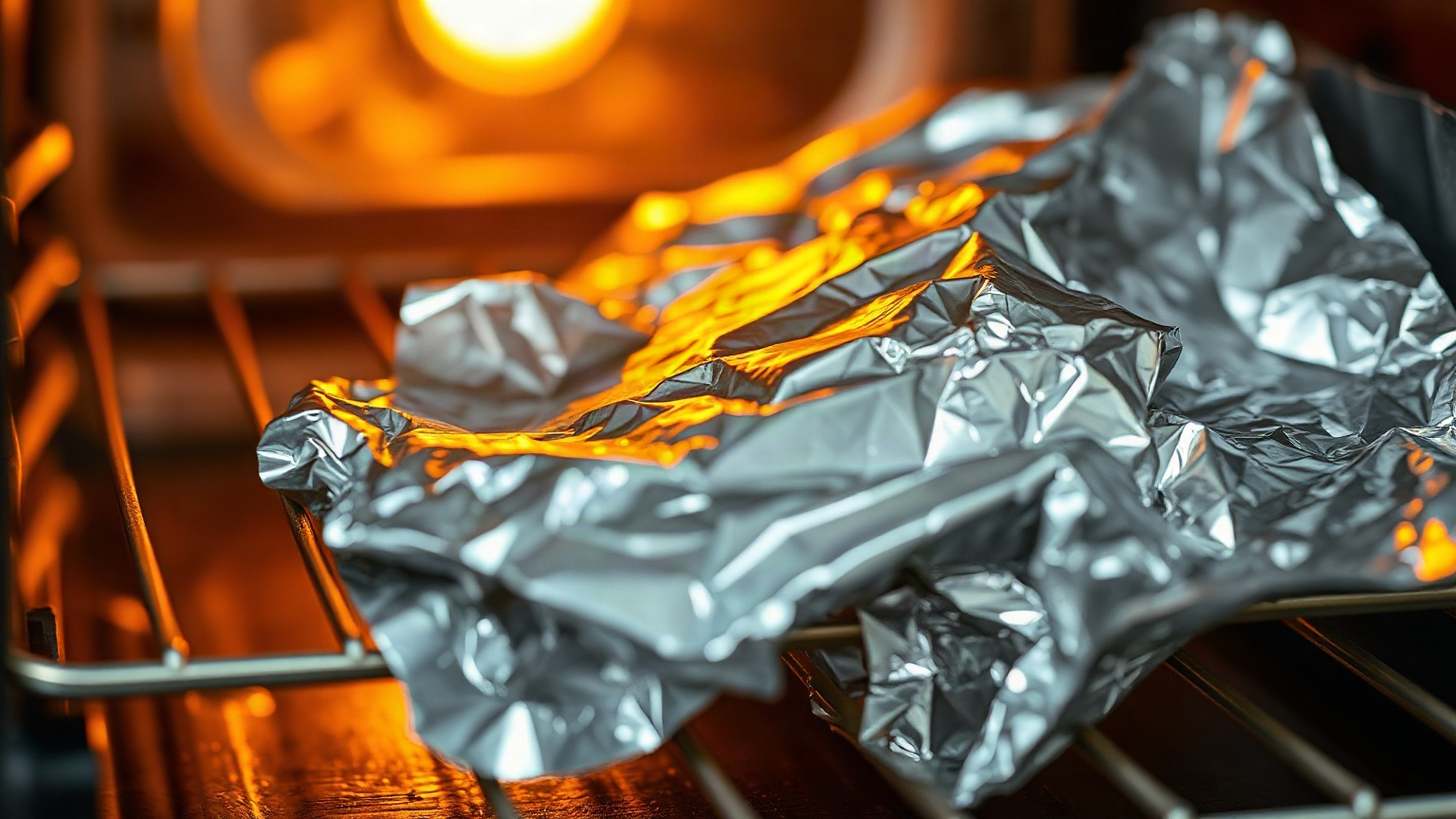
The confusion mostly comes from conflating toaster ovens with full-size conventional ovens. In a big oven, lining the bottom rack with foil is common practice — messy, probably not great for heat distribution, but not immediately dangerous. Toaster ovens are a different situation. The heating elements are much closer to the food and to any foil you place inside. We’re talking inches, not feet. That proximity is what changes everything.
I learned this the slightly embarrassing way. First time I used my Cuisinart toaster oven, I casually laid a sheet of foil across the crumb tray the way I had in my old full-size oven. By the time the salmon was done, the foil had partially bonded to the tray in a couple of spots and the oven smelled faintly metallic for three uses afterward. Not a fire, thankfully. But not nothing, either.
The other piece of confusion: some brands say foil is fine, others say avoid it entirely. The truth is somewhere more specific than either camp. It’s not about the foil itself — it’s about placement.
Where Foil Is Actually Safe to Use
On top of or under food on the rack
This is the most legitimate use case. Wrapping a piece of chicken in foil before placing it on the rack, or loosely tenting foil over a dish of roasted vegetables to stop over-browning — both are fine. The foil is surrounded by food, it’s not near the walls, and there’s enough clearance from the heating elements. I do this regularly for fish and baked potatoes. Works exactly as expected.
If you’re using foil under food (say, folding it into a rough tray shape to catch drips), leave gaps around the edges so air can still circulate. A sealed foil tray that covers the entire rack surface will impede airflow and cause uneven cooking, especially in convection mode.
As a makeshift tray for small items
Shaping foil into a small open tray — maybe 6 inches by 4 inches — for things like garlic bread, nachos, or reheating a slice of pizza is genuinely useful. A proper toaster oven baking pan is better for this in the long run (easier cleanup, more consistent heat), but the foil tray works fine in a pinch. Just don’t let the edges extend far enough to touch the walls.
Where Foil Is Genuinely Dangerous
Lining the crumb tray
This is the big one. The crumb tray sits at the bottom of the toaster oven cavity, usually right below or very close to the lower heating element. If you cover it edge-to-edge with foil, you’ve effectively sealed off ventilation, created a reflective surface that bounces heat back into the element, and given any grease or crumbs nowhere to go except against hot metal. That’s a fire scenario. Not a theoretical one — this is the scenario that causes kitchen fires with toaster ovens.
Every major manufacturer says so. Breville’s manuals say it explicitly. So does Cuisinart’s. So does Hamilton Beach’s. If you’ve been doing this for years without incident, you’ve been lucky, not safe.
Touching the heating elements
Obvious when you think about it, less obvious when you’re hurriedly tenting foil over a casserole dish and the foil grazes the top element. At 400°F the element is glowing. Foil that contacts it can arc, scorch, or in some cases ignite nearby grease. Keep foil at least an inch away from any element. More is better.
Lining the walls or bottom of the cavity
Same logic as the crumb tray. The walls and interior bottom of a toaster oven cavity are part of a heat-management system. Covering them disrupts heat reflection patterns, can trap heat against the outer housing (raising the exterior temperature), and creates adhesion points when grease accumulates. Just don’t.
The Acidic Food Problem: An Edge Case Most Articles Skip
Here’s one you don’t see discussed often. When you cook acidic foods — tomato sauce, lemon-marinated chicken, anything with vinegar — directly on or wrapped tightly in aluminum foil at high heat, a low-level chemical reaction occurs. The acid attacks the foil, and trace amounts of aluminum can leach into the food.
The research on whether this is actually harmful at the quantities involved is genuinely inconclusive. A 2012 study published in the International Journal of Electrochemical Science found that cooking acidic foods in foil did increase aluminum content in the food. Whether that level matters for health is still debated. But the flavor effect is real and not debated at all: acidic foods cooked in contact with aluminum foil at temperatures above 375°F can taste slightly metallic. I’ve noticed it with lemon chicken. It’s subtle but it’s there.
For those dishes specifically, parchment paper or a ceramic baking dish is a better call. Check out Serious Eats — they’ve covered the cooking-with-foil flavor question more thoroughly than most.
Foil vs. Parchment: Which Should You Actually Use?
This is worth a quick comparison because the two get used interchangeably and they really shouldn’t be.
| Factor | Aluminum Foil | Parchment Paper |
|---|---|---|
| Max safe temp in toaster oven | No meaningful limit (melts at ~1,220°F) | 425°F (starts to brown/degrade above this) |
| Best for | Wrapping, tenting, catching drips | Lining pans, baking cookies, sticky foods |
| Acidic foods | Avoid (potential metallic taste) | Fine |
| Crisping/browning underneath food | Reflects heat — can over-brown | Absorbs some heat — gentler browning |
| Fire risk if misused | Higher (can arc near elements) | Lower, but can char/ignite above 450°F |
| Reusable | Sometimes | No |
My default is parchment for anything I’m baking or roasting flat on a pan, and foil for anything I’m wrapping or tenting. That split works for about 90% of what I use a toaster oven for. For heavier-duty cooking — roasting a chicken, anything dripping a lot — a proper toaster oven wire rack with drip pan is genuinely the right tool. Easier to clean, more even heat, and you’re not wrestling with foil that wants to curl up at the edges.
If you’re curious about how hot your specific toaster oven actually gets at different settings, I wrote about how hot a toaster gets — the numbers are more variable than you’d expect across brands. And if you’re mostly using your toaster oven for leftovers, the tips on reheating food in a toaster oven will help you get better results without having to fuss with foil at all.
What the Manufacturers Actually Say
Most people never read their toaster oven manual. I get it. But the foil guidance in those manuals is genuinely worth knowing, because it varies more than you’d think.
Breville’s instruction manuals for most of their Smart Oven line state clearly that foil should not be placed on the crumb tray or used to line the walls. They do allow foil wrapped around food or placed on the rack under food. Cuisinart says essentially the same. Hamilton Beach is slightly more permissive in some of their older manuals but still warns against crumb tray lining. Oster explicitly permits foil on or around food but prohibits contact with the oven sides or heating elements.
The takeaway: no manufacturer fully prohibits foil, but every single one prohibits the exact uses that people most commonly default to. Which suggests the guidance isn’t overly cautious — it’s based on how people actually misuse foil in practice.
If you’re shopping for a new unit and want to know which ones are easiest to cook in without fussing around safety constraints, the best mini toaster ovens roundup covers the models I’d actually recommend.
The Bottom Line
Aluminum foil and toaster ovens can coexist fine. The rules are genuinely simple: keep foil on or around food, away from the elements and the walls, and never use it as a liner across the crumb tray. That’s it. The reason this feels confusing is that the line between “safe use” and “dangerous use” is spatial — how the foil is positioned — not categorical.
If you’re ever in doubt, parchment paper below 425°F solves most of the same problems without the fire risk. But foil for wrapping, tenting, and small makeshift trays? Totally fine. Just tuck those edges in.
Frequently Asked Questions
Can aluminum foil catch fire in a toaster oven?
Foil itself won’t ignite — it’s metal — but it can cause nearby grease or food debris to ignite if it traps heat or causes arcing near a heating element. The real fire risk comes when foil covers the crumb tray edge-to-edge or makes contact with the heating elements, which can cause a localized arc or overheat adjacent combustible material. Keep foil away from elements and clear of the crumb tray and the risk drops to essentially nothing.
Can you line the bottom of a toaster oven with aluminum foil?
No — lining the bottom of the toaster oven cavity or the crumb tray with foil is specifically prohibited by most manufacturers and is a genuine fire hazard. It disrupts airflow, reflects heat back toward the elements, and can trap grease in a way that leads to overheating. Use the crumb tray as designed and clean it regularly instead.
Is parchment paper safer than aluminum foil in a toaster oven?
For most tasks, yes — parchment paper is lower-risk because it won’t arc near heating elements, and it’s better suited for baking and roasting without affecting flavor. The catch is temperature: parchment starts to degrade above 425°F and can char or catch fire above 450°F, so it’s not appropriate for broiling. Aluminum foil handles higher heat but requires more careful placement.
Does aluminum foil affect cooking results in a toaster oven?
Yes, noticeably. Foil reflects radiant heat, which means food directly on foil tends to brown more on top from the element and less on the bottom. Tenting foil over food slows browning and keeps moisture in — useful for the first half of cooking a roast, less useful if you want crispy skin. In convection mode, foil that restricts airflow will unevenly cook food and extend cook times by 10 to 15 percent in my experience.
Can I use aluminum foil in a toaster oven to reheat food?
Yes, and it works well for certain foods — wrapping leftover bread or a pastry in foil to reheat at 325°F keeps it from drying out while the inside warms through. For pizza or anything you want to stay crispy on the bottom, skip the foil and place it directly on the rack or a small toaster oven pizza pan instead. Foil traps steam, which is great for some things and bad for others.

Written by
Emma founded Toastera to turn vague appliance advice into clear, researched, safety-first guidance on toasters and toaster ovens.
Free: the Toaster Oven Cheat Sheet
Get the printable cheat sheet (temps, cook times & safety tips) plus new recipes. No spam, unsubscribe anytime.