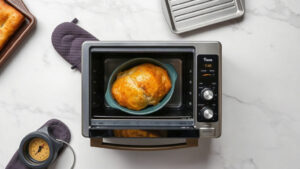
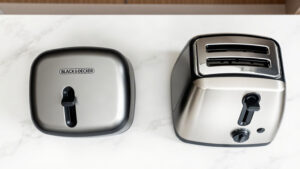
For one or two people, a compact toaster oven (0.5–0.8 cubic feet) handles the vast majority of daily cooking tasks better than a full-size model: it preheats faster, uses less electricity, and takes up less precious counter space. Full-size toaster ovens (1.0–1.5 cubic feet) earn their keep only if you regularly cook whole chickens, 12-inch pizzas, or large sheet-pan meals. For most solo cooks or couples with a standard kitchen, compact wins on practicality — unless you’re convinced you’ll actually use that extra capacity.
Safety First: Toaster ovens run heating elements at temperatures up to 450–500°F and draw 1,200–1,800 watts of power. Always keep your toaster oven at least 4 inches from walls, cabinets, and curtains. Never leave it unattended at high heat, and use oven mitts — the exterior walls get surprisingly hot, even on compact models. Unplug when not in use if children are in the home.
Quick Facts: Compact vs Full-Size Toaster Oven for 1–2 People
- Compact toaster ovens (0.5–0.8 cu ft) typically draw 1,200–1,500 watts and preheat to 400°F in roughly 5–7 minutes. Full-size models need 1,500–1,800 watts and can take 8–12 minutes.
- A compact oven fits a 9-inch pizza, 4 slices of toast, or a 3-lb chicken breast batch. Full-size fits a 12-inch pizza, 6 slices, or a whole 4–5 lb bird.
- Counter footprint matters: compact models average 16″ x 12″, full-size models 20″ x 16″ or larger.
- For everyday reheating, toasting, and small bakes, a compact oven is almost always enough for two people.
- If you entertain occasionally or want to replace your full-size oven entirely, go full-size — but know the tradeoffs.
What “Compact” and “Full-Size” Actually Mean (The Numbers)
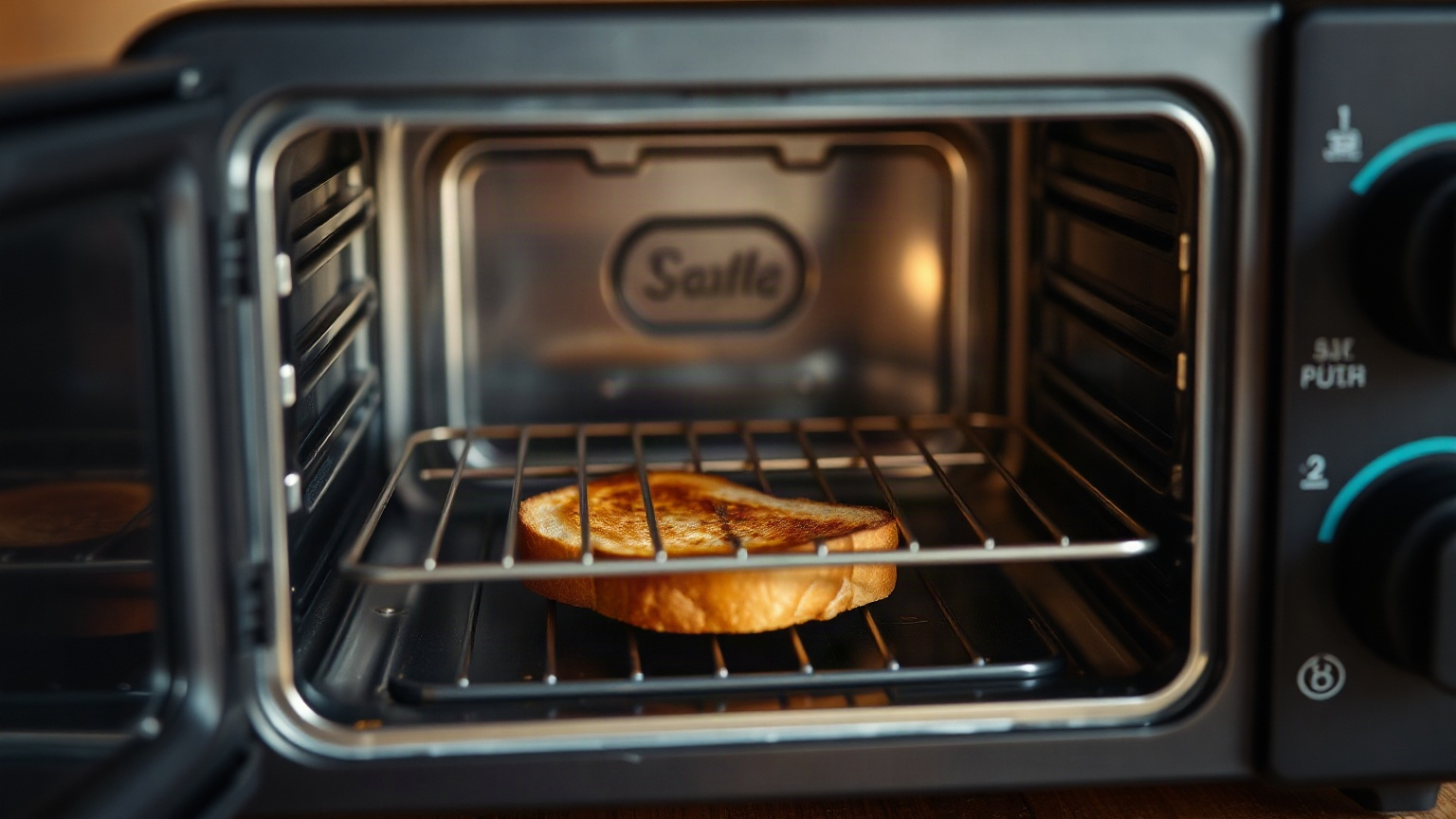
The terms get thrown around loosely, so let’s be specific. Compact toaster ovens typically run from 0.5 to 0.8 cubic feet of interior space. Something like the Cuisinart TOA-60 lands in this range — big enough to feel useful, small enough that it doesn’t eat your entire counter. Full-size countertop ovens push 1.0 to 1.5 cubic feet. The Breville Smart Oven Air Fryer Pro, for instance, sits at 1.0 cubic feet, and even that feels substantial when you’re standing in a one-bedroom apartment kitchen.
Capacity translates directly to what fits inside. Here’s a rough breakdown:
| Feature | Compact (0.5–0.8 cu ft) | Full-Size (1.0–1.5 cu ft) |
|---|---|---|
| Pizza size | Up to 9 inches | Up to 12–13 inches |
| Toast capacity | 4 slices | 6 slices |
| Chicken/roast | Up to 3 lbs (parts, not whole) | Whole bird, 4–5 lbs |
| Preheat time (400°F) | 5–7 minutes | 8–12 minutes |
| Wattage draw | 1,200–1,500W | 1,500–1,800W |
| Typical footprint | ~16″ x 12″ | ~20″ x 16″ or larger |
| Price tier | Budget to mid-range ($40–$150) | Mid-range to premium ($120–$350+) |
Worth knowing: capacity labeling isn’t standardized. Two ovens both marketed as “compact” can differ by several inches internally. Always check the manufacturer’s interior dimensions, not just the marketing copy.
Real-World Cooking for 1–2 People: What Actually Happens
I’ve run both sizes through the same weekly routine — breakfast toast, lunch reheating, the occasional roasted vegetables or baked salmon. Honestly? For two people eating normal meals, I almost never needed the extra space of a full-size unit. The compact handled 95% of it without complaint.
The one place the compact tripped me up initially was sheet-pan cooking. I tried to roast a full tray of Brussels sprouts — the standard half-sheet pan didn’t fit, and I had to use the oven’s own 9×11 tray, crowding the sprouts instead of spreading them. They steamed instead of crisping. Once I got a proper quarter-sheet pan sized for compact ovens, that problem went away entirely. Small lesson: the oven’s own included pan isn’t always the best tool.
Everyday Tasks Where Compact Wins
Toast. Obviously. But also: reheating leftover pizza at 375°F for 6–8 minutes (infinitely better than a microwave — see our guide on reheating food in a toaster oven for specifics). Baking two chicken thighs at 400°F for 25 minutes. Warming up a couple of croissants. A compact oven preheats so fast that you’ll actually use it instead of defaulting to the microwave. That speed difference is real, and it changes your habits.
Tasks That Push a Compact to Its Limits
A full 12-inch frozen pizza. Any roast larger than about 3 lbs. Cooking for a small dinner party (even just 4 people). Baking a standard 9×13 casserole dish — it won’t fit. If these come up regularly, a compact will frustrate you. If they come up twice a year, you’ll manage fine. Borrow a neighbor’s oven for the holidays and move on.
Specific Model Recommendations: Which One to Actually Buy
Let me be direct here, because vague advice isn’t helpful. These are real models worth considering, not a random list.
Best Compact Options
Hamilton Beach 31127D — Budget tier. No frills, no air frying, but it toasts evenly and bakes reliably. Good first toaster oven if you’re not sure how much you’ll use it. It’s around $40–$60 and does exactly what it says.
Cuisinart TOA-60 — Mid-range, my personal pick for most couples. It air fries, toasts, bakes, broils, and the controls are intuitive from day one. The 0.6 cubic foot interior fits a 9-inch pizza comfortably and handles two salmon fillets without crowding. One minor pet peeve: the air fry basket that comes with it is on the small side. A third-party replacement air fry basket helps.
Ninja Foodi Digital Air Fry Oven (SP101) — This one flips up to store flat against the wall, which is either brilliant or gimmicky depending on your kitchen layout. For a small apartment, the vertical storage is genuinely useful. Cooks well. Slightly harder to clean because of the flip mechanism.
Best Full-Size Options (For When You Actually Need Them)
Breville Smart Oven Air Fryer Pro (BOV900BSS) — Premium. Worth it if you’re replacing your main oven or cooking for two people with ambitious tastes. The 13 cooking functions and smart element IQ system produce genuinely consistent results. The interior is 1.0 cubic feet, fits a 13-inch pizza and a 9×13 pan. It’s expensive (premium tier, $350+), and it takes up serious counter space. Don’t buy it hoping you’ll grow into it.
Cuisinart TOA-70 — A step up from the TOA-60, with slightly more capacity and a stainless interior that’s easier to wipe clean. Mid-range to premium. If you cook a lot and want the extra room without going full Breville, this is a reasonable middle ground.
| Model | Size Category | Capacity | Air Fry | Price Tier | Best For |
|---|---|---|---|---|---|
| Hamilton Beach 31127D | Compact | ~0.5 cu ft | No | Budget ($40–$60) | Bare-bones daily use |
| Cuisinart TOA-60 | Compact | ~0.6 cu ft | Yes | Mid-range ($100–$150) | Most 1–2 person households |
| Ninja SP101 | Compact | ~0.6 cu ft | Yes | Mid-range ($120–$160) | Small kitchens, storage-conscious |
| Cuisinart TOA-70 | Full-Size | ~0.95 cu ft | Yes | Mid-range/Premium ($180–$250) | Ambitious home cooks, couples |
| Breville BOV900BSS | Full-Size | ~1.0 cu ft | Yes | Premium ($350+) | Oven replacement, serious cooks |
The Edge Cases Most Guides Skip
Here’s something you won’t see discussed much: energy costs over time. A compact oven drawing 1,200 watts used for 30 minutes daily runs about 18 kWh per month. At the US average electricity rate of roughly $0.16/kWh, that’s under $3/month. A full-size model at 1,800 watts for the same usage hits nearly $4.30/month. Not a huge gap individually, but add it up across appliances and it matters, especially if you’re in a high-rate state like California or New York where rates can push $0.30/kWh or higher.
Another edge case: studio apartments with no full-size oven at all. This is more common than guides acknowledge. According to Serious Eats, countertop ovens have become the primary cooking appliance for a growing number of urban renters. In that situation, skipping straight to a full-size toaster oven makes sense, because you’re not supplementing anything — you’re replacing your entire oven. Check our roundup of best mini toaster ovens if you’re constrained on space but still want real cooking capability.
And one more: altitude. Baking at high altitude in a compact oven can mean uneven results because the smaller cavity has less thermal mass to buffer temperature swings. If you’re in Denver or Salt Lake City and you bake regularly, a full-size model with better insulation may produce more consistent results. I hadn’t thought about this until a reader mentioned it, and it’s a real thing.
So Which One Should You Actually Buy?
Here’s my honest, non-hedged take. Most couples and solo cooks should buy a compact toaster oven, specifically the Cuisinart TOA-60 if you want air frying, or the Hamilton Beach 31127D if you just want reliable toasting and baking on a budget. Full stop.
Get a full-size model if: you have no conventional oven and this is your primary cooking appliance, you regularly cook whole birds or large cuts of meat, or you bake full-size batches and won’t compromise. In that case, the Breville BOV900BSS is excellent and worth the price, or the Cuisinart TOA-70 if you want to spend a bit less and sacrifice a little capacity.
Don’t let the marketing convince you that more capacity is always smarter. A bigger oven takes longer to preheat, uses more electricity, and sits half-empty most of the time if you’re cooking for one or two. Right-sizing your appliance is actually the smarter move. You can also read more about how hot a toaster gets to understand the temperature ranges you’re working with across different models. And the Food Network’s toaster oven cooking tips are worth a skim if you’re just getting started with countertop cooking.
The Verdict
Compact toaster oven. For one or two people eating normal meals, it covers about 90% of daily cooking needs, preheats faster, costs less to run, and doesn’t take over your counter. The Cuisinart TOA-60 is where I’d send most people. If you genuinely cook large meals regularly, need to roast whole chickens, or have no conventional oven at all, step up to the Breville BOV900BSS and don’t look back. But be honest with yourself about what you’ll actually cook, not what you imagine you might cook someday.
Frequently Asked Questions
Is a compact toaster oven enough for two people?
Yes, for most two-person households a compact toaster oven (0.5–0.8 cubic feet) handles daily cooking comfortably. You can toast 4 slices, bake two chicken breasts, roast vegetables, and reheat leftovers without running out of room. The only situations where it falls short are cooking large roasts, full 12-inch pizzas, or standard 9×13 baking dishes.
What is the difference between a compact and full-size toaster oven?
Compact toaster ovens typically offer 0.5–0.8 cubic feet of interior space, fit up to a 9-inch pizza, and draw 1,200–1,500 watts. Full-size countertop ovens run 1.0–1.5 cubic feet, accommodate 12-inch pizzas or whole chickens, and draw 1,500–1,800 watts. Full-size models also take longer to preheat and have a larger counter footprint.
Can a toaster oven replace a full-size oven for one person?
A full-size toaster oven (1.0+ cubic feet) can realistically replace a conventional oven for one person who cooks normal meals. It handles roasting, baking, and broiling at the same temperatures (up to 450–500°F). The main limitations are batch size — you can’t bake multiple trays of cookies simultaneously — and anything requiring a large roasting pan.
How much electricity does a compact toaster oven use compared to a full-size?
A compact toaster oven draws roughly 1,200–1,500 watts versus 1,500–1,800 watts for a full-size model. Used 30 minutes daily, that translates to approximately 18 kWh vs. 27 kWh per month — a difference of about $1.50/month at average US electricity rates, and more if you’re in a high-cost state. Not dramatic, but real over a year.
Which toaster oven is best for a small apartment?
The Cuisinart TOA-60 is the best all-around compact toaster oven for small apartments — it air fries, bakes, broils, and toasts in a footprint of roughly 16″ x 14″, and it’s genuinely easy to use from day one. If storage space is extremely tight, the Ninja Foodi SP101 flips upright against the wall, which is a real advantage in a galley kitchen. Both are mid-range in price and handle 95% of one-or-two-person cooking needs.

Written by
Emma founded Toastera to turn vague appliance advice into clear, researched, safety-first guidance on toasters and toaster ovens.
Free: the Toaster Oven Cheat Sheet
Get the printable cheat sheet (temps, cook times & safety tips) plus new recipes. No spam, unsubscribe anytime.