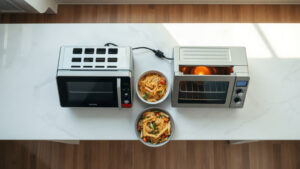
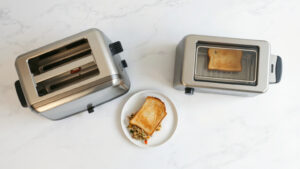
A toaster’s heating element works by running electricity through a high-resistance metal wire — usually nichrome — which converts that electrical energy directly into heat, reaching surface temperatures between 1,000°F and 1,200°F (538°C–649°C). That intense heat radiates outward as infrared radiation, which penetrates the surface of your bread and triggers the Maillard reaction, browning and crisping it in 60 to 90 seconds. The whole process is faster than most people expect because nichrome wire heats up almost instantly — there’s virtually no warm-up lag.
Safety First: Toaster heating elements carry live electrical current during operation and remain dangerously hot for several minutes after the cycle ends. Never insert metal utensils (forks, knives, tongs) into a toaster — even when it appears off — as residual current or accidental activation can cause a serious electric shock. Always unplug your toaster before attempting to remove stuck bread, clean the crumb tray, or inspect any internal component.
Quick Facts: Toaster Heating Elements at a Glance
- Nichrome wire (80% nickel, 20% chromium) is the standard heating element material in most pop-up toasters
- Element surface temperatures typically hit 1,000°F–1,200°F; the air inside the toaster slot reaches roughly 300°F–400°F
- Most household toasters draw between 800W and 1,500W — the higher the wattage, the faster the toast
- The browning you see is the Maillard reaction, which starts around 280°F (138°C) at the bread surface
- Quartz heating elements (found in some toaster ovens) produce more infrared energy and heat up even faster than nichrome coils
What the Heating Element Is Actually Made Of
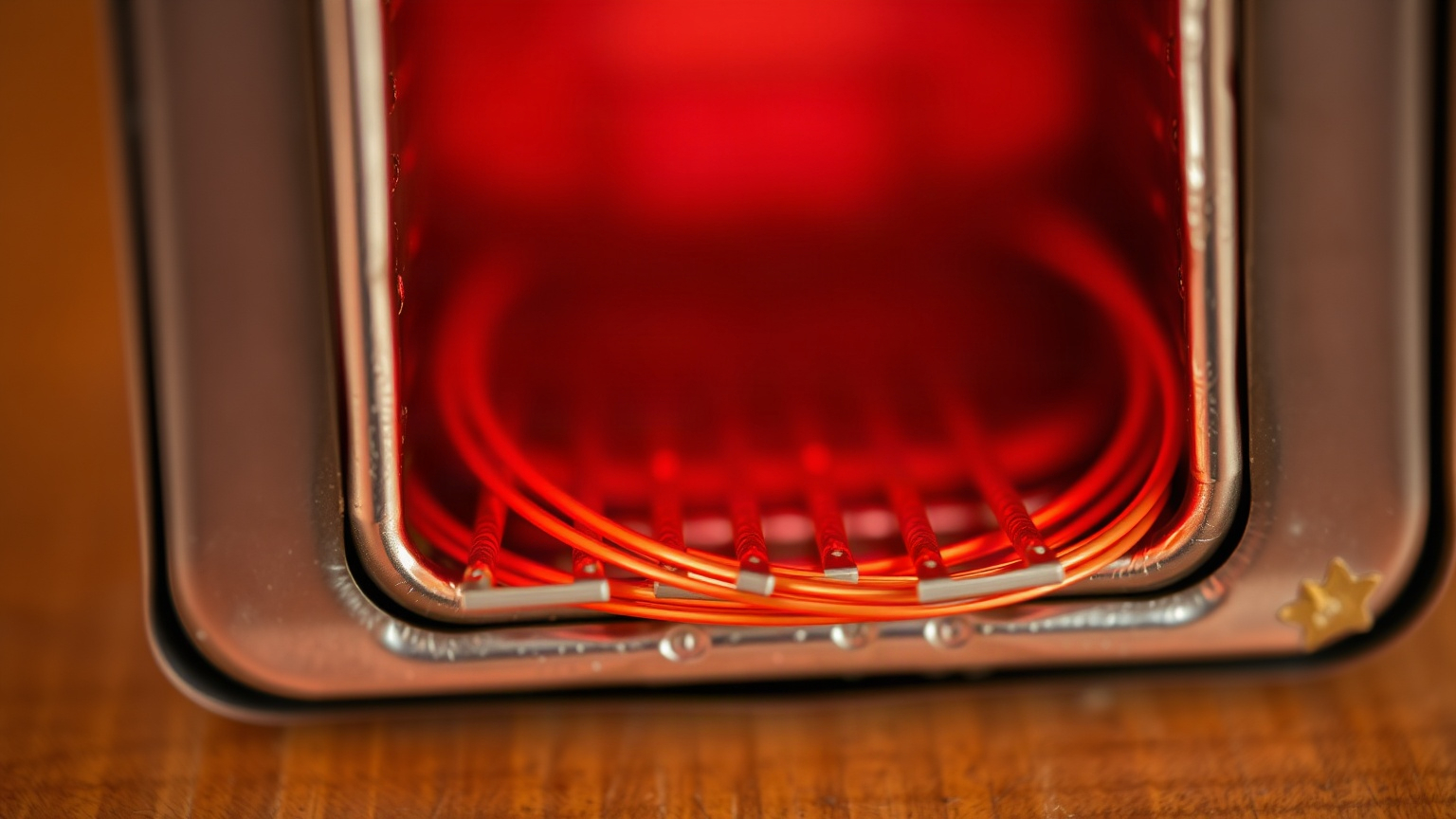
Nichrome. That’s the short answer. It’s an alloy — roughly 80% nickel and 20% chromium — and it’s been the go-to material for resistive heating elements since the early 1900s. The reason it works so well is a combination of properties that are genuinely hard to replicate: it has high electrical resistance (so it converts energy to heat efficiently), it doesn’t oxidize at high temperatures the way iron or copper would, and it’s ductile enough to draw into thin wire without snapping.
When I first cracked open an old two-slice toaster years ago — just out of curiosity, don’t judge me — I expected something complicated. It’s not. You’ll find thin ribbons or coils of nichrome wire wound around a mica panel, which is a heat-resistant mineral sheet. Those panels sit on either side of each bread slot. Some cheaper toasters use nichrome wire alone without the mica backing, which works fine but is a little more fragile.
Higher-end toaster ovens sometimes use quartz tubes instead of bare nichrome wire. The quartz envelope allows the element to get hotter faster and emit a higher proportion of near-infrared radiation. In practice, that means quicker preheating and more even browning. It’s one reason a good quartz toaster oven can out-toast a standard nichrome model at the same wattage.
The Physics: How Resistance Creates Heat
Here’s where it gets satisfying. When you push the lever down on a toaster, you’re completing an electrical circuit. Current flows from the wall outlet through the nichrome wire. But nichrome resists that flow — that’s literally the point — and when electrons push through a resistive material, their kinetic energy converts to thermal energy. This is Joule heating, described by the formula P = I²R, where P is power (watts), I is current, and R is resistance.
What that means practically: a thinner wire with higher resistance generates more heat per inch. Manufacturers tune this by controlling the wire gauge and the total length of wire in the element. A 1,200W toaster running on a 120V circuit draws 10 amps. Push that through nichrome with the right resistance and you get wire that glows orange-red in under three seconds. That’s not an exaggeration — time it yourself.
The heat then travels to your bread primarily through infrared radiation, not convection. This distinction matters. Radiation doesn’t need air movement to transfer energy — it travels straight from the wire to the bread surface at the speed of light, essentially. That’s why toast browns on the outside first and can stay soft inside if you’re not careful about slice thickness or moisture content.
How the Browning Actually Happens
The Maillard Reaction (Not Caramelization)
People mix these two up all the time. Caramelization is what happens to sugar when it heats up — it’s responsible for that amber color in a crème brûlée. The Maillard reaction is different: it’s a chemical interaction between amino acids and reducing sugars, and it’s what gives toast its specific flavor and color. It kicks in around 280°F at the bread surface and accelerates quickly from there.
The infrared radiation from the element dries out the bread’s surface layer almost instantly, dropping the moisture content enough to let the surface temperature climb above 212°F (the boiling point of water). Once that surface moisture is gone, the temperature spikes rapidly toward the Maillard range. That’s the sequence: dry → brown → potentially burn, all within a minute or two. It’s why the difference between “light golden” and “charcoal” is literally 15 seconds.
Why Thicker Bread Behaves Differently
Thicker slices have more internal moisture, which acts as a heat sink. The surface can brown fine while the center stays cool and doughy. I’ve made this mistake with Texas toast — cranked the browning dial to medium, got a nice crust, bit in, and it was basically still soft bread inside. The fix is either a lower setting with a second cycle, or use a toaster oven where you can control the heat more precisely. For anything over about 1 inch thick, I’d honestly just skip the pop-up toaster entirely. You can read more about how hot a toaster gets and why that affects thicker slices.
The Control Mechanism: What the Browning Dial Actually Does
This surprised me when I first learned it. The browning dial on most toasters doesn’t control heat output — the element runs at the same wattage regardless of the dial setting. What it controls is time. Specifically, it adjusts a bimetallic strip or an electronic timer that determines when the toaster pops up.
The bimetallic strip is clever old-school engineering. It’s made of two metals bonded together, each with a different thermal expansion rate. As the toaster heats up, the strip bends because one metal expands faster than the other. When it bends enough, it trips the latch that holds the bread down and releases the spring mechanism — pop. The browning dial adjusts the threshold at which the strip releases. Higher setting = more bend required = more time = darker toast.
Newer toasters sometimes use electronic timers or even sensors instead, which are more consistent across different ambient temperatures. The bimetallic approach actually has a quirk: on a cold morning, your first slice might come out lighter than the second, because the strip starts at room temperature and takes a moment to calibrate. If you’ve ever noticed your toast inconsistency and blamed yourself, it might just be the physics of your toaster.
Heating Element Types: A Comparison
Not all heating elements are created equal. Here’s how the main types stack up:
| Element Type | Material | Heat-Up Speed | Common Use | Typical Wattage Range |
|---|---|---|---|---|
| Nichrome wire coil | 80% Ni, 20% Cr alloy | Fast (2–4 sec glow) | Pop-up toasters, budget toaster ovens | 800W–1,500W |
| Nichrome on mica | Nichrome + mica sheet | Fast | Toaster ovens, wide-slot toasters | 1,000W–1,800W |
| Quartz/halogen tube | Tungsten filament in quartz | Very fast (under 1 sec) | Premium toaster ovens | 1,200W–1,800W |
| Ceramic element | PTC ceramic | Moderate | Some specialty toasters | 600W–1,000W |
If you’re shopping for a toaster oven that actually browns evenly, look at models with quartz elements. They’re a bit pricier but the difference in performance on pastries and bagels is real. A good nichrome replacement element is also worth knowing about if you’re repairing an older unit — they’re cheap and usually available.
The Edge Case Most Articles Miss: What Happens When Elements Age
Nobody talks about this. Nichrome wire doesn’t last forever. Over time — we’re talking years of daily use — the wire develops micro-oxidation and thin spots. The resistance changes unevenly, which means some sections of the element run hotter than others. You’ll notice this as uneven browning: one side of the bread is darker, or you get stripes of toast instead of uniform color.
The other failure mode is deposition. Crumbs and food particles that fall on a hot element don’t just burn off cleanly — sometimes they carbonize and bond to the wire, creating hot spots and occasionally producing smoke or a burning smell even when you’re toasting plain bread. This is usually the sign that it’s time to either clean the crumb tray obsessively or accept that your toaster has lived a good life.
There’s also an interesting edge case with frozen bread. Frozen slices have surface ice crystals that need to vaporize before browning can start, which delays the Maillard reaction and can fool the bimetallic timer — the toaster pops before the bread is properly done. That’s literally why the “frozen” button exists on most modern toasters. It extends the cycle time to compensate. If your toaster doesn’t have one, just run the cycle twice on a low setting rather than cranking the dial and burning the edges. For more on getting the most out of heat-based cooking, the reheating food in a toaster oven guide has some useful crossover advice.
One more thing: altitude. At high elevations, bread loses surface moisture faster because the air is drier and ambient pressure is lower. Toast browns quicker at 6,000 feet than at sea level, even on the same toaster setting. I’ve seen people move to Denver and suddenly find their usual medium setting producing near-charcoal results. Drop the dial by one or two notches and see if that helps.
Wrapping Up
The heating element is genuinely the whole show inside a toaster. It’s deceptively simple: resistive wire that converts electrical energy to radiant heat, aimed directly at your bread, controlled by a timer that most people assume is a temperature dial. Understanding this doesn’t just satisfy curiosity — it actually helps you use the thing better. Know that thicker bread needs two cycles. Know that the first slice on a cold morning might toast lighter. Know that a burning smell from a “clean” toaster usually means it’s not as clean as you think. If you’re in the market for an upgrade, check out our picks for the best mini toaster ovens — some of the quartz-element models will genuinely change how you think about countertop cooking. And if you’re curious about how that radiant heat translates to actual air temperatures, Serious Eats has a good breakdown of the food science behind perfect toast. For the electrical engineering side of heating elements, the infrared thermometer is an underrated kitchen tool — point it at your element when it’s running and you’ll see exactly what 1,100°F looks like. Respect it accordingly.
Frequently Asked Questions
How hot does a toaster get?
The heating element surface itself reaches 1,000°F to 1,200°F (538°C–649°C) during a normal toast cycle. The air inside the bread slot is significantly cooler — around 300°F to 400°F — and the bread surface only needs to hit roughly 280°F to start browning. The exterior of the toaster housing stays much cooler but can still cause burns on contact, especially on the top vents.
Is it safe to leave a toaster plugged in?
Leaving a toaster plugged in when not in use carries a small but real fire risk — especially if the crumb tray is full of debris or if the toaster is near flammable materials. Most toaster fires start from accumulated crumbs igniting. Unplugging when not in use is the safest habit, and emptying the crumb tray weekly reduces the risk significantly.
Why does my toaster smell like burning?
A burning smell usually means food particles or crumbs are sitting on or near the heating element and carbonizing during use. Empty and clean the crumb tray first — that solves it about 80% of the time. If the smell persists with a visibly clean toaster, the element itself may have contamination baked onto the wire, or in rare cases, the insulation around the wiring is degrading, which is a sign to replace the unit.
What is a toaster heating element made of?
Most toaster heating elements are made from nichrome wire, an alloy of approximately 80% nickel and 20% chromium. This material is used because it has high electrical resistance, doesn’t oxidize readily at high temperatures, and maintains its structural integrity through thousands of heat cycles. Some premium toaster ovens use quartz-encased tungsten filaments instead, which heat up faster and emit more infrared energy.
Can a toaster shock you if you stick a fork in it?
Yes — and it can be lethal, not just painful. If the toaster is plugged in, inserting a metal object into the slot can bridge the live electrical circuit through the fork and into your body. Even if the toaster isn’t actively running a toast cycle, the elements remain live as long as the toaster is plugged in. Always unplug before retrieving stuck bread, and use wooden tongs if needed.

Written by
Emma founded Toastera to turn vague appliance advice into clear, researched, safety-first guidance on toasters and toaster ovens.
Free: the Toaster Oven Cheat Sheet
Get the printable cheat sheet (temps, cook times & safety tips) plus new recipes. No spam, unsubscribe anytime.