For a small apartment, you’ll want a toaster oven in the 1,200 to 1,800 watt range. That sweet spot gives you enough power to actually cook food (not just warm it) without tripping a 15-amp circuit that’s already sharing a wall with your mini-fridge and phone chargers. Anything under 1,000 watts tends to be underpowered for real cooking; anything pushing 1,800+ watts starts becoming a concern if your apartment has older wiring or limited dedicated circuits.
Safety First: Toaster ovens draw significant current — a 1,500W unit on a 15-amp, 120V circuit pulls about 12.5 amps, leaving almost no headroom for other appliances on the same circuit. Never run a toaster oven on an extension cord or power strip, keep it at least 4 inches from walls and cabinets, and unplug it when not in use. If your apartment’s breaker trips frequently, talk to your landlord before assuming the toaster oven is the culprit — it may be a wiring issue that’s a fire hazard regardless of what you’re plugging in.
Quick Facts
- The ideal wattage for a small-apartment toaster oven is 1,200–1,500 watts for most people; go up to 1,800W only if you have a dedicated kitchen circuit.
- A 1,500W toaster oven running 30 minutes a day costs roughly $2–$4 per month in electricity at average U.S. rates (around $0.16/kWh).
- Wattage controls how fast an oven preheats and how well it maintains temperature — not just how “powerful” it feels.
- Compact toaster ovens (0.5–0.8 cu ft) typically run 1,200–1,500W. Mid-size units (1.0–1.5 cu ft) usually pull 1,500–1,800W.
- Air fryer toaster oven combos almost always require 1,700–1,800W minimum to actually air-fry properly — that’s worth factoring in before you buy.
Why Wattage Matters More Than You’d Think
I’ll be honest — when I first bought a toaster oven for my studio apartment, I picked it almost entirely based on how it looked on the counter. Big mistake. I ended up with a 900W unit that took nearly 15 minutes to preheat to 375°F and couldn’t hold that temperature consistently when I actually put food in it. The heating elements were essentially underpowered for the cavity size.
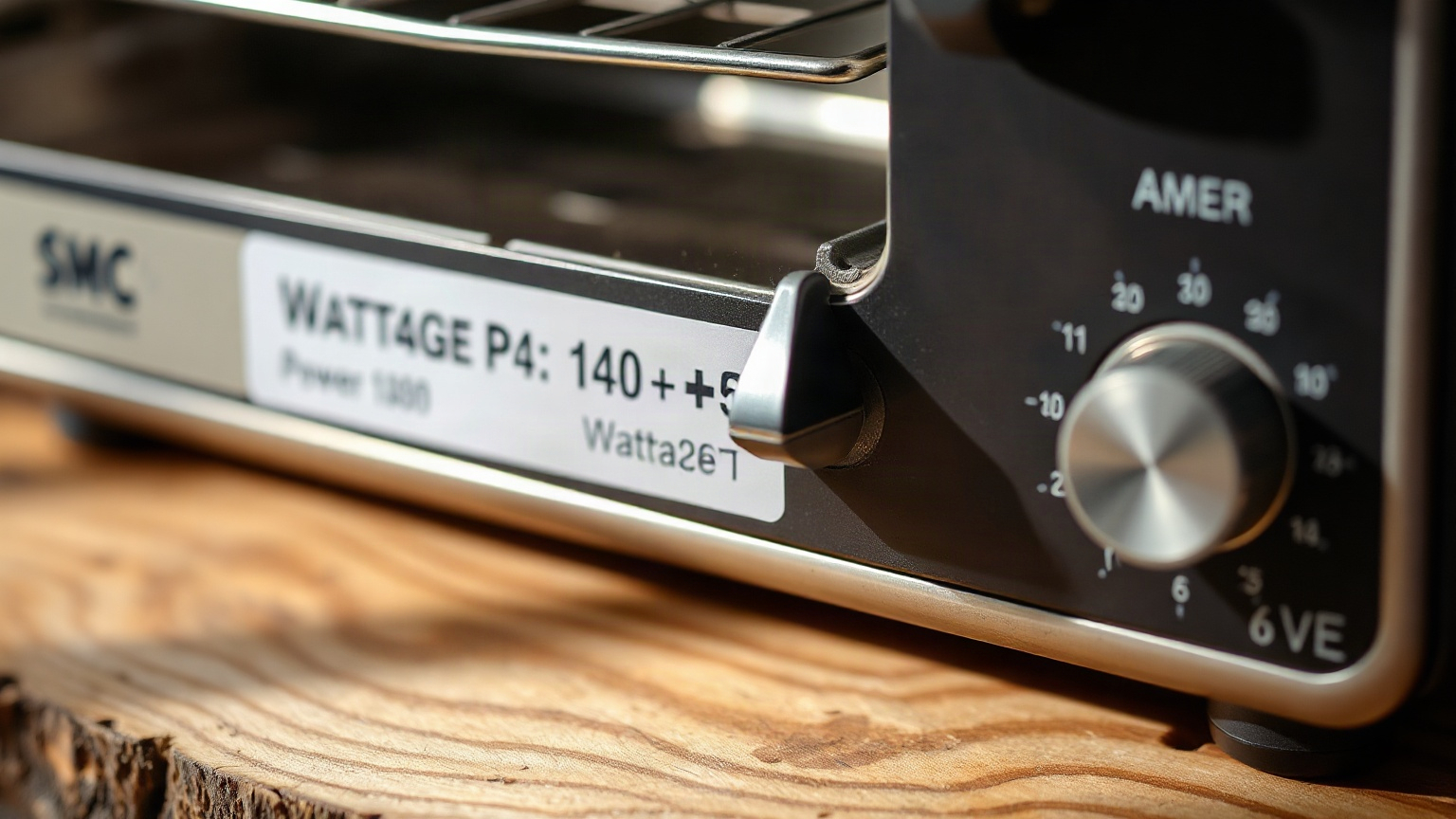
Wattage is basically the rate at which your toaster oven converts electricity into heat. Higher wattage means faster preheat times, better temperature recovery when you open the door, and more consistent cooking overall. It’s not just about raw power. It’s about whether your appliance can actually do the job without compensating by running longer (which ironically can cost you more in electricity, not less).
Low-wattage ovens also tend to have hot and cold spots that are more pronounced, because the heating elements cycle on and off more aggressively trying to maintain temperature. That’s how you end up with toast that’s burned on one edge and pale on the other.
The Wattage-to-Size Relationship: What the Numbers Actually Mean
There’s a loose rule of thumb that works pretty well: you want roughly 1,500 watts per cubic foot of oven capacity. So a compact 0.8 cubic foot toaster oven at 1,200W is actually pretty efficient. A larger 1.5 cubic foot unit at the same 1,200W is going to struggle.
Compact Ovens (Under 0.8 cu ft)
These are your true apartment workhorses. Models in this range typically pull 1,100–1,500 watts and handle toast, bagels, reheating leftovers, and small baking jobs without drama. The Cuisinart compact toaster oven line and Hamilton Beach’s budget-friendly options both live here. Perfectly reasonable for one or two people.
Mid-Size Ovens (0.8–1.2 cu ft)
This is where most people land, and honestly where I’d land too. You can fit a 9×13 pan, do a small roast chicken, or bake a batch of cookies. These units need 1,500–1,800 watts to perform well. Below that, the preheat time climbs fast and you’ll notice uneven browning on baked goods.
Air Fryer Combo Ovens (Usually 1,700–1,800W)
If you want the air fry function to actually work — crispy fries, properly crisped chicken skin — you need the wattage to run the convection fan hard enough to matter. The Breville Smart Oven Air Fryer and Ninja Foodi both sit around 1,800W. That’s worth checking against your apartment’s circuit capacity before you buy. I’ll cover that below.
Wattage Comparison: Popular Apartment-Friendly Models
Here’s a table comparing some of the most commonly recommended toaster ovens for small spaces, so you can see at a glance how wattage lines up with size and price tier.
| Model | Wattage | Capacity | Air Fry? | Price Tier | Best For |
|---|---|---|---|---|---|
| Hamilton Beach 31127D | 1,200W | 0.5 cu ft | No | Budget | Solo users, toast + reheat only |
| Cuisinart TOB-40N | 1,500W | 0.6 cu ft | No | Mid-range | Compact kitchens, occasional baking |
| Breville BOV450XL | 1,800W | 0.45 cu ft | No | Premium | Users who want precision in a small footprint |
| Ninja Foodi SP101 | 1,800W | 0.6 cu ft | Yes | Mid-range | Air frying in limited space |
| Breville Smart Oven Air Fryer | 1,800W | 1.0 cu ft | Yes | Premium | Serious cooks, larger apartments |
| BLACK+DECKER TO3250XSB | 1,500W | 1.2 cu ft | No | Budget | Budget-conscious, counter space to spare |
My honest verdict: for a studio or one-bedroom apartment where you’re cooking real food (not just reheating pizza), the Cuisinart TOB-40N or Ninja Foodi SP101 hits the best balance. The Breville units are genuinely excellent, but you’re paying for precision that most people won’t fully use. The Hamilton Beach 31127D is fine if all you do is toast and occasionally warm up leftovers. Don’t overspend on features you won’t touch.
Can Your Apartment’s Wiring Handle It?
This is the edge case almost no buying guide bothers to address. Most apartments in the U.S. have kitchen outlets on a 15-amp or 20-amp circuit running at 120 volts. The math is simple: a 15-amp circuit maxes out at 1,800 watts total (15A × 120V = 1,800W). The general rule is to never load a circuit above 80% of its rating continuously — so realistically, your safe limit on a 15-amp circuit is about 1,440 watts.
That means a 1,800W toaster oven, running alone, is already right at the edge of a 15-amp circuit. Add a coffee maker (900–1,200W) on the same circuit and you will trip the breaker. Possibly every morning.
What I’d actually do: plug a lamp or phone charger into the outlet you plan to use, then check your breaker panel to see which breaker controls it. If that same breaker also controls the microwave or the refrigerator, you’re sharing a circuit with high-draw appliances. In that case, stay at or under 1,500W for your toaster oven. If you have a 20-amp kitchen circuit (look for outlets with a small T-shaped slot), you have more headroom — up to about 1,920W continuously.
Older apartment buildings — anything pre-1980s — sometimes have kitchen circuits that aren’t even dedicated. If you’re regularly tripping breakers, that’s worth raising with your landlord as a maintenance issue, not just an inconvenience.
What Does It Actually Cost to Run?
Running a toaster oven is cheap. Really cheap compared to a full-size oven. Here’s the actual math if you’re curious.
A 1,500W toaster oven used for 30 minutes consumes 0.75 kWh. At the U.S. average electricity rate of roughly $0.16 per kWh (as of recent EIA data), that’s about $0.12 per session. Use it once a day for a month and you’re looking at around $3.60. A full-size oven pulling 3,000–5,000 watts doing the same job costs two to four times more for the same 30-minute cook time. The U.S. Energy Information Administration tracks average state-by-state rates, so if you’re in California or Hawaii (where rates run much higher), that math shifts — but the toaster oven still wins against a full oven.
One thing worth flagging: wattage on the label is the maximum draw. When an oven is preheated and just maintaining temperature, it cycles on and off, drawing significantly less. So your real-world cost is usually lower than the worst-case calculation.
Getting the Most Out of Whatever Wattage You Have
A few things I’ve learned from actually cooking in toaster ovens regularly — not from reading spec sheets.
First, always preheat. Even the lower-wattage units benefit from a 5-minute preheat. Skipping this is probably the single most common reason food comes out unevenly cooked. It’s not glamorous advice, but it works.
Second, use the right rack position. Most toaster ovens come with a wire rack and a crumb tray, and that’s about it. If you’re doing anything other than toast, putting the rack in the middle position almost always gives better results than the top or bottom. The heating elements in lower-wattage ovens are more aggressive, and you’ll scorch the bottom of things if the rack is too low.
Third, dark pans absorb more heat. If your toaster oven runs hot (which many budget units do), switch to a lighter-colored toaster oven baking pan for cookies and pastries. It makes a noticeable difference, especially in smaller cavities where the walls are close to the food.
And honestly, check out our guide to reheating food in a toaster oven — wattage affects reheat times significantly more than most people realize. What works in a 1,800W unit will leave food cold in a 1,000W one if you use the same time and temperature.
If you haven’t settled on a model yet, our list of best mini toaster ovens covers the compact options in more detail, with real-world notes on how they perform. And if you’re curious about how toaster oven temps compare to a standard slot toaster, we’ve got that covered in our piece on how hot a toaster gets.
The Bottom Line
For a small apartment, 1,200–1,500 watts covers most people’s needs. It’s enough to toast, bake, roast, and reheat without overwhelming your circuits. If you want to air-fry, budget for 1,800W and check that your outlet can handle it alone. Don’t obsess over squeezing into the lowest wattage possible — an underpowered oven is genuinely annoying to cook with, and that frustration will outlast whatever you saved at checkout.
The Ninja Foodi SP101 at 1,800W is my current pick for anyone who wants one appliance to do it all in a tight space. For pure simplicity without the air fry function, the Cuisinart TOB-40N at 1,500W is hard to argue with. Both fit on a standard apartment counter without monopolizing it.
Frequently Asked Questions
How many watts does a toaster oven use per hour?
A typical toaster oven uses between 1,200 and 1,800 watts, so running it for one full hour consumes 1.2 to 1.8 kWh of electricity. At the U.S. average rate of around $0.16/kWh, that’s roughly $0.19–$0.29 per hour. Most cooking sessions run 15–30 minutes, so your real cost per use is usually well under $0.15.
Can I run a toaster oven in an apartment with old wiring?
Yes, but stick to 1,200–1,500W models and make sure the toaster oven is the only high-draw appliance on that circuit when it’s running. Older wiring wasn’t designed for the density of modern appliances, and repeatedly tripping a breaker or running a circuit at capacity creates a fire risk over time. If your breakers trip often, it’s worth getting an electrician to assess the wiring before adding more load.
Is a 1,000-watt toaster oven enough for cooking real meals?
It’s enough for toast, reheating, and simple tasks, but it’ll struggle with actual cooking. At 1,000W, preheat times are long, temperature recovery after opening the door is slow, and you’ll see more uneven browning. If real cooking is the goal — roasting vegetables, baking, chicken thighs — spend a little more for 1,500W. The difference in performance is noticeable.
Does a higher-watt toaster oven cost more to run?
Marginally, yes — but the difference is small enough that it usually doesn’t matter. A 1,800W unit used for 20 minutes costs about $0.096, while a 1,200W unit for the same time costs about $0.064. That’s a difference of about $0.03 per use. The higher-wattage unit also cooks faster, so the actual run time is often shorter, which partially offsets the gap.
What size toaster oven is best for a small apartment?
For one to two people, a compact unit in the 0.5–0.8 cubic foot range hits the right balance between capability and counter space. These fit under most overhead cabinets, handle a 9-inch pizza or a half-sheet of toast, and don’t require more than 1,500W to run well. If you’re cooking for three or more people regularly, consider a mid-size 1.0–1.2 cubic foot model even if counter space is tight — the cooking headroom is worth it.

Written by
Emma founded Toastera to turn vague appliance advice into clear, researched, safety-first guidance on toasters and toaster ovens.
Free: the Toaster Oven Cheat Sheet
Get the printable cheat sheet (temps, cook times & safety tips) plus new recipes. No spam, unsubscribe anytime.