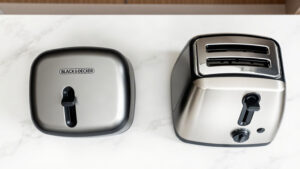
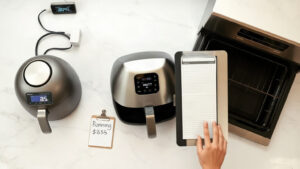
A standard toaster uses roughly 1,000 to 1,500 watts while running, but since toasting a single slice takes only about 1.5 to 3 minutes, the actual energy consumed per slice works out to somewhere between 0.025 and 0.075 kWh. At the U.S. average electricity rate of around $0.16 per kWh, that’s less than a penny per slice — about $0.004 to $0.012. Over a year of daily toasting, the cost is still surprisingly small, though the exact number shifts depending on your wattage and how dark you like your toast.
Safety First: Never leave a running toaster unattended, and unplug it before cleaning or clearing a jam. Crumb trays that aren’t emptied regularly are a genuine fire hazard — crumbs can smolder or ignite near the heating elements. If your toaster trips a breaker or you notice burning smells that aren’t from bread, stop using it and have it checked. Don’t plug a toaster into an extension cord if you can help it; they draw enough current that a cheap cord can overheat.
Quick Facts: Toaster Electricity Use at a Glance
- Most 2-slice toasters draw between 1,000 and 1,500 watts (4-slice models can hit 1,800W)
- A typical toast cycle runs 1.5–3 minutes, so energy per slice is around 0.025–0.075 kWh
- Cost per slice: roughly $0.004 to $0.012 at $0.16/kWh — yes, less than a cent
- Annual cost for one slice every morning: approximately $1.50 to $4.40
- Standby draw is negligible for most toasters (they have no electronics when off), but smart toasters with displays can pull 1–3 watts continuously
What Actually Determines How Much Electricity Your Toaster Uses
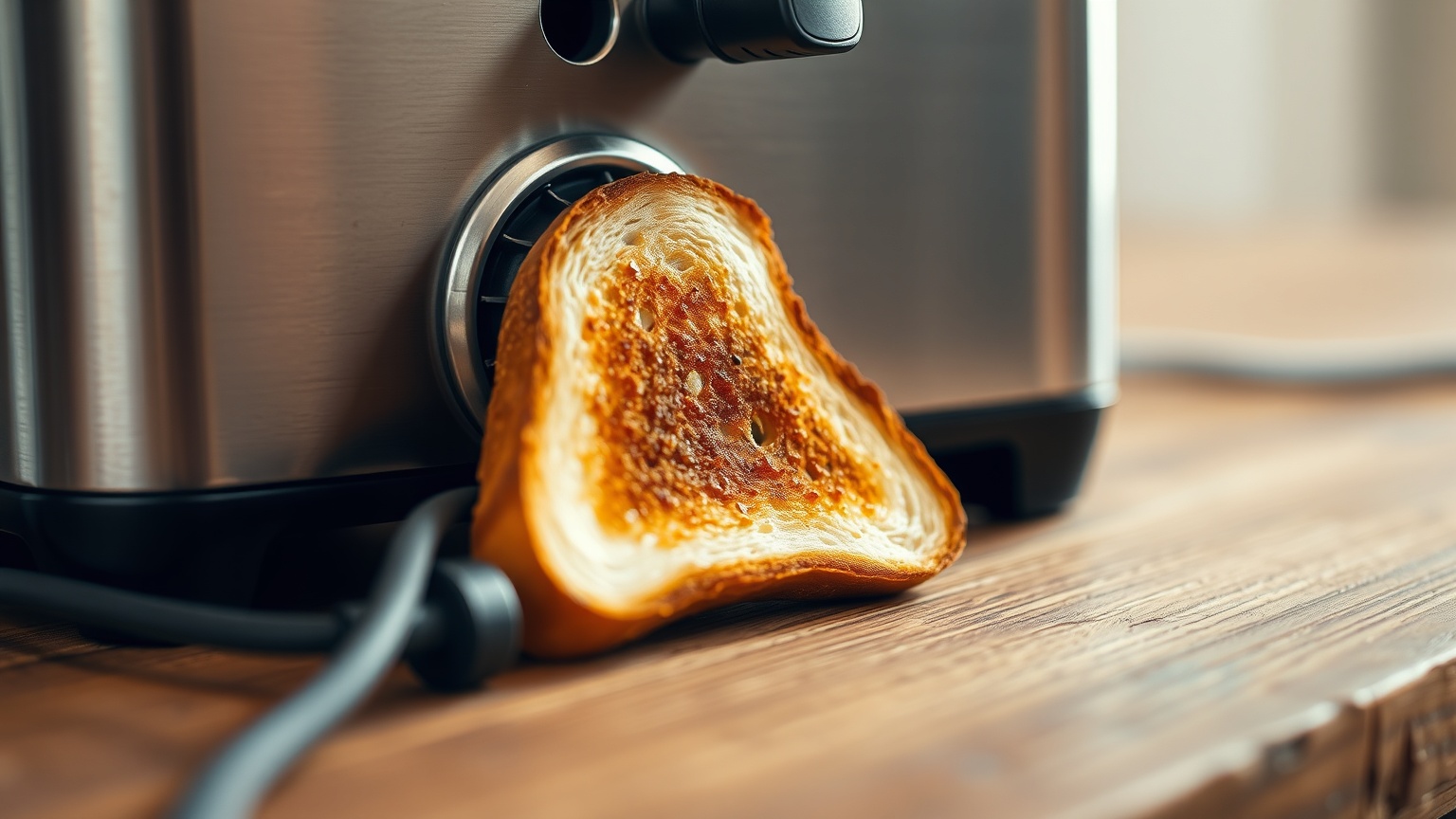
Wattage is the obvious factor, but it’s not the only one. The real-world energy consumption comes down to three things: how many watts your toaster draws, how long each cycle runs, and whether you’re toasting one slice or two. A toaster rated at 1,200 watts running for two minutes uses exactly 40 watt-hours — or 0.04 kWh. That’s the math. But in practice, a lot of people set their toasters darker than they need to, which stretches the cycle by another 30–60 seconds and bumps energy use noticeably.
The first time I actually measured this, I was surprised by the variance. I ran my Cuisinart 2-slice on setting 3 (my usual) and it finished in about 1 minute 45 seconds. Pushed to setting 6, the same cycle took closer to 3 minutes 20 seconds. Nearly double the time, nearly double the energy. Toast setting matters more than most people think.
Wattage by Toaster Type
Not all toasters are equal. Here’s a breakdown of typical wattages so you have actual numbers to work with:
| Toaster Type | Typical Wattage | Avg. Cycle Time (medium toast) | Energy Per Slice (kWh) | Cost Per Slice ($0.16/kWh) |
|---|---|---|---|---|
| Budget 2-slice | 800–1,000W | 2–2.5 min | 0.027–0.042 kWh | $0.004–$0.007 |
| Standard 2-slice | 1,000–1,200W | 1.5–2.5 min | 0.025–0.050 kWh | $0.004–$0.008 |
| Premium 2-slice | 1,200–1,500W | 1.5–2 min | 0.030–0.050 kWh | $0.005–$0.008 |
| 4-slice toaster | 1,400–1,800W | 2–3 min | 0.047–0.090 kWh (total) | $0.007–$0.014 |
| Long-slot toaster | 1,500–2,000W | 2–3 min | 0.050–0.100 kWh | $0.008–$0.016 |
Worth knowing: higher wattage doesn’t always mean worse efficiency. A 1,500W toaster that finishes in 90 seconds uses less energy than an 800W model that takes three minutes to achieve the same level of browning. Faster heat-up, faster done. This is actually why I’ve come to mildly prefer higher-wattage toasters — they’re quicker on a busy morning and the total energy draw isn’t meaningfully higher. For a look at what’s happening inside that machine temperature-wise, check out how hot a toaster gets — the internal temps are higher than most people expect.
How to Calculate Your Exact Cost Per Slice
The formula is genuinely simple. You need three numbers: your toaster’s wattage (it’s on the bottom label), your typical toast time in minutes, and your electricity rate (check your utility bill — it varies wildly by state, from around $0.10/kWh in Louisiana to over $0.25/kWh in California and Hawaii).
Here’s the calculation:
- Step 1: Watts ÷ 1,000 = kilowatts (kW)
- Step 2: kW × (minutes ÷ 60) = kWh used per cycle
- Step 3: kWh × your electricity rate = cost per cycle
Example: 1,200W toaster, 2-minute cycle, $0.16/kWh rate.
1,200 ÷ 1,000 = 1.2 kW
1.2 × (2 ÷ 60) = 0.04 kWh
0.04 × $0.16 = $0.0064 per cycle
If you’re toasting two slices at once (which you should be, honestly — same energy, double the output), the per-slice cost halves to about $0.003. That’s about as cheap as cooking gets.
What It Adds Up To Annually
One slice of toast every morning for a year: 365 cycles × $0.0064 = roughly $2.34. Even at California’s high rate of $0.28/kWh, that’s only about $4.09 per year. A household making two slices every day spends maybe $3–$8 annually running their toaster. It’s basically nothing. The only reason to even bother calculating it is if you’re doing whole-house energy audits, or just curious (like me, apparently).
Toaster vs. Toaster Oven: The Energy Comparison That Actually Matters
This is the question worth asking. If you’ve got both a pop-up toaster and a toaster oven on your counter, which should you use for toast? The pop-up wins on efficiency every single time. A toaster oven uses 1,200 to 1,800 watts and typically needs 4–8 minutes to toast bread because it has to heat a larger cavity — that works out to 0.08–0.24 kWh per batch. Two to four times more energy for the same output.
The toaster oven makes more sense when you’re cooking something that requires it — reheating leftovers, melting cheese, making a small batch of anything that needs top-down heat. For those uses, it’s far more efficient than firing up a full oven. More on that in our guide to reheating food in a toaster oven. But for plain toast? Use the pop-up. It does one thing extremely well.
One edge case worth mentioning: if you live somewhere very cold and your kitchen hovers below 60°F in winter, a toaster oven actually takes noticeably longer to preheat, pushing its energy cost even higher. The pop-up toaster is unaffected by ambient temperature because it works through radiant heat directly on the bread surface. Small thing, but it matters in a drafty kitchen.
Does Leaving a Toaster Plugged In Waste Electricity?
For a basic pop-up toaster — no display, no digital timer, no smart features — the answer is essentially no. There’s no standby circuit drawing power. When it’s off, it’s off. I’ve tested this with a kill-a-watt meter and a standard Breville toaster showed 0.0 watts while plugged in and idle.
But smart toasters with LED displays or app connectivity are a different story. Some of them pull 1–4 watts continuously, which adds up to about 9–35 kWh per year — potentially costing more to sit idle than to actually toast. If you have one of those, it’s genuinely worth unplugging between uses, or putting it on a smart plug that you can schedule. For a look at what standby power consumption actually looks like across kitchen appliances, the data from energy efficiency organizations shows that small constant draws add up faster than most people realize.
That said, there’s a separate practical reason to unplug: safety. If a crumb tray is full and there’s a power surge, you’d rather the thing not be connected. I unplug mine when I’m away for more than a day. Call it habit.
Tips for Keeping Your Toaster’s Energy Use Low
Most of these are common sense, but a couple of them genuinely made a difference when I started paying closer attention.
- Always toast two slices at once. It costs the same energy as toasting one, so the per-slice cost drops in half immediately.
- Use a lower browning setting. Going from setting 6 to setting 3 on most toasters cuts cycle time nearly in half. If your toast is burning, you’re wasting energy.
- Keep your crumb tray clean. Built-up crumbs insulate the bottom of the toaster and can affect how evenly it heats, sometimes leading to longer cycles or uneven toast that you re-run. Clean it weekly if you’re toasting daily.
- Don’t use a toaster oven for plain toast unless you’re already using it for something else. The energy math just doesn’t work out.
- Consider a high-wattage model if you’re replacing yours. Counterintuitively, a high-wattage 2-slice toaster often uses less total energy per cycle than a low-wattage one because it completes the cycle faster.
If you’re in the market for a new machine and efficiency matters to you, our roundup of the best mini toaster ovens covers models that handle both toasting and small cooking jobs without the energy footprint of a full-size toaster oven. Some of them are surprisingly efficient. And if you want to measure your own toaster’s real draw — not the spec sheet number — a Kill-A-Watt electricity monitor runs about $25 and is one of the more satisfying kitchen purchases I’ve made. You’ll end up measuring everything.
The Bottom Line on Toaster Electricity Costs
A toaster is one of the cheapest appliances to run in your kitchen. Less than a penny per slice, maybe $2–8 per year for daily use. If you were hoping to find big savings by optimizing your toaster habits, I’m sorry to disappoint — the gains are real but tiny. The better question, if you care about kitchen energy use, is whether you’re using a full-size oven when a toaster oven would do, or running a toaster oven for plain toast when a pop-up would be faster and cheaper.
The U.S. Energy Information Administration tracks residential energy use by appliance category, and small kitchen appliances as a group are genuinely minor contributors to household energy bills. Worth knowing, not worth losing sleep over. Toast your bread, don’t burn the crumbs, and move on with your morning.
Frequently Asked Questions
How many watts does a toaster use?
Most standard 2-slice toasters draw between 1,000 and 1,500 watts while running. Budget models can be as low as 800W, while 4-slice toasters often reach 1,800W. The wattage rating is printed on the label on the bottom of the unit. Keep in mind that wattage is the rate of draw, not the total energy used — a 1,500W toaster finishing in 90 seconds uses less total electricity than an 800W model taking 4 minutes.
How much does it cost to run a toaster per year?
For one person toasting two slices every morning, the annual electricity cost is roughly $3 to $8 depending on your toaster’s wattage and your local electricity rate. At the U.S. national average of about $0.16/kWh, a standard 1,200W toaster used daily costs around $4 per year. Even in high-rate states like California or Hawaii, you’re unlikely to exceed $10 annually.
Is it cheaper to use a toaster or a toaster oven for toast?
A pop-up toaster is significantly cheaper for making plain toast — typically 2 to 4 times more energy-efficient than a toaster oven for that specific task. Toaster ovens have a larger cavity to heat and take longer to brown bread, using roughly 0.08–0.24 kWh per batch versus 0.025–0.075 kWh for a pop-up. Use the toaster oven when you need its additional capabilities; stick to the pop-up for everyday toast.
Does leaving a toaster plugged in use electricity?
A basic pop-up toaster with no digital display draws essentially zero watts when plugged in but not running — there’s no standby circuit to power. Smart toasters with LED displays or Wi-Fi connectivity are the exception; those can draw 1–4 watts continuously, adding a small but real ongoing cost. For standard toasters, the main reason to unplug is safety, not energy savings.
How much electricity does a toaster use per slice?
A single slice of toast typically uses between 0.025 and 0.075 kWh of electricity, depending on toaster wattage and cycle time. At a rate of $0.16/kWh, that works out to roughly $0.004 to $0.012 per slice — well under a cent. Toasting two slices simultaneously halves the per-slice cost since the energy draw is the same as toasting one.

Written by
Emma founded Toastera to turn vague appliance advice into clear, researched, safety-first guidance on toasters and toaster ovens.
Free: the Toaster Oven Cheat Sheet
Get the printable cheat sheet (temps, cook times & safety tips) plus new recipes. No spam, unsubscribe anytime.