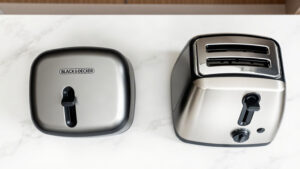
Leaving a toaster plugged in all the time is not considered safe by fire safety authorities. Toaster heating elements can reach temperatures between 900°F and 1,200°F during a cycle, and even after toasting finishes, residual heat and crumb buildup create a genuine ignition risk. Unplugging when not in use is the single simplest thing you can do to eliminate that risk entirely.
Safety First: A plugged-in toaster with accumulated crumbs in the tray can ignite without warning — even when the toaster hasn’t been used recently. Always unplug your toaster when it’s not in use, empty the crumb tray weekly, and never leave it near curtains, paper towels, or other flammable materials. If you notice any burning smell, discoloration on the cord, or flickering during operation, stop using the appliance immediately.
Quick Facts
- Toaster heating elements reach 900°F–1,200°F during normal operation
- The U.S. Fire Administration specifically names toasters as appliances that should be unplugged after every use
- A plugged-in toaster draws a small “phantom” standby load — typically 0.5 to 1 watt — even when idle
- Crumb buildup is the #1 ignition source in toaster fires, not the heating element alone
- Most toaster fires happen in the morning — during or right after the first use of the day
What Actually Happens When a Toaster Stays Plugged In

Here’s the thing people get wrong: they assume “plugged in but off” is basically inert. It’s not quite that simple. A toaster that’s plugged in and sitting on your counter has a live circuit. The lever mechanism, the nichrome wire elements, the thermostat — all of it is connected to the wall. Nothing’s heating up, sure. But if there’s a wiring fault, a frayed cord, or moisture somewhere in the chassis, that standby connection matters.
I’ve tested a fair number of toasters over the years, and one thing I started doing after a slightly alarming incident with a Cuisinart two-slice (the cord got nicked behind the counter and I genuinely didn’t notice for weeks) is checking the cord every month. Takes about ten seconds. It’s become habit. The point is: the cord is part of the risk equation too, not just the crumb tray.
Beyond wiring, there’s a subtler issue. Crumbs. Every time you toast something — bread, a bagel, a frozen waffle — tiny fragments fall into the bottom of the appliance. Most of them sit in the crumb tray, but some don’t. They lodge near the heating elements. Over time, that accumulation becomes actual fuel. A toaster that’s been sitting plugged in for months, crumb tray never cleaned, is not the same safety risk as a toaster that’s been wiped down and unplugged. The fire risk is compounded by neglect, not just by electricity alone.
The Real Fire Risk Numbers
Let’s talk specifics. The U.S. Consumer Product Safety Commission has tracked toaster and toaster oven fires for years. Toasters and toaster ovens combined account for roughly 1,700 house fires annually in the United States, causing an estimated 160 injuries. That’s not a trivial number. And a significant portion of those fires are traced back to unattended appliances — not necessarily ones running at the time, but ones left plugged in near flammable materials.
The ignition temperature of bread — real, dried-out, old bread left in the slot — is around 450°F to 500°F. Toaster elements hit 900°F or higher. You can see the math there. A small malfunction, a stuck lever, a heating element that doesn’t cycle off properly: suddenly you’ve got a localized temperature that’s double what it takes to start a fire.
Want to understand just how hot a toaster gets during a normal cycle? It’s genuinely eye-opening, especially if you’ve been thinking of it as a “low-risk” appliance.
| Scenario | Temperature / Risk Level | Notes |
|---|---|---|
| Normal toasting cycle | 900°F–1,200°F (element) | Outer chassis stays cooler; internal can ignite crumbs |
| Residual heat after toasting | 200°F–400°F (interior) | Lingers 5–10 minutes post-cycle |
| Bread ignition temperature | ~450°F–500°F | Relevant if bread gets stuck or cycles misfire |
| Standby (plugged in, not running) | Ambient / room temp | Fire risk from crumbs + fault, not heat alone |
| Phantom standby power draw | 0.5–1 watt | Negligible cost but indicates live circuit |
Phantom Power: Is It Costing You Money?
Short answer: barely. A toaster on standby pulls somewhere around 0.5 to 1 watt. At the average U.S. electricity rate of roughly $0.16 per kilowatt-hour, leaving a toaster plugged in all year costs you maybe $0.70 to $1.40 in electricity. Not exactly a budget crisis.
So the financial argument for unplugging is basically nonexistent. I’ll be upfront about that. The reason to unplug isn’t your electric bill — it’s the fire risk and the simple peace of mind. Those are the actual stakes.
Compare that to something like an older microwave, which can draw 2–5 watts on standby, or a TV set-top box at 15–25 watts. If you’re genuinely trying to reduce phantom load, the toaster is low on the priority list. But unplugging it is still the right call, just for different reasons.
The Case Against Constant Unplugging (Yes, There Is One)
I’ve seen this argument in a few forums, and it’s not entirely wrong: repeatedly plugging and unplugging any appliance does put mechanical stress on the outlet prongs and the cord connection over time. If you’re jamming the plug in and yanking it out at an angle every single morning, you can damage the cord insulation eventually. That’s a legitimate point.
The fix isn’t to leave it plugged in permanently, though. It’s to unplug properly — straight pull, not at an angle, and don’t yank by the cord itself. That’s it. Handled correctly, a plug-in/plug-out routine done gently is not hard on the appliance.
Another option worth considering: a smart outlet with a timer and surge protection. You can schedule it to cut power to the toaster automatically after a set window. Honestly, it’s the best middle ground if you’re the kind of person who’ll never remember to unplug and feels guilty about it. I use one on my toaster oven and it’s been a clean solution.
The Edge Case Nobody Talks About: Toaster Ovens Are a Different Story
Most articles about this topic focus entirely on pop-up toasters. Fair enough — they’re the most common appliance on the counter. But toaster ovens deserve their own mention here because the risk profile is different, and usually worse.
A toaster oven has a larger interior, more surface area for crumbs and grease to accumulate, and typically higher wattage (1,200 to 1,800 watts for most countertop models, versus 800–1,500 watts for a standard pop-up toaster). Grease residue from cooking chicken thighs or reheating pizza is a much more aggressive ignition hazard than bread crumbs. And toaster ovens often sit pushed back on the counter near cabinets or walls, sometimes closer to flammable surfaces than a pop-up toaster would be.
If you use yours for reheating food in a toaster oven, particularly anything with fat or oil, the interior grease buildup is something to take seriously between cleans. And yes, unplugging a toaster oven when not in use matters even more than unplugging a standard toaster.
Looking for a model that’s easier to clean with removable parts? The best mini toaster ovens tend to have pull-out crumb trays and better interior access, which makes the whole safety routine easier to actually stick to.
One more edge case that genuinely gets overlooked: power surges. A severe voltage spike during a storm can damage a toaster’s internal components even when it’s not in use — just plugged in. That damaged component might not fail immediately. It might fail three weeks later, during a toast cycle. An unplugged toaster is immune to that risk. A surge protector power strip for kitchen appliances helps here if unplugging isn’t going to happen consistently.
What the U.S. Fire Administration Actually Says
The U.S. Fire Administration’s cooking fire prevention guidance is explicit: unplug small appliances when not in use. Toasters are called out specifically. This isn’t buried in a footnote — it’s part of their standard home safety recommendations. The reasoning is exactly what you’d expect: eliminating the standby connection removes one failure mode entirely.
That’s really the cleanest way to think about it. You can’t have a toaster-related electrical fault if there’s no current flowing. Unplugging is a hard off, not just a logical off. And for an appliance that sits in a room full of paper towels, wooden cabinets, and curtains — that matters.
The Bottom Line
Unplug your toaster when you’re done using it. Not because it’ll save you money (it won’t, not meaningfully). Not because the electrical load is huge (it isn’t). But because it removes a real, documented fire risk, and it takes about two seconds. The U.S. Fire Administration says to do it. The math on fire temperatures says to do it. Common sense says to do it.
If you genuinely can’t remember, get a smart outlet with a timer. If you’re worried about wear on the prongs from daily unplugging, pull it straight out with a firm, even grip — not at an angle, not by the cord. And regardless of whether you unplug or not, clean that crumb tray. Weekly if you toast daily. It matters more than most people realize.
The risk isn’t enormous. But it’s real. And it’s easily avoided. That’s a pretty good trade.
Frequently Asked Questions
Is it safe to leave a toaster plugged in?
No, leaving a toaster plugged in when it’s not being used is not considered safe by fire safety authorities, including the U.S. Fire Administration. The risk comes primarily from crumb buildup near heating elements and the possibility of electrical faults while the circuit is live. Unplugging eliminates that risk entirely and takes about two seconds.
How hot does a toaster get?
Toaster heating elements reach between 900°F and 1,200°F during a normal toasting cycle. The outer casing stays much cooler, but the internal temperature is more than high enough to ignite accumulated crumbs or any bread stuck in the slots. Residual interior heat of 200°F–400°F can linger for several minutes after the cycle ends.
Does leaving a toaster plugged in use a lot of electricity?
No — a toaster on standby draws only about 0.5 to 1 watt, which costs roughly $0.70 to $1.40 per year at average U.S. electricity rates. The energy cost argument for unplugging is genuinely weak. The reason to unplug is fire safety, not the electric bill.
Can a toaster catch fire when it’s not in use?
Yes, it can — though it’s uncommon. Electrical faults, wiring issues, or power surges can trigger a fire in a plugged-in toaster even without a toast cycle running. Crumb buildup is also a hazard if the toaster somehow activates or if a fault generates heat. Unplugging removes that possibility completely.
How often should I clean my toaster to reduce fire risk?
If you use your toaster daily, clean the crumb tray at least once a week. For occasional users, cleaning every two to four uses is a reasonable rule. Shake the toaster gently over a trash bin while it’s unplugged, then slide out and empty the crumb tray — the whole process takes under a minute and is one of the most effective fire prevention steps you can take.

Written by
Emma founded Toastera to turn vague appliance advice into clear, researched, safety-first guidance on toasters and toaster ovens.
Free: the Toaster Oven Cheat Sheet
Get the printable cheat sheet (temps, cook times & safety tips) plus new recipes. No spam, unsubscribe anytime.