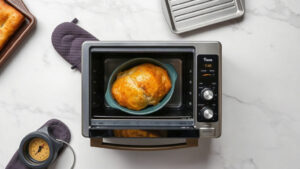
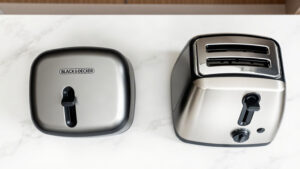
For a small household, a compact toaster oven (under 0.5 cubic feet) handles most daily tasks just fine — toast, reheating, small bakes — but a mid-size model in the 0.5–0.8 cubic foot range is genuinely worth the extra counter space if you cook real meals more than a few times a week. The math changes fast once you start fitting a 9-inch baking dish or a whole chicken breast in there. If you’re a true one-mug-of-coffee, bowl-of-cereal person, a compact unit will never feel limiting.
Safety First: Toaster ovens run heating elements at temperatures up to 450–500°F and pull significant wattage (1,200–1,800W depending on size). Always leave at least 4 inches of clearance on all sides, never place a large-capacity unit under a low cabinet, and keep flammable materials away from the exterior vents. If your countertop outlet is on a shared circuit with other high-draw appliances, plug the toaster oven in alone — running it alongside a microwave or coffee maker on the same circuit is a real fire risk.
Quick Facts: Compact vs. Large Toaster Oven
- Compact toaster ovens (2–4 slice capacity) typically run 800–1,200 watts and fit a 9-inch pizza or two slices of toast side-by-side.
- Large/extra-large units (6+ slice, 0.6–0.9 cu ft) pull 1,500–1,800 watts and can fit a 13×9 baking dish, a spatchcocked chicken, or a full sheet pan of vegetables.
- For one or two people who cook actual dinners at home, a mid-size model often replaces the full oven entirely — saving electricity and time.
- Counter footprint is the real bottleneck in small kitchens; a large unit can measure 20+ inches wide and needs airflow clearance on all sides.
- Budget compacts start around $30–60. Premium large models (Breville, Cuisinart) run $200–400+.
I’ve had a half-dozen toaster ovens in my kitchen over the years. Some were gifts, one was an impulse buy I regretted immediately (too small, too loud, too aggressively orange on the outside), and a couple I sought out specifically for testing. What I’ve noticed is that the capacity question trips people up more than anything else when they’re shopping. They either overbuy — a giant countertop convection oven for someone who just wants toast — or they go too small and end up annoyed every time they try to reheat half a pizza and the cheese hits the top element. Let me walk through what actually matters.
What “Capacity” Actually Means in Practice
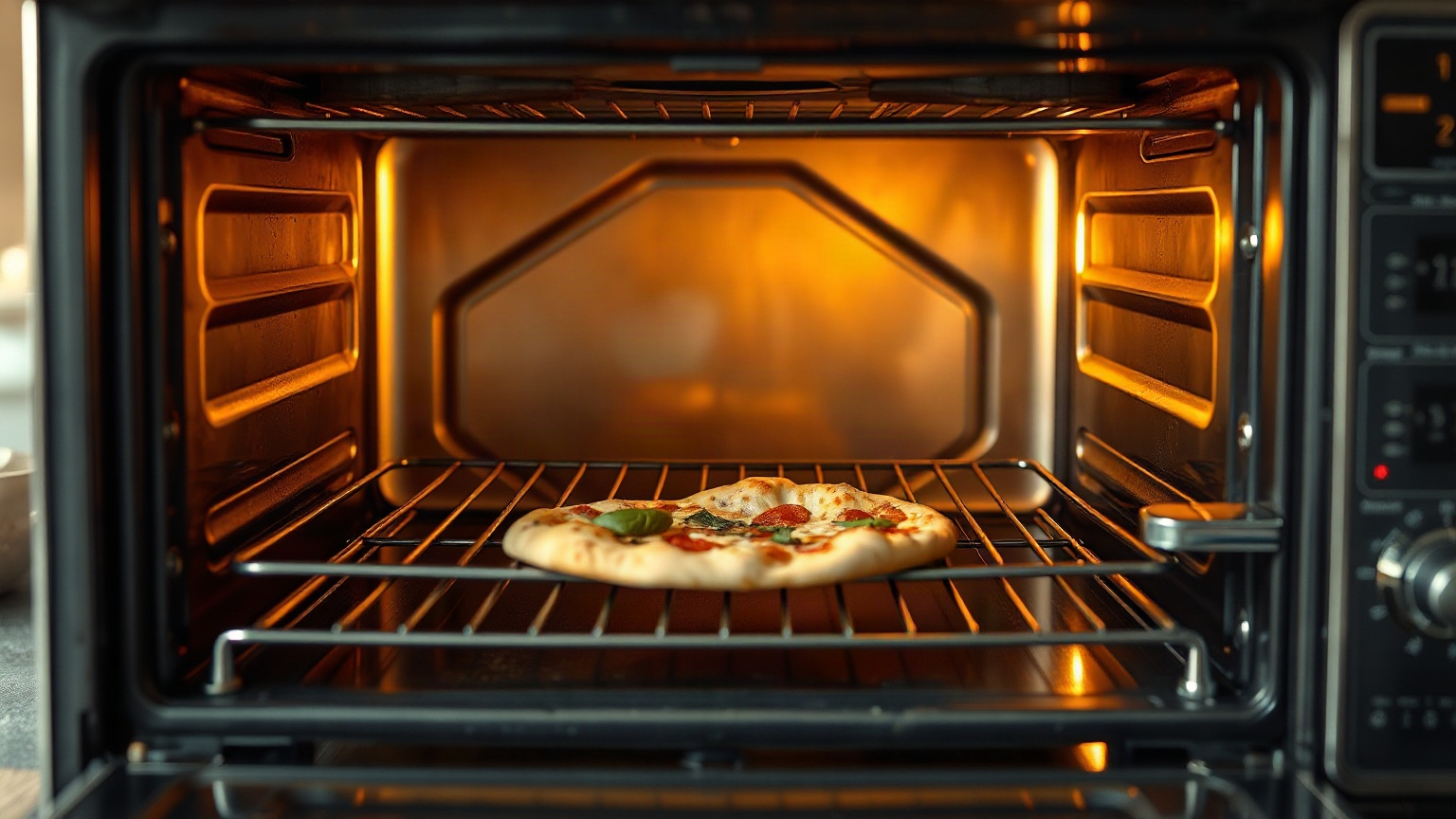
Manufacturers love to advertise slice count. “6-slice toaster oven!” But slices of what? Standard sandwich bread, sure. A sourdough boule? Absolutely not six. I’d honestly ignore slice counts and look at internal cubic footage and actual rack dimensions instead.
Here’s the useful split, roughly:
Compact (2–4 slice, under 0.5 cu ft)
These fit on tight counters. They’re great for toast, a bagel, warming a croissant, maybe reheating a slice of pizza. Most of them max out around 400°F and have limited function settings — a broil option, maybe a convection fan if you’re lucky. The Cuisinart CPT-122 and the Hamilton Beach 31127D live in this category. Perfectly good if your cooking life is minimal. But the moment you try to fit a small casserole dish or bake actual cookies? You’ll hit the walls. Literally.
Mid-Size (4–6 slice, 0.5–0.7 cu ft)
This is the sweet spot for most single people or couples who genuinely cook. You can fit a 9×9 baking dish, a whole fish fillet on a rack, a personal pizza that’s actually personal-pizza sized. The Cuisinart TOA-60 sits here — it’s a convection air fryer toaster oven that’s legitimately useful without taking over your entire counter. I’ve roasted Brussels sprouts in one at 400°F for about 18 minutes and they came out properly caramelized, not steamed. That matters to me.
Large (6–12 slice, 0.7–0.9+ cu ft)
The Breville Smart Oven Air Fryer Pro and the Ninja Foodi XL Pro live here. These are practically countertop ovens. The Breville’s interior fits a 13×9 pan, which means you can bake a full batch of brownies, roast a whole chicken, or cook a sheet pan dinner for four. For a small household, this is overkill — unless you frequently host, batch cook, or have genuinely given up on your wall oven (valid). The footprint is real. My Breville took up about 21 inches of counter width plus clearance. In a galley kitchen, that’s a commitment.
Model Comparison: Real Picks Across the Size Range
Here’s a straightforward look at how specific models compare on the factors that actually matter for a small household decision:
| Model | Capacity | Footprint (approx.) | Key Functions | Price Tier | Best For |
|---|---|---|---|---|---|
| Hamilton Beach 31127D | 4-slice / ~0.35 cu ft | ~15″ wide | Bake, broil, toast | Budget ($30–50) | True minimalists, dorms, offices |
| Cuisinart TOA-60 | 6-slice / ~0.6 cu ft | ~16″ wide | Air fry, bake, broil, toast, convection | Mid-range ($130–180) | Solo cooks or couples who actually cook |
| Cuisinart TOA-70 | 7-slice / ~0.65 cu ft | ~17″ wide | Air fry, bake, broil, dehydrate, toast | Mid-range ($180–220) | Couples wanting more versatility |
| Breville Smart Oven Air Fryer Pro | 13-slice / ~0.9 cu ft | ~21″ wide | Air fry, convection, roast, proof, slow cook, dehydrate | Premium ($350–450) | Small household that cooks big or hosts often |
| Ninja Foodi XL Pro Air Fry Oven | XL / ~0.9 cu ft | ~20″ wide | Air fry, bake, roast, dehydrate, reheat | Mid-premium ($200–280) | Air fry enthusiasts, batch cooks |
My honest verdict: if you’re a small household (one or two people) who actually cooks dinner most nights, the Cuisinart TOA-60 or TOA-70 hits the right balance. The Breville is an exceptional appliance — I genuinely love it — but it’s a lot of oven for one person unless you’re using all those modes regularly. The Ninja Foodi is a strong mid-tier option if air frying is your main goal. And the Hamilton Beach is fine for toast and nothing more.
Counter Space: The Conversation Nobody Wants to Have
Counter space is finite. This sounds obvious but people routinely underestimate how much they’ll resent a large appliance until it’s sitting there blocking the backsplash and making the kitchen feel cramped. I made this mistake with a 6-quart air fryer I owned for about eight months before I admitted I didn’t need it.
A few practical measurements to keep in mind: compact units generally need about 15–16 inches of width plus 4 inches of clearance on each side, so budget for roughly 23–24 inches of actual counter space. Large models like the Breville need closer to 21 inches wide plus clearance — that’s potentially 29+ inches of counter devoted to one appliance. In a typical apartment kitchen with 36–48 inches of total usable counter on one side, that’s a significant chunk.
Also: under-cabinet placement with a large toaster oven is a real concern. These things vent heat from the top. Putting a large-capacity model directly under a wood cabinet is risky and can damage the cabinet over time. If your kitchen layout doesn’t give you open counter space with overhead clearance, that automatically rules out the large models.
For more on reheating food in a toaster oven efficiently regardless of size, I’ve got a full breakdown that covers timing and settings by food type.
When a Large Capacity Toaster Oven Actually Makes Sense for One or Two People
I don’t want to be too dismissive of the large-capacity option for small households. There are real scenarios where it makes sense:
You batch cook on weekends
If you spend Sunday afternoon roasting a sheet pan of vegetables, baking chicken thighs, and prepping grain bowls for the week, a large toaster oven genuinely earns its place. Doing three rounds of small batches in a compact unit takes significantly longer and more energy than one pass in a large one. The Breville at 375°F with convection will roast a full sheet pan of sweet potato cubes in about 25–30 minutes. A compact unit doing the same thing in two batches? You’re looking at close to an hour, plus it heats up the kitchen more cumulatively.
You’re replacing — or bypassing — a full-size oven
Some apartments have genuinely terrible ovens. Old, uneven heating, takes forever to preheat. If that’s your situation, a large-capacity toaster oven can legitimately stand in for most oven tasks. A 9-inch round cake pan fits in a Breville or a Ninja XL. I’ve baked focaccia in mine at 450°F and it came out properly crispy on the bottom — something I couldn’t manage in the ancient wall oven in my previous apartment.
Serious Eats has a solid rundown on maximizing toaster oven cooking if you want to go deeper on technique.
You care about air frying and want actual results
Small-capacity air fryer toaster ovens work. But the smaller the interior, the more you need to cook in batches, and batch cooking defeats the purpose of quick weeknight cooking. If air frying is a priority — and I mean actually making crispy food, not just heating it — a mid-to-large model gives you enough space to let hot air circulate properly around the food. Crowded air fryer baskets steam instead of crisp. That first time I tried to air fry a full batch of frozen fries in a 4-slice unit, I ended up with disappointingly soft results. Lesson learned.
See our picks for the best mini toaster ovens if you’ve decided compact is the right call — there’s a big range of quality in that category.
Energy Use: Does Size Actually Matter for Your Electric Bill?
People ask this a lot. The short answer is: less than you’d think, compared to a full-size oven. Even a large toaster oven at 1,800 watts preheat time is typically 5–10 minutes vs. 15–20 for a wall oven. For small meals, the energy savings over a year can be real.
The compact vs. large toaster oven energy difference, though? Mostly negligible unless you’re running the thing all day. A 1,200-watt compact used for 30 minutes a day uses about 18 kWh a month. An 1,800-watt large model for the same use: about 27 kWh. At average US electricity rates (roughly $0.16/kWh), that’s a difference of about $1.44 a month. Not nothing, but not a reason to choose a smaller oven if it doesn’t meet your cooking needs.
The USDA and Energy.gov both point out that countertop appliances use significantly less energy than conventional ovens for small meals — that holds true across size classes. You can check the Food Network’s toaster oven tips for some practical guidance on using these appliances efficiently.
Also useful: knowing how hot a toaster gets vs. a toaster oven matters when you’re thinking about whether a smaller unit can actually handle higher-heat cooking tasks.
So, Which Should You Actually Buy?
Here’s my actual opinion, not a balanced “it depends on your needs” non-answer:
If you live alone or with one other person and you cook dinner at home three or more times a week — even simple dinners — get a mid-size convection unit. The Cuisinart TOA-60 is my go-to recommendation in this category. It’s not the flashiest appliance, but it’s reliable, has a smaller footprint than most competitors at its capacity, and the air fry function is genuinely useful. It fits a full chicken breast, a 9-inch baking dish, or a decent amount of vegetables on the rack.
If you cook minimally and mostly just want toast, a bagel, or the occasional reheated slice of pizza, save the money and counter space. A compact Hamilton Beach or similar budget unit does that job without complaint. Pair it with a good toaster oven wire rack and a small nonstick baking pan and you’re set for the basics.
The Breville Smart Oven Air Fryer Pro? Worth every penny if you’re serious about cooking and have the counter space. But it’s not the right first toaster oven for someone who’s unsure how much they’ll use it. Start mid-size, upgrade if you find yourself wanting more room. That’s genuinely what I’d tell a friend standing in the appliance aisle.
The Bottom Line
Large-capacity toaster ovens are absolutely worth it for small households — but only specific ones. If you cook real food regularly, batch prep, or have a mediocre wall oven, a larger unit pays for itself in convenience. If you’re toasting bread and reheating leftovers, a compact model is all you need and you’ll appreciate the counter space back.
The mistake people make is buying capacity they’ll never use because it feels like better value. Bigger isn’t automatically better — it’s just bigger. Get the size that matches how you actually cook, not how you imagine you might cook someday. Trust me on that one.
Frequently Asked Questions
Is a large capacity toaster oven worth it for a small household?
Yes, if you cook actual meals at home most nights. A mid-size to large toaster oven (0.6–0.9 cu ft) lets you bake, roast, and air fry without running your full wall oven, which saves time and energy. If your cooking is mostly toast and reheating, a compact unit is genuinely all you need and takes up significantly less counter space.
What size toaster oven is best for one or two people?
A 0.5–0.65 cubic foot toaster oven (roughly 4–6 slice capacity) is the best fit for one or two people who cook regularly. It fits a 9-inch baking dish, a decent batch of vegetables, or a full chicken breast without wasting energy on unused interior space. Models like the Cuisinart TOA-60 hit this range well.
Can a toaster oven replace a full-size oven for a small household?
For most everyday cooking, yes. A large-capacity toaster oven (0.8–0.9 cu ft) handles baking, roasting, broiling, and even proofing dough. You’ll hit limits with very large items — a full turkey, a 9×13 lasagna — but for one or two people cooking daily meals, a quality large toaster oven can replace the wall oven for 90% of tasks.
How much counter space does a large toaster oven take up?
A large toaster oven typically measures 19–22 inches wide, 16–18 inches deep, and 12–14 inches tall. With the required 4-inch clearance on all sides for ventilation, you’re looking at roughly 27–30 inches of counter width and adequate overhead clearance — meaning it can’t go under a low cabinet safely. Measure your available counter space before buying.
Which toaster oven is best for a small apartment?
The Cuisinart TOA-60 is the best balance of capacity and footprint for a small apartment. It delivers air fry and convection functions in a body that’s narrower than most competitors at its size class. If counter space is extremely tight, check compact options — our best mini toaster ovens guide covers the top picks in the smaller category.

Written by
Emma founded Toastera to turn vague appliance advice into clear, researched, safety-first guidance on toasters and toaster ovens.
Free: the Toaster Oven Cheat Sheet
Get the printable cheat sheet (temps, cook times & safety tips) plus new recipes. No spam, unsubscribe anytime.