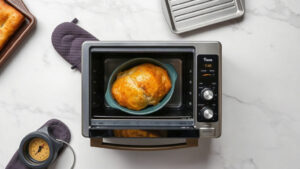
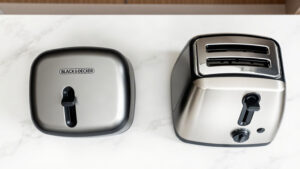
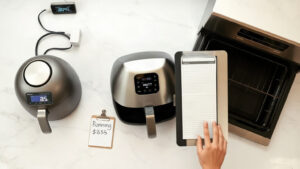
A compact toaster oven (roughly 9–12 liters / 0.3–0.4 cu ft) handles toast, reheating, and small bakes for one or two people without taking over your counter. A mid-size toaster oven (roughly 18–25 liters / 0.6–0.9 cu ft) fits a 12-inch pizza, a 9×13 pan, or a whole chicken — meaning it can genuinely replace your full oven for most weeknight cooking. The smarter buy depends almost entirely on whether you cook actual meals or just reheat things, and I’ll be honest: most buyers get that self-assessment wrong.
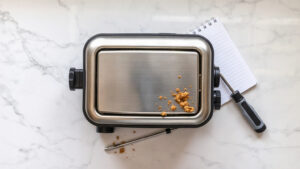
Safety First: Toaster ovens run hot — some models hit 450°F or higher — and the exterior walls and door glass can reach burn temperatures during normal use. Always keep at least 4–6 inches of clearance on all sides (including above), never line the crumb tray with foil as it can trap heat and cause a fire, and unplug the unit when it’s not in active use. Keep children away from the exterior during and after cooking cycles.
Quick Facts Before You Decide
- Compact toaster ovens typically draw 1,100–1,500 watts; mid-size models run 1,500–1,800 watts — a real difference on a shared circuit.
- A compact oven fits a 6-slice bread capacity at best; mid-size models handle 9–12 slices and a 12″ pizza.
- Compact footprint averages around 16″ W × 11″ D; mid-size jumps to roughly 20″ W × 16″ D — that’s significant on a small counter.
- Mid-size models generally preheat 20–40% slower than compact ones, but recover heat faster after you open the door.
- For solo cooking or reheating, a compact saves energy and space with almost no trade-off. For families or real meal prep, compact feels frustrating within a week.
What “Compact” and “Mid-Size” Actually Mean
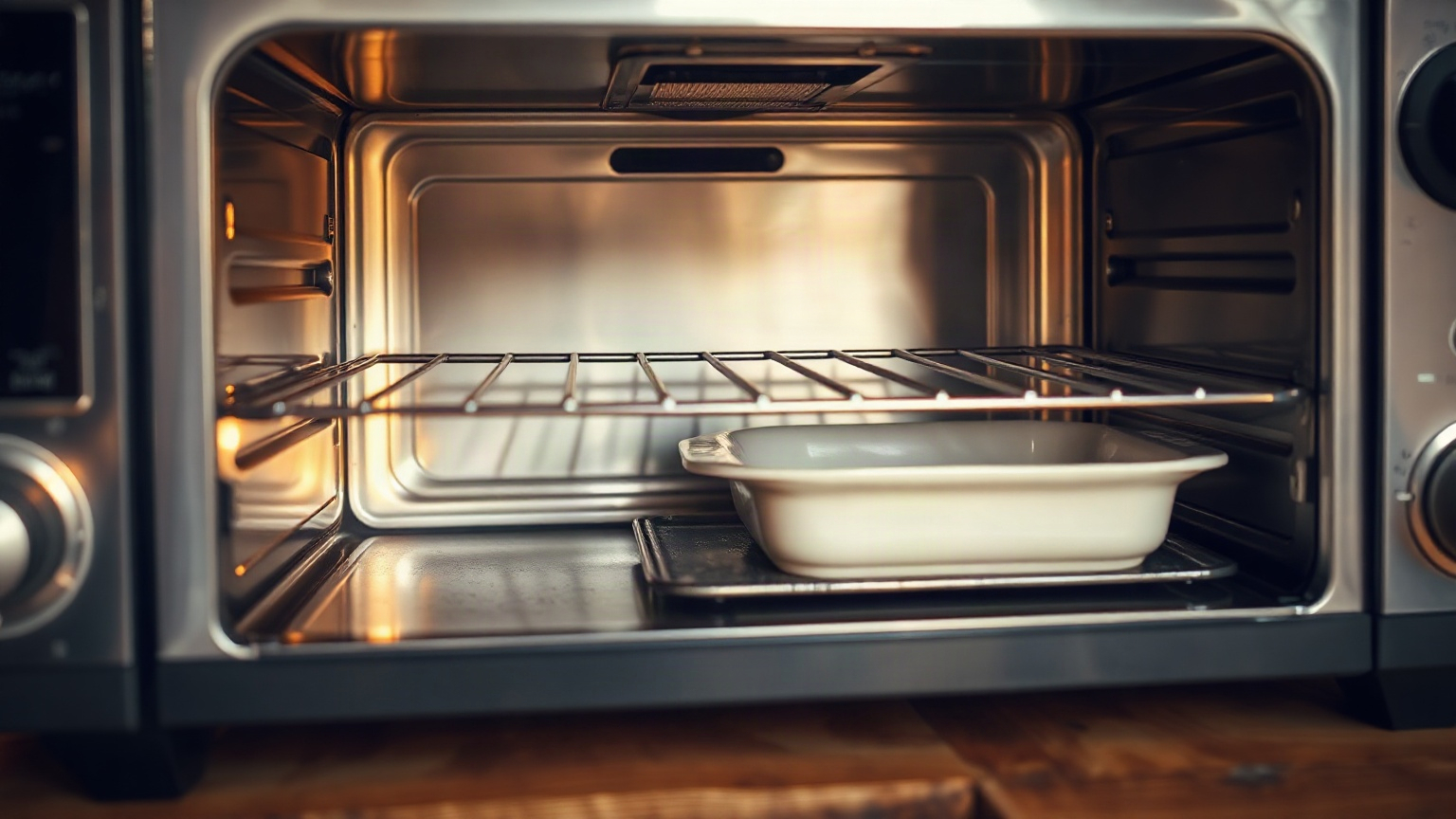
These labels aren’t standardized. Brands use “compact” to mean anything from a two-slice toaster-adjacent box up to a reasonably capable little oven. So let me give you the numbers I actually use when sorting models out.
Compact: interior capacity under about 12 liters, exterior width under 17 inches. Think Breville Mini Smart Oven (BOV450XL) or Hamilton Beach Easy Reach. These fit on a crowded countertop without rearranging your life. The trade-off is that the interior is tight — a standard compact toaster oven baking pan is typically 9″ × 7″, which limits what you can bake in one go.
Mid-size: 18–25 liters, exterior width 19–22 inches. The Breville Smart Oven (BOV800XL), Cuisinart TOA-60, and Ninja Foodi Digital Air Fry Oven (SP101) all live here. These fit a 12-inch pizza flat, a proper roasting pan, and can air fry a full pound of chicken wings without stacking them. That last part matters. Stacked food doesn’t air fry — it steams.
Head-to-Head: The Real Differences by Task
Toast and Basic Reheating
Compact wins here. Full stop. A smaller cavity means the heating elements are physically closer to your bread, which produces faster, more even browning. I’ve run the same bread through a Breville Mini Smart Oven and a Cuisinart TOA-60 side by side — the Mini consistently browned 90 seconds faster on the same shade setting. For reheating food in a toaster oven, the compact’s smaller space also means less wasted energy heating air you’re not using.
Baking
Mid-size wins, but only if you use a proper rack. I learned this the hard way: the first time I tried baking cookies in my old compact Oster, I had three cookies touching the sides, which browned unevenly because the elements were too close. A mid-size oven has enough clearance between the food and the walls to let heat circulate properly. Most mid-size models also have a convection fan, which genuinely matters for baking — it evens out the hot spots that haunt toaster oven baking. Set convection at 325°F for cookies instead of the recipe’s 350°F; the fan makes up the difference.
Air Frying
Both can air fry — with caveats. Compact models that include an air fry mode (like the Breville Smart Oven Air Fryer Compact) are genuinely useful for single servings. But the basket is tiny. One portion of fries. Maybe two chicken thighs if they’re small. A mid-size model like the Ninja SP101 or Cuisinart TOA-60 can handle a real family serving in one batch. If you’re cooking for more than one person and you want crispy results, compact air frying is sort of a lie — you’ll be running two or three batches and the first batch will be cold by the time the last one’s done.
Whole Meals and Protein
Mid-size, no contest. A 4-pound chicken fits in a mid-size oven. It does not fit in a compact. A 9×13 casserole dish doesn’t fit in a compact either. This is where the “smarter buy” question really gets decided. If you own a full-size oven you use regularly, a compact makes perfect sense as a supplemental appliance. If you’re trying to skip preheating the big oven for weeknight dinners — or you live in a studio apartment where your “oven” is whatever fits on the counter — mid-size is the only way that actually works.
Model Comparison: The Contenders Worth Knowing
| Model | Size Category | Capacity | Key Feature | Price Tier | Best For |
|---|---|---|---|---|---|
| Breville Mini Smart Oven (BOV450XL) | Compact | 0.45 cu ft / ~9-slice toast | Element IQ, 5 functions | Mid-range | Solo users, toast-heavy households |
| Hamilton Beach Easy Reach (31334) | Compact | 0.35 cu ft | Roll-top door, budget price | Budget | Tight budgets, small spaces |
| Breville Smart Oven Air Fryer Compact (BOV860) | Compact (larger end) | 0.45 cu ft | Air fry + convection | Premium | Solo air frying without the footprint |
| Breville Smart Oven (BOV800XL) | Mid-size | 0.8 cu ft | Element IQ, consistent baking | Premium | Bakers, couples, frequent cooks |
| Cuisinart TOA-60 | Mid-size | 0.6 cu ft | Air fry + toaster oven combo | Mid-range | Family air frying and baking |
| Ninja Foodi SP101 | Mid-size | 0.45 cu ft (flips up) | Folds flat against wall | Mid-range | Mid-size cooking in compact footprint |
One honest note on the Ninja SP101: the flip-up design is clever, but the door-opening mechanism takes some getting used to, and the Ninja SP101 wire rack that ships with it is flimsier than I’d like. A good thing to replace early on.
The Edge Cases Nobody Talks About
RV and Small Apartment Cooking
In a Class B RV or studio apartment, compact seems obvious — but it might not be. If the compact is your only oven, you’ll hit its limits fast. The Ninja SP101’s fold-flat design actually makes it the rare mid-size oven that works in an RV context, because it stores vertically. Worth knowing.
High-Altitude Baking
Toaster ovens struggle more at altitude than full ovens because their smaller thermal mass means temperature swings hit harder. If you’re baking above 5,000 feet, a mid-size model with a reliable convection fan handles the adjustment better. According to Serious Eats’ guidance on high-altitude baking, consistent oven temperature control is more important at elevation — and mid-size models generally have better thermostat accuracy.
The Second-Oven Scenario
Hosting Thanksgiving? A compact toaster oven running simultaneously with your main oven is genuinely useful for keeping sides warm (around 170–200°F works well for this). A mid-size oven doing the same thing draws more power and takes up more counter space for no additional benefit in this specific use case. Compact is actually the smarter second oven. People miss this.
What to Buy and Who Should Buy It
Here’s my actual take, without hedging.
Buy compact if: you’re cooking for one, you mostly make toast and reheat leftovers, you have a full-size oven you use regularly, or your counter space is genuinely limited (under 18 inches of clear width). The best mini toaster ovens do these jobs reliably without a lot of fuss. I’d point most people toward the Breville Mini Smart Oven as the compact sweet spot — not the cheapest, but the toast quality and durability are measurably better than budget alternatives.
Buy mid-size if: you regularly cook actual meals on a countertop oven, you want to air fry more than one serving at a time, you bake with any seriousness at all, or you’re treating the toaster oven as your primary oven. For mid-size, the Cuisinart TOA-60 is my pick for most people — it’s mid-range priced, genuinely capable, and replacement Cuisinart TOA-60 baking accessories are easy to find. The Breville BOV800XL bakes better, but costs noticeably more. The Ninja SP101 is the pick if space is tight and mid-size cooking is still a priority.
The biggest mistake I see is someone who cooks real dinners three times a week buying a compact because it’s cheaper upfront, then being annoyed by it constantly. You can learn more about how hot a toaster gets and why that matters for different cooking tasks, but honestly, capacity is what bites people first. Size before features, every time.
The Bottom Line
Compact toaster ovens are genuinely good at a specific set of tasks and genuinely limited beyond them. Mid-size models give you real cooking flexibility but ask for counter space and a slightly higher budget in return. Neither is universally better. But most buyers who are unsure are probably better served by mid-size — because the people who should buy compact usually already know exactly what they need. If you’re reading a comparison article, you probably cook more varied things than you’re giving yourself credit for.
The USDA recommends cooking poultry to an internal temperature of 165°F — and a mid-size toaster oven can get you there reliably, a compact often can’t (at least not with anything larger than chicken thighs). USDA safe minimum cooking temperatures are worth bookmarking regardless of which oven you choose.
Pick the right size for how you actually cook — not how you cook in your head.
Frequently Asked Questions
Is a mid-size toaster oven worth it for one person?
It depends less on how many people and more on what you cook. If you regularly bake, roast vegetables, or air fry full portions, a mid-size oven earns its counter space even for a single person. If your typical use is toast and reheating a plate of leftovers, a compact handles that better and wastes less energy.
Can a compact toaster oven replace a full-size oven?
Not realistically for most households. Compact toaster ovens max out at roughly 9″×7″ pan capacity, which rules out standard casseroles, sheet pans, and roasts. A mid-size toaster oven can replace a full oven for a lot of everyday cooking, but compact models genuinely can’t — the interior is just too small for most real recipes.
Which uses more electricity, compact or mid-size toaster oven?
Mid-size toaster ovens typically draw 1,500–1,800 watts versus 1,100–1,500 watts for compact models, so the mid-size uses more power per session. That said, both use far less electricity than a full-size oven, which runs 2,000–5,000 watts. For occasional use, the difference is minor on your bill — but if you’re running the oven multiple times daily, it adds up over a year.
What size toaster oven fits a 12-inch pizza?
You need a mid-size toaster oven with an interior width of at least 13–14 inches to fit a standard 12-inch pizza flat on the rack. Most compact models max out at 9–10 inches of usable interior width, which means a 12-inch pizza either doesn’t fit or has to be angled awkwardly. Check the interior dimensions, not the exterior, when shopping.
Is a compact toaster oven or mid-size better for air frying?
Mid-size wins for air frying if you’re cooking more than one portion at a time. Air frying requires space around food for hot air to circulate — a compact air fryer basket typically handles one to two small servings before results get steamy instead of crispy. Mid-size models like the Cuisinart TOA-60 and Ninja SP101 can air fry a full pound of wings in a single batch, which is the more practical real-world experience.

Written by
Emma founded Toastera to turn vague appliance advice into clear, researched, safety-first guidance on toasters and toaster ovens.
Free: the Toaster Oven Cheat Sheet
Get the printable cheat sheet (temps, cook times & safety tips) plus new recipes. No spam, unsubscribe anytime.