A toaster oven typically costs between $1.50 and $5 per month to run, while a full-size electric oven costs $8 to $15 per month under typical household use — so you’re realistically looking at saving $6 to $10 every month by switching smaller meals to a toaster oven. The difference comes down to wattage (most toaster ovens draw 1,200–1,800W versus 2,000–5,000W for a full oven) and preheat time (a toaster oven hits 350°F in about 5 minutes; a full oven can take 15–20). If you’re cooking for one or two people most nights, the savings add up faster than you’d expect.
Safety First: Never leave a toaster oven unattended on high heat settings for extended periods, and keep at least 4 inches of clearance on all sides — both appliances generate significant radiant heat that can ignite nearby cabinets, dish towels, or paper bags. If you’re measuring outlet draw with a plug-in watt meter (which I’d actually recommend doing), make sure your hands are dry and the appliance is off before plugging and unplugging the meter.
Quick Facts: Toaster Oven vs Full Oven Monthly Cost
- A 1,500W toaster oven running 30 minutes daily costs roughly $3.70/month at the US average rate of 16.5¢/kWh
- A 3,000W full electric oven running the same 30 minutes daily costs roughly $7.40/month — double, before you even account for longer preheat time
- Preheat waste alone can add $1–$3/month to your full oven bill
- Convection toaster ovens are measurably more efficient — they cook faster at lower temps, which shrinks the cost gap even further
- Gas oven owners: your math is different (and covered below)
The Actual Math: Breaking Down What You Pay Per Session
Let me show you how I calculated these numbers, because the formula is simple and you should run it for your own situation. Energy cost = (wattage ÷ 1,000) × hours × electricity rate. That’s it.
Say you’re reheating a sheet pan of roasted vegetables. Twenty minutes in a 1,500W toaster oven: (1.5 kW) × (0.33 hrs) × $0.165 = about $0.08. Same job in a full 3,000W oven that you preheated for 15 minutes first? You’ve used (3.0 kW) × (0.58 hrs total) × $0.165 = about $0.29. That’s nearly four times as much for identical food.
Not every cooking task looks like that, obviously. But it gives you a sense of the gap.
Monthly Cost Comparison Table
These figures assume 30 minutes of daily use at 16.5¢/kWh (the 2024 US average per the EIA). Full oven figures include an estimated 15-minute preheat.
| Appliance | Typical Wattage | Daily Use (cooking + preheat) | Daily Cost | Monthly Cost |
|---|---|---|---|---|
| Compact toaster oven (1,200W) | 1,200W | 35 min | $0.12 | $3.52 |
| Standard toaster oven (1,500W) | 1,500W | 35 min | $0.14 | $4.33 |
| Large/convection toaster oven (1,800W) | 1,800W | 35 min | $0.17 | $5.20 |
| Full electric oven (3,000W) | 3,000W | 45 min | $0.37 | $11.14 |
| Full electric oven (4,500W, double oven) | 4,500W | 45 min | $0.56 | $16.70 |
Your numbers will shift based on your electricity rate — Californians paying 30¢/kWh are looking at double these figures, which makes the toaster oven case even more compelling.
What I Actually Measured in My Kitchen
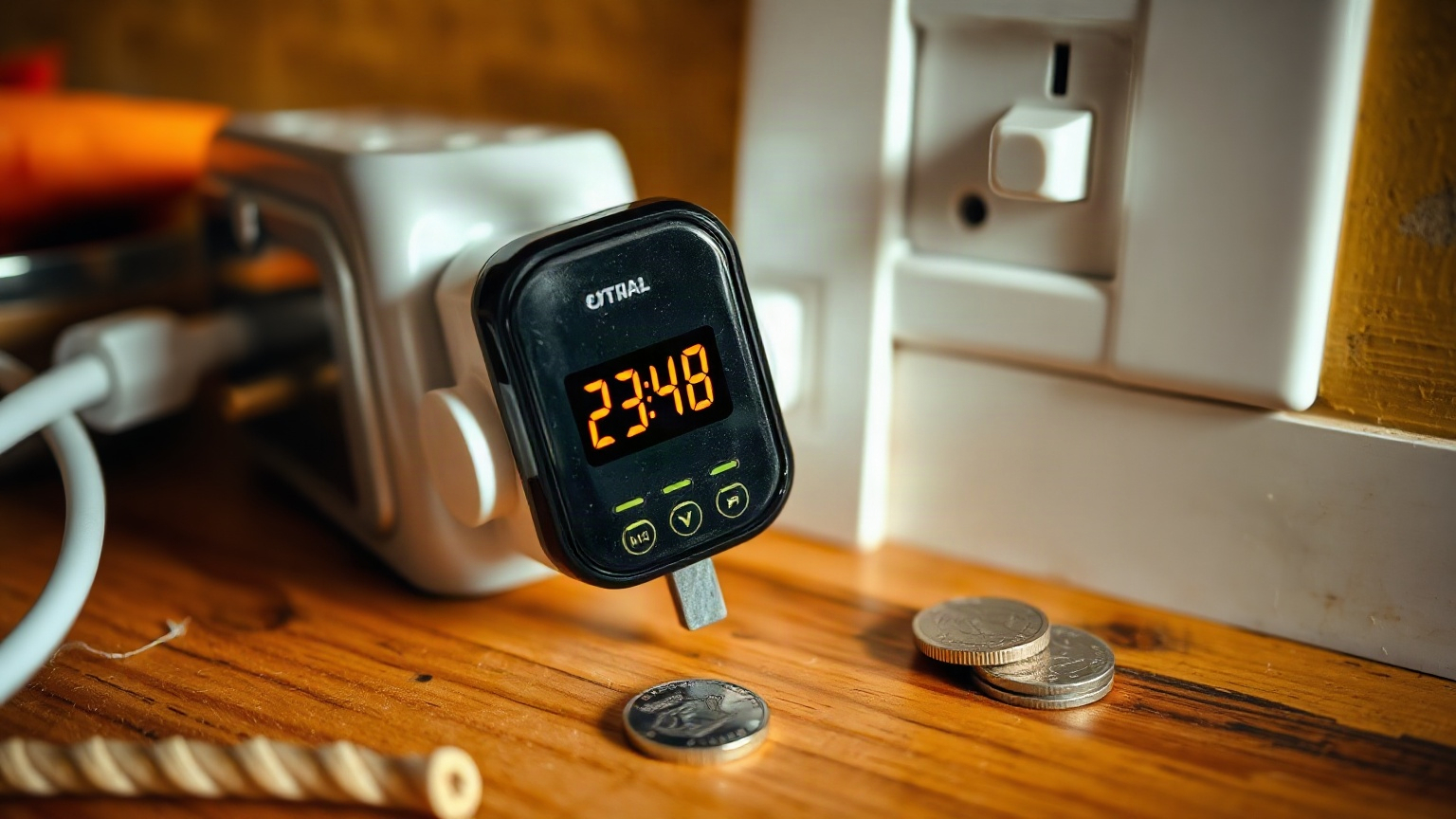
I picked up a plug-in watt meter for about $15 and started logging actual draw from my Breville Smart Oven (1,800W rated) and my old Frigidaire range. What I found surprised me a little.
The Breville doesn’t actually pull 1,800W continuously. During a typical bake cycle at 375°F, it was averaging closer to 900–1,100W because the heating elements cycle on and off to maintain temperature. That’s normal — but it means the nameplate wattage overstates real-world cost. My measured monthly cost running it about 25 minutes a day came to roughly $3.80. The full oven? About $12.40 that same month, and that included three or four actual baking sessions with long preheats.
The preheat is really where the oven bleeds money. I timed my Frigidaire reaching 400°F — 18 minutes, drawing the full 3,000W the entire time. That preheat alone cost about $0.15 each time I used it. Doesn’t sound like much. But at 20 uses per month, that’s $3 just to get it to temperature before I’ve cooked a single thing.
I’ll admit I was skeptical going into this. I thought the difference would be modest enough to ignore. It wasn’t.
Gas Oven vs Toaster Oven: The Calculation Changes
If you’ve got a gas range, the comparison is trickier. Natural gas is priced per therm, and the US average sits around $1.20–$1.40 per therm (again, varies wildly by region and season). A typical gas oven uses about 0.112 therms per hour at 350°F. So 30 minutes of cooking costs roughly $0.07–$0.08 — cheaper than a toaster oven running at full draw.
But here’s the edge case almost every comparison article ignores: gas ovens also dump heat into your kitchen. In summer, that heat gets counteracted by your air conditioning, which runs on electricity. Depending on your climate and your AC’s efficiency, that hidden cost can add another $0.03–$0.08 per cooking session. A toaster oven vents far less heat into the room. So the summer calculus actually favors the toaster oven even against gas, particularly in warmer states.
Winter is the opposite. The oven’s waste heat contributes to warming the kitchen, so it’s not entirely wasted energy. I know that sounds like rationalizing using a giant appliance to reheat leftovers, but the numbers do partially support it.
Which Cooking Tasks Actually Justify the Full Oven
I’m not going to pretend the toaster oven wins every situation. It doesn’t.
A whole turkey? A 9×13 casserole? Two racks of Christmas cookies? You need the full oven. No amount of cost savings justifies trying to roast a 14-pound bird in a countertop appliance that doesn’t fit it. And batch cooking — where you’re running the oven for two or three hours anyway — narrows the per-session cost gap because the preheat becomes a smaller fraction of total run time.
The sweet spot for toaster oven savings is single portions, reheating (the toaster oven absolutely destroys a microwave for reheating food texture-wise), toast and bagels, sheet pan meals for two, and anything under 45 minutes of cook time. That covers, honestly, the majority of weeknight cooking for most households.
If you want to see which countertop models handle the most tasks well, I’ve put together a list of my best mini toaster ovens that covers the compact end of the market too.
Convection Mode Changes the Math Again
A convection toaster oven with the fan running can cook at 25°F lower than the recipe states, and often cuts time by 10–20%. That means less total energy drawn per session. If you’re buying a new toaster oven specifically to save money, get one with convection — the efficiency gain is real and consistent, not just marketing copy. The convection countertop ovens in the 1,800W range are the ones I’d look at first.
How to Reduce Your Toaster Oven’s Energy Cost Even Further
A few things I’ve found actually matter, versus the advice that sounds good but doesn’t move the needle much.
Don’t preheat longer than necessary. Most toaster ovens reach temperature in 4–6 minutes. I used to give mine 10 “just to be safe” — that extra four minutes is wasted draw. Set a timer and check the internal thermometer indicator instead.
Use the right pan. Dark metal pans absorb heat faster and can shorten cook time by a few minutes. I use a dark nonstick toaster oven baking pan for most things. Shiny aluminum reflects heat, which can mean a longer cook at the same temperature setting — and yes, that matters for cost.
Don’t open the door to check. Every time you open it, you lose 25–50°F of internal temperature and the element has to cycle back up. Peer through the glass window. It exists for a reason.
Unplug it when you’re not using it. Most toaster ovens draw a small standby load — typically 1–3W — when plugged in but off. Over a month that’s maybe $0.02–$0.10, so it’s not going to change your life. But if you’re already reaching behind the counter, it’s worth doing.
For more context on how these appliances behave at different temperature settings, it’s worth reading about how hot a toaster gets — the temperature ceiling matters for understanding which tasks each appliance handles well.
The U.S. Department of Energy notes that cooking with a countertop appliance instead of a full oven can reduce cooking energy use by as much as 50% for small meals — their figure aligns with what I’ve measured, which is reassuring.
The Bottom Line on Monthly Savings
If you use your full oven daily for meals that could realistically fit in a toaster oven, you’re probably spending $6–$10 more per month than you need to. That’s $72–$120 a year. Not a fortune, but it’s also not nothing — that’s a decent toaster oven itself, paid for in 12 months of savings.
The biggest gains come from two specific habit changes: stop preheating the full oven for small meals, and use the toaster oven for anything that doesn’t genuinely need 18+ inches of rack space. Those two shifts alone cover most of the savings gap without requiring you to change what you cook or how you cook it.
Gas oven owners save less switching to a toaster oven in dollar terms, but the summer cooling-offset argument is real and often overlooked. Electric oven households see the clearest, most immediate savings.
My honest take: I stopped using my full oven for weeknight dinners almost entirely about 18 months ago. The food’s just as good — sometimes better, because the toaster oven’s smaller cavity browns things more evenly at lower airflow settings — and the monthly energy difference is real and consistent on my bill. I don’t miss it for daily cooking at all.
Frequently Asked Questions
How much does it cost to run a toaster oven for one hour?
A 1,500W toaster oven running for a full hour costs about $0.25 at the US average electricity rate of 16.5¢/kWh. In practice, most toaster ovens cycle their elements on and off during cooking, so the real-world cost is typically $0.14–$0.20 per hour of active cooking time. Very few people run a toaster oven for a continuous 60 minutes, so your per-session cost is usually well under $0.15.
Is a toaster oven cheaper to run than a microwave?
For most reheating tasks, a microwave is cheaper — it typically draws 700–1,200W but runs for 1–3 minutes versus 10–15 minutes in a toaster oven. However, toaster ovens produce vastly better texture results for things like pizza, fries, roasted vegetables, and anything with a crust. If pure cost is the goal, microwave wins for reheating; if food quality matters, toaster oven is worth the small extra cost.
How much can I save per month by using a toaster oven instead of my full oven?
Most households switching daily cooking tasks from a full electric oven to a toaster oven save $6–$10 per month, or $72–$120 annually. The exact amount depends on your electricity rate, how often you cook, and how long your full oven takes to preheat. Households with rates above 20¢/kWh (California, Hawaii, parts of the Northeast) save significantly more.
Does a toaster oven use a lot of electricity when not in use?
Most toaster ovens draw between 1 and 3 watts in standby mode when plugged in but switched off — that works out to roughly $0.05–$0.15 per month, which is negligible. If you want to eliminate it entirely, plug the toaster oven into a smart plug or power strip that you switch off when not in use. It’s not a meaningful contributor to your bill either way.
Is it cheaper to use a toaster oven or gas oven?
At current US average gas prices, a gas oven costs roughly $0.07–$0.10 per 30-minute cooking session — comparable to or slightly cheaper than a toaster oven running at full draw. However, gas ovens add significant heat to your kitchen, which increases air conditioning costs in summer; factoring in that cooling load often makes the toaster oven the cheaper option from May through September in warm climates. In winter, that waste heat contributes to warming the home, narrowing the gap further.
—
Written by
Emma founded Toastera to turn vague appliance advice into clear, researched, safety-first guidance on toasters and toaster ovens.
Free: the Toaster Oven Cheat Sheet
Get the printable cheat sheet (temps, cook times & safety tips) plus new recipes. No spam, unsubscribe anytime.