For a 12-inch pizza, you need a toaster oven with at least 1,500 watts — and honestly, 1,800 watts is where you stop fighting the oven and start actually cooking. Lower wattage units struggle to hold a consistent high temperature once you open the door and slide a cold pizza in, which means soggy crusts and uneven browning. If you’re on a 15-amp circuit (most kitchens are), 1,800 watts is the practical ceiling before you start tripping breakers anyway.
Safety First: Toaster ovens running at 1,500–1,800 watts generate significant surface heat on the casing, rack, and door glass. Always use oven mitts when handling a pizza at 400°F+, keep the oven at least 4 inches from cabinets and walls, never leave it unattended on a high broil setting, and make sure your outlet and circuit can handle the wattage before you plug in. If your outlet feels warm to the touch during use, stop and call an electrician.
Quick Facts: Wattage and 12-Inch Pizza
- Minimum usable wattage for a 12-inch pizza: 1,500W (works, but barely)
- Recommended wattage: 1,800W — faster preheat, more stable temp under load
- Most 12-inch-capable toaster ovens physically measure 18–20 inches wide internally
- Typical cook temp for pizza: 400°F–450°F, time: 10–14 minutes depending on crust thickness
- Wattage affects recovery time after door opening — a bigger deal than most buyers realize
Why Wattage Matters More Than the “Pizza” Button
Here’s what nobody tells you upfront: almost every toaster oven has a pizza setting. It means almost nothing. The button is marketing. Wattage is physics.
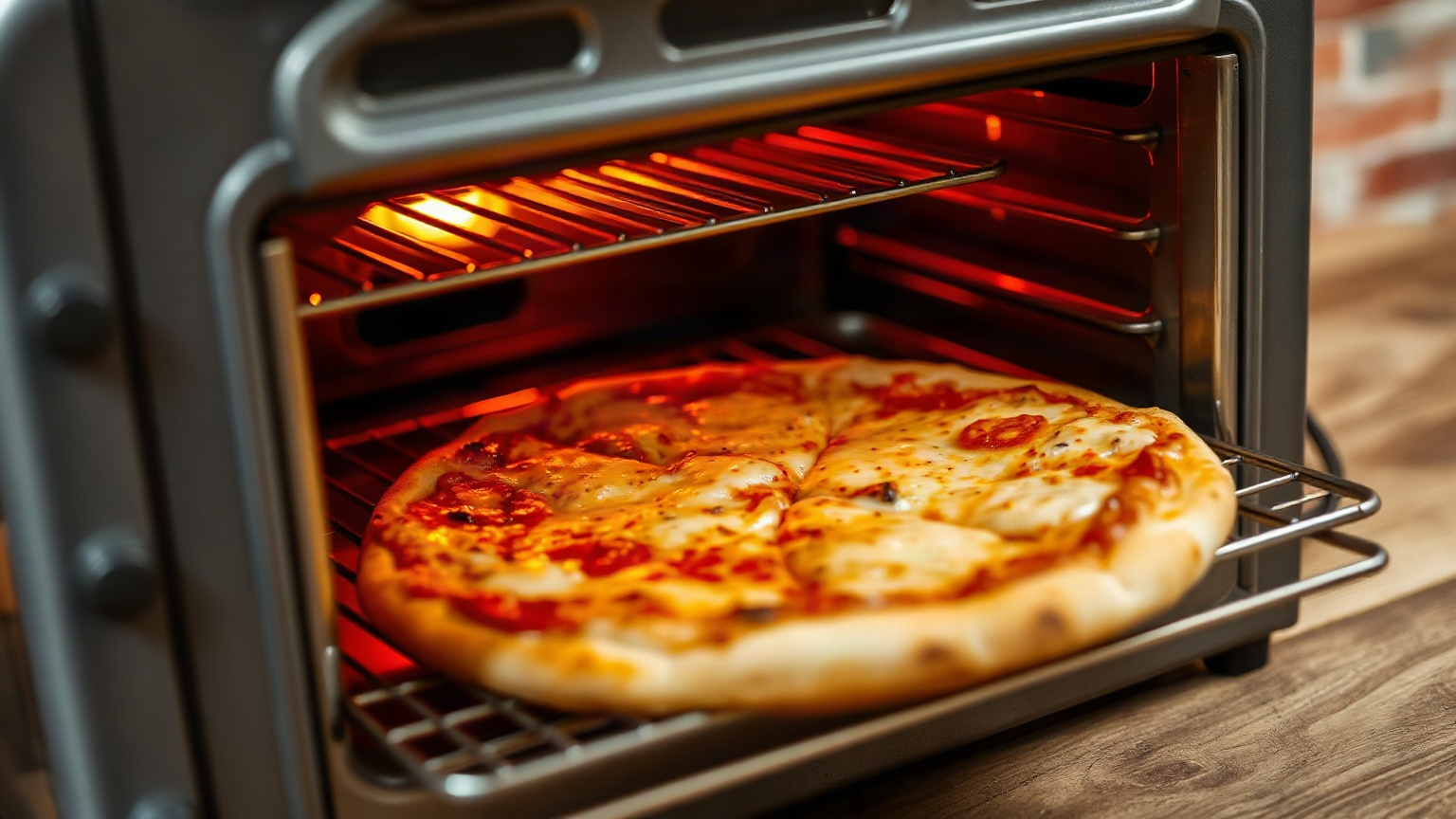
When you slide a 12-inch pizza — whether it’s frozen or fresh — into a toaster oven, you’re introducing a cold, dense mass into a hot, small cavity. The oven’s temperature drops. How fast it recovers depends almost entirely on how many watts the heating elements can push. A 1,200-watt unit I tested (briefly — I gave up on it pretty quickly) took nearly four minutes to climb back to 425°F after I opened the door. The pizza came out pale on top and soft on the bottom. Not ideal.
An 1,800-watt oven recovers in under 90 seconds in my experience. That difference shows up directly on your crust.
The Thermal Recovery Problem
Thermal recovery is the interval between “I just opened the door” and “the oven is back to target temperature.” Smaller, lower-wattage ovens have long recovery windows. The heating elements just don’t have the juice to compensate fast. For toast or reheating leftovers, this barely matters. For pizza — especially if you want a crispy bottom — it matters a lot. You can read more about how heat behaves in these smaller appliances in our piece on how hot a toaster gets.
What 1,200W Actually Gets You
A 1,200-watt toaster oven isn’t useless. It’s fine for toast, reheating slices, baking small items. But a full 12-inch pie? You’ll probably be disappointed. The cavity on most 1,200W units is also physically too small — there’s a loose correlation between wattage and interior size, since bigger cavities need more power to heat.
The Real Wattage Tiers — And What Each One Can Do
I’ve used a lot of these things. Here’s my honest breakdown by wattage range, not by brand or price.
1,000–1,200 Watts: Skip It for Pizza
These are compact units — usually 4-slice capacity or less. The interior diameter rarely clears 11 inches. Even if you could wedge a 12-inch pizza in (you can’t), the wattage isn’t there to cook it properly. These are toasters that got a door, not real pizza ovens.
1,400–1,500 Watts: Technically Works
This range is where things get interesting and a little frustrating. Some 1,500-watt ovens can hold a 12-inch pizza and reach 450°F. They’ll cook a pizza. But they’re slow to preheat — often 15-plus minutes to stabilize at high heat — and the temperature consistency across the rack isn’t great. One side of my pizza consistently cooked faster than the other in the 1,500W unit I tested for three weeks. I started rotating halfway through as a workaround. It helped, but it was annoying.
1,800 Watts: The Sweet Spot
This is where I’d tell a friend to start their search. At 1,800 watts, you get fast preheat (8–10 minutes to 425°F in most units), strong thermal recovery, and enough interior space to physically fit a 12-inch pizza with a little room to breathe. The Hamilton Beach 31123D runs at 1,800 watts and fits a 12-inch pizza — it’s genuinely one of the better budget options in this class. Most of the Breville Smart Oven lineup also sits in this range.
Over 1,800 Watts: Overkill? Maybe Not
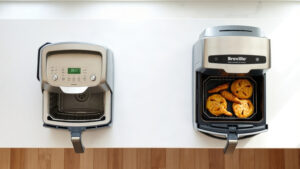
Some air fryer toaster ovens — the Breville Smart Oven Air Fryer Pro, for instance — push toward 1,800W with convection fans that effectively increase cooking efficiency beyond what the raw wattage suggests. Convection is worth paying attention to here: a 1,600W unit with a well-designed convection fan can outperform a static 1,800W oven for pizza because circulating air pulls moisture off the crust. It’s not just about watts. That said, going above 1,800W gets you into territory where you might need to check your circuit before buying.
Specific Models Worth Knowing About
I’m going to name names here, because vague recommendations drive me up the wall.
| Model | Wattage | Fits 12″ Pizza? | Convection? | Price Tier | Best For |
|---|---|---|---|---|---|
| Hamilton Beach 31123D | 1,800W | Yes | No | Budget | Basic pizza, everyday toasting |
| Cuisinart TOA-70 | 1,800W | Yes | Yes (Air Fry) | Mid-range | Pizza + air frying, versatile households |
| Breville Smart Oven (BOV800XL) | 1,800W | Yes | Yes | Premium | Precision baking, serious home cooks |
| Ninja Foodi XL Pro (SP351) | 1,800W | Yes (14″) | Yes | Mid-premium | Families, large capacity needs |
| Oster Extra Large (TSSTTVDGXL) | 1,400W | Yes (tight) | No | Budget | Light use, tight budgets |
My personal pick for most people: the Cuisinart TOA-70. It hits 1,800W, has solid convection, fits a 12-inch pizza without drama, and it’s not trying to be a spaceship. The controls are intuitive. I’ve cooked probably 40 pizzas in one, and I can’t find a serious complaint. The Breville is better if you really care about precision — it has element IQ that adjusts where heat comes from depending on what you’re cooking — but you pay for it.
The Oster is the edge case worth mentioning: at 1,400W, it does technically fit a 12-inch pizza, but barely. The rack sits close to the top element and the crust can scorch before the cheese fully melts if you’re not watching. Not my favorite experience. If budget is the hard constraint, it’ll work with careful monitoring — but I’d rather save another month and get the Hamilton Beach.
For those cooking in an RV or on a limited circuit — a scenario I’ve seen come up a lot in forums — the 1,400W Oster is actually more practical because it won’t trip a 15-amp breaker as reliably. That’s the real edge case the other guides miss: if your available circuit is 1,500W or less, a 1,800W oven is a bad idea regardless of pizza quality. A 1,400W unit on a 15-amp/120V circuit draws about 11.7 amps — workable. An 1,800W unit draws 15 amps exactly, which is technically the circuit limit and leaves zero headroom for anything else running on that circuit. You’ll want to check before buying.
How to Actually Cook a 12-Inch Pizza in a Toaster Oven (The Settings That Work)
Wattage gets you there, but technique finishes the job. Here’s what I actually do, not what the manual says.
Preheat longer than you think you need to. Most toaster ovens claim they’re ready when a light clicks off, but the interior rack and walls haven’t fully absorbed heat at that point. I give it an extra 5 minutes past the preheat signal, especially for pizza. Set it to 425°F on convection bake (or just bake if you don’t have convection). If your oven has a pizza setting that locks it to a lower temp like 375°F, ignore it and set manually — 375°F is too low for a crispy crust.
Placement matters too. Middle rack is usually safest, but if your oven runs hot on top (scorching cheese before crust crisps), drop to the lower position. And use a perforated toaster oven pizza pan if you want a better bottom crust — it lets heat circulate under the pizza in a way a solid pan doesn’t. Serious Eats has some good general guidance on pizza cooking surfaces that applies here too.
Frozen pizza: 12–14 minutes. Fresh pizza (especially thin crust): 8–11 minutes. Check at 8 minutes regardless. Toaster ovens vary more than full-size ovens, and the first time you cook in a new unit, treat the time estimate as a starting guess, not a guarantee. For reheating food in a toaster oven including leftover pizza, the approach is slightly different — lower temp, shorter time.
The Bottom Line
Get 1,800 watts. That’s the real answer. It’s not complicated, but the details behind it matter — cavity size, convection, circuit capacity, and whether you’re in an RV or a full kitchen all shift the calculus a little. For most people buying a toaster oven to cook a 12-inch pizza at home, the Cuisinart TOA-70 or the Hamilton Beach 31123D will do the job well without overspending. If you want the best result money can reasonably buy, the Breville BOV800XL is worth the extra cost.
One last thing: whatever you buy, don’t skip the extended preheat. That single habit will improve your pizza more than any spec on the box. You can also browse our picks for the best mini toaster ovens if you’re working with limited counter space and want to see how the smaller end of the market stacks up.
Frequently Asked Questions
What wattage toaster oven do I need for a 12-inch pizza?
1,800 watts is the recommended wattage for cooking a 12-inch pizza in a toaster oven. Units at 1,500 watts can technically manage it, but they’re slower to recover temperature after you open the door, which leads to softer, less evenly cooked crusts. If you have a convection option, that helps compensate for slightly lower wattage.
Can a 1,500-watt toaster oven cook a 12-inch pizza?
Yes, a 1,500-watt toaster oven can cook a 12-inch pizza, but expect slower preheat times and less consistent results compared to 1,800W models. You’ll likely need to rotate the pizza halfway through cooking to account for uneven heat distribution. It’s a workable setup, just not an ideal one.
What size toaster oven fits a 12-inch pizza?
You need a toaster oven with an interior width of at least 13–14 inches to comfortably fit a 12-inch pizza. Most ovens in the 1,800-watt range meet this size, but always check the interior dimensions in the product specs — exterior size is misleading. The cooking cavity measurement is what matters, not the outer footprint.
Is a convection toaster oven better for pizza?
Convection makes a real difference for pizza because the circulating air pulls moisture off the crust, producing a crispier bottom and more even browning across the top. If you’re choosing between a 1,600W convection oven and a 1,800W non-convection model at a similar price, the convection unit often turns out better pizza. It’s one of the few features worth paying extra for.
How long does it take to cook a 12-inch frozen pizza in a toaster oven?
A 12-inch frozen pizza typically takes 12–14 minutes at 425°F in a preheated 1,800-watt toaster oven. Thin-crust varieties cook faster, closer to 10–12 minutes, while thicker crusts may need the full 14–16 minutes. Always preheat the oven for at least 10 minutes before the pizza goes in — a cold start is the most common reason for soggy results.

Written by
Emma founded Toastera to turn vague appliance advice into clear, researched, safety-first guidance on toasters and toaster ovens.
Free: the Toaster Oven Cheat Sheet
Get the printable cheat sheet (temps, cook times & safety tips) plus new recipes. No spam, unsubscribe anytime.