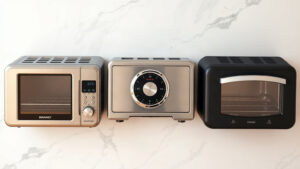
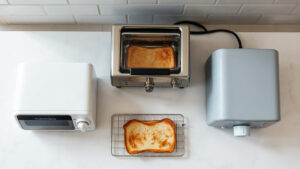
A standard 2-slice toaster pulls between 800 and 1,200 watts, while a 4-slice model typically runs 1,200 to 1,800 watts — though most land right around 1,100W and 1,500W respectively. The extra slots don’t just add capacity; they draw meaningfully more power, usually 30–50% more per cycle. In practice, that difference on your electricity bill is small, but it adds up if you’re running the thing four times a morning for a family.
Safety First: Never operate a toaster near water, never insert metal objects to retrieve stuck bread, and always unplug before cleaning. Toasters draw significant amperage at startup — if your circuit breaker trips when the toaster runs alongside a coffee maker, move one appliance to a different circuit rather than ignoring repeated trips. A tripping breaker is a warning, not an inconvenience.
Quick Facts: Toaster Wattage at a Glance
- Most 2-slice toasters: 800–1,200 watts (average ~1,000–1,100W)
- Most 4-slice toasters: 1,200–1,800 watts (average ~1,400–1,500W)
- A typical 2-minute toast cycle uses roughly 0.033–0.050 kWh per use
- At the U.S. average electricity rate (~$0.16/kWh), daily toasting costs less than $0.01 for a 2-slice model
- Toaster ovens use far more energy per batch — roughly 3–4x more watt-hours for equivalent toast output
Why Wattage Varies More Than You’d Think
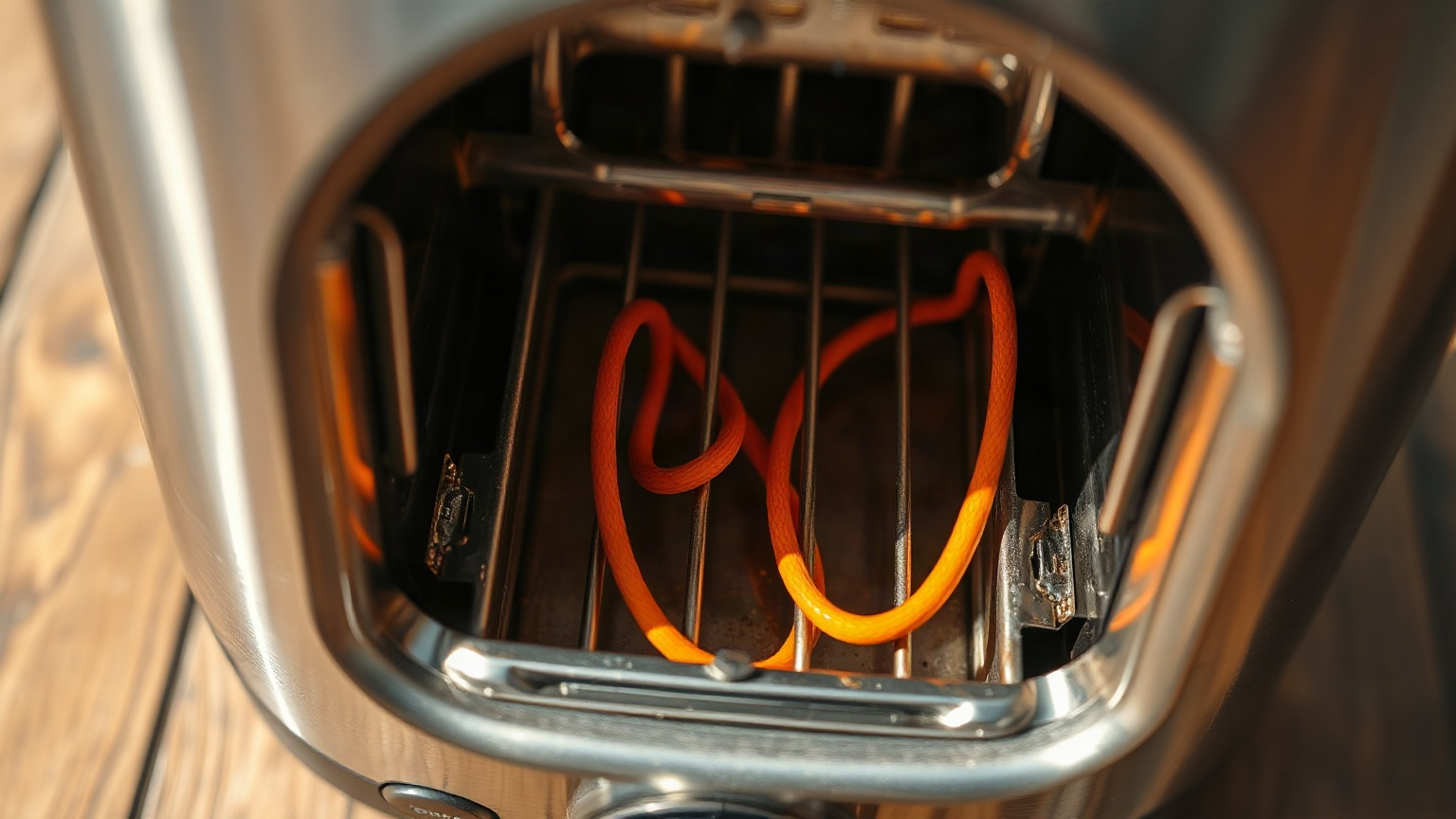
Here’s the thing nobody tells you when you’re standing in the small appliances aisle: the watt rating on the box isn’t a fixed draw. It’s the maximum rated load. Your toaster doesn’t hit 1,100 watts the whole time. It cycles its heating elements on and off to maintain the browning level you set. On a lower setting, the elements are active less of the time. On the darkest setting, they’re running nearly flat out.
I found this out the slightly tedious way. I put a kill-a-watt meter on my Black+Decker 2-slice (rated 900W) and my old Cuisinart 4-slice (rated 1,800W, though I’d always been skeptical of that number). On setting 3 out of 6, the 2-slice averaged about 740 watts across the cycle. The Cuisinart hovered around 1,350W — not the 1,800 on the box. Darker settings pushed both closer to their rated maximums.
So if you’re calculating your real-world energy use, the rated wattage will always overestimate slightly. For anything more than rough math, measuring with a plug-in meter is worth the $15 investment. They’re easy to find on Amazon and genuinely useful for checking any kitchen appliance.
2-Slice vs 4-Slice: The Real Numbers Side by Side
Let me put the typical specs in a table because this is exactly the kind of thing that gets muddled in paragraphs.
| Feature | 2-Slice Toaster | 4-Slice Toaster |
|---|---|---|
| Typical wattage range | 800–1,200W | 1,200–1,800W |
| Common average wattage | ~1,000–1,100W | ~1,400–1,500W |
| Avg. toast cycle (2 min) | 0.033–0.040 kWh | 0.047–0.060 kWh |
| Daily cost (1 cycle, $0.16/kWh) | ~$0.005–$0.006 | ~$0.008–$0.010 |
| Annual cost (1 cycle/day) | ~$1.90–$2.20 | ~$2.80–$3.50 |
| Startup amp draw (120V circuit) | ~7–10A | ~10–15A |
| Circuit requirement | Standard 15A circuit | Standard 15A, but verify if sharing |
The annual difference is barely a dollar. Genuinely. If you’re choosing between a 2-slice and 4-slice based on electricity cost alone, that’s the wrong filter. Choose based on how many pieces you actually need at once.
What about wattage per slice?
This is where it gets interesting. A 4-slice toaster at 1,500W is doing 375 watts per slot. A 2-slice at 1,100W is doing 550 watts per slot. The 4-slice is actually more efficient on a per-slice basis — which makes intuitive sense since the two pairs of slots share heating elements and insulation. If you’re regularly toasting four slices anyway and doing it in two batches with a 2-slice, you’re using more total energy than someone who just runs one cycle on a 4-slice.
I’ll be honest — I didn’t expect that math to work out that way the first time I thought about it.
How These Compare to Toaster Ovens (The Real Competition)
Toaster ovens are a completely different story, and I think a lot of people underestimate just how much more power they draw relative to output. A typical countertop toaster oven — something like the Cuisinart TOA-60 or the Breville compact Smart Oven — runs at 1,500 to 1,800 watts. That sounds similar to a 4-slice toaster. But here’s the catch: the preheat time.
A slot toaster goes from cold to finished toast in about 2 minutes. A toaster oven needs 3–5 minutes to preheat before the toast cycle even starts, and then the toast function itself takes 4–6 minutes. You’re looking at 8–10 minutes of runtime versus 2. The watt-hours consumed per batch is roughly 3 to 4 times higher in a toaster oven. That tracks with the data: independent testing has found toaster ovens use around 130–140 Wh for four slices, compared to roughly 35–45 Wh in a dedicated 4-slice toaster.
So if you’re doing toast regularly and you have both appliances, use the slot toaster. Use the toaster oven for everything else — bagels with toppings, reheating pizza, broiling. Check out the breakdown of reheating food in a toaster oven if you’re trying to figure out when it’s actually worth the extra energy draw.
What Wattage Means for Your Circuit — and When It Actually Matters
Most kitchens in U.S. homes run on 15-amp or 20-amp circuits at 120 volts. A 15-amp circuit can handle up to 1,800 watts continuously (and a bit more in short bursts). A 4-slice toaster at 1,800W is sitting right at the edge of a 15-amp circuit’s rated capacity. Usually fine on its own. But add a 1,200-watt coffee maker, and you’re asking for a tripped breaker.
This is the edge case almost nobody mentions. I had a period where my kitchen breaker kept tripping on weekend mornings. Took me an embarrassingly long time to realize the toaster and the kettle were on the same circuit. Moved the kettle to a different outlet on a different circuit wall — problem solved permanently.
High-wattage outliers worth knowing about
A few 4-slice models push past 1,800 watts. The Dualit 4-slice, for example, is rated at 2,100–2,400 watts depending on the market version — and those are designed for the UK’s 230V grid. If you somehow end up with one intended for a 240V circuit running on a 120V outlet with an adapter, it’ll either not function properly or draw half the rated wattage and toast very, very slowly. Not dangerous in the usual sense, but not useful either. Voltage matters. Power ratings on imported appliances aren’t interchangeable.
For anyone shopping for something compact with lower overall wattage, some of the best mini toaster ovens run as low as 1,000–1,200 watts and still handle toast reasonably well — useful if your kitchen circuit is already crowded.
Calculating Your Actual Electricity Cost
The formula is simple: watts ÷ 1,000 × hours of use × your electricity rate = cost in dollars.
Say you have a 1,100W 2-slice toaster, you run it for 2 minutes (0.033 hours) once a day, and your electricity rate is $0.16 per kWh (close to the U.S. average as of 2025, though rates vary significantly by state — Hawaii pays closer to $0.38, Louisiana closer to $0.09).
1,100 ÷ 1,000 × 0.033 × $0.16 = about $0.0058 per use. Multiply by 365 days: roughly $2.10 per year.
For a 1,500W 4-slice running the same cycle: 1,500 ÷ 1,000 × 0.033 × $0.16 = $0.0079 per use. About $2.90 per year.
The difference is $0.80 a year. Buy the toaster that fits your actual household needs, not the one with lower wattage.
If you’re curious about what’s happening inside during those two minutes, the temperatures a toaster reaches are surprisingly high — the elements themselves can hit over 1,000°F, even if the bread only reaches the Maillard reaction zone around 300–350°F. The U.S. Energy Information Administration tracks average residential electricity rates by state if you want to plug in your actual number.
Which Type Should You Actually Buy?
Here’s my honest take after testing both formats across several models over the past couple of years. The wattage difference is genuinely not the deciding factor. It’s background noise.
Get a 2-slice if you live alone or with one other person who doesn’t do big breakfasts. Smaller footprint, slightly less power draw, cheaper upfront price. The Müeller 2-slice and Hamilton Beach 2-slice both perform solidly in the 900–1,000W range without any drama. I have a slight personal preference for wider-slot models because I got burned (not literally, thankfully) trying to fit sourdough into a standard slot and having it jam. Look for slots that are at least 1.5 inches wide.
Get a 4-slice if you have kids, you batch-toast, or you hate doing two rounds of toast while the first batch goes cold. Models like the Cuisinart CPT-440 and the Hamilton Beach 4-slice stainless sit in a reasonable mid-range wattage (1,500–1,600W) and toast evenly without hot spots near the ends. The extra 400–500 watts versus a 2-slice costs you less than a dollar a year. It’s not a meaningful consideration.
The Bottom Line
A 2-slice toaster averages around 1,000–1,100 watts. A 4-slice averages 1,400–1,500 watts. The real-world annual cost difference between them is under a dollar. Where wattage actually matters is circuit load — don’t run a high-wattage 4-slice alongside your coffee maker and kettle on a shared 15-amp circuit without checking. And if you’re comparing a slot toaster to a toaster oven for daily toast, the slot toaster wins on energy efficiency by a wide margin every single time. Use the right tool for the job, not the one with the impressive feature list. Toast is not that complicated.
Frequently Asked Questions
What is the average wattage of a 2-slice toaster vs a 4-slice toaster?
A 2-slice toaster typically averages 1,000–1,100 watts, while a 4-slice model averages 1,400–1,500 watts. Both types fluctuate during a cycle since the heating elements cycle on and off based on your browning setting — the rated wattage on the box is the maximum draw, not a constant.
How much electricity does a toaster use per day?
One cycle in a 1,100W 2-slice toaster running for about 2 minutes uses roughly 0.037 kWh. At the U.S. average electricity rate of around $0.16/kWh, that’s less than a cent per use — approximately $2.10 per year for daily use. A 4-slice model costs around $2.90 per year under the same assumptions.
Does a 4-slice toaster use twice as much electricity as a 2-slice?
No. A 4-slice toaster typically draws about 30–50% more watts than a comparable 2-slice, not double. On a per-slice basis, 4-slice toasters are actually more efficient because the heating elements are shared across more slots. Two back-to-back cycles in a 2-slice often consume more total energy than one cycle in a 4-slice.
Can a toaster trip a circuit breaker?
Yes, especially if it’s a high-wattage 4-slice model sharing a 15-amp circuit with other appliances like a coffee maker or electric kettle. A 1,800W toaster plus a 1,200W coffee maker exceeds what a 15-amp/120V circuit is rated to handle continuously. The fix is simple: plug one appliance into an outlet on a different circuit.
Is it safe to leave a toaster plugged in all the time?
Technically toasters draw negligible standby power when not in use, but most fire safety guidelines recommend unplugging them between uses — crumbs and residual heat near the elements are a real (if uncommon) fire risk over time. Unplugging also protects against power surges. It takes two seconds and it’s a reasonable habit.

Written by
Emma founded Toastera to turn vague appliance advice into clear, researched, safety-first guidance on toasters and toaster ovens.
Free: the Toaster Oven Cheat Sheet
Get the printable cheat sheet (temps, cook times & safety tips) plus new recipes. No spam, unsubscribe anytime.