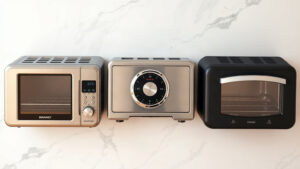
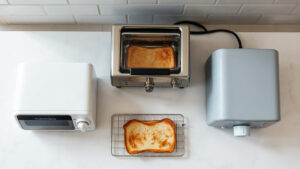
The Cuisinart TOA-60 runs about $60 more than the Instant Vortex Plus 7-in-1, and for most people, that gap isn’t justified. The Instant Vortex Plus handles everyday air frying, roasting, and reheating with fewer quirks and a simpler footprint. But if you regularly bake, broil, or want a true toaster oven that also air fries rather than an air fryer that also toasts, the Cuisinart earns its price premium.
Safety First: Both appliances reach internal temperatures above 400°F and their exterior surfaces get hot during and after use. Keep at least 5 inches of clearance on all sides, never place either unit under a cabinet during operation, and always use oven mitts when removing the TOA-60’s drip tray or the Vortex’s cooking basket — the metal stays searingly hot for several minutes after shutting off.
Quick Facts Before We Get Into It
- The Cuisinart TOA-60 is a mid-range countertop toaster oven with a built-in air fry function; the Instant Vortex Plus 7-in-1 is primarily an air fryer with additional cooking modes.
- The TOA-60 has a larger usable interior (roughly 0.6 cubic feet vs. the Vortex Plus’s basket-style cooking space) and fits a 12-inch pizza.
- Both hit max temps of 450°F, but the TOA-60’s heating element arrangement gives it a meaningful advantage for true baking and broiling.
- The Instant Vortex Plus is easier to clean. Full stop.
- If your main goal is crispy wings and fries a few nights a week, save the $60. If you want to replace your toaster oven and get air frying as a bonus, spend it.
How These Two Machines Actually Differ
I want to be clear about something before we compare settings and wattage: these aren’t really the same category of appliance dressed up differently. The TOA-60 is a toaster oven first. It has a door that swings open, a wire rack that slides in, and an interior you can actually see into while food cooks. The Instant Vortex Plus is a basket-style air fryer with extra modes tacked on. That fundamental design difference shapes everything else about how they perform.
I’ve had both running on my kitchen counter over the past several months — the Vortex Plus for longer, the TOA-60 more recently. First time I used the TOA-60’s air fry mode, I forgot to pull the drip tray out from the bottom slot and ended up with smoke at the 15-minute mark. Not a disaster, but the kind of thing nobody tells you. The Vortex Plus has no such gotcha.
Head-to-Head Comparison Table
| Feature | Cuisinart TOA-60 | Instant Vortex Plus 7-in-1 |
|---|---|---|
| Primary Design | Toaster oven with air fry | Air fryer with extended modes |
| Wattage | 1800W | 1700W |
| Max Temperature | 450°F | 400°F (air fry) / 450°F (roast) |
| Interior Capacity | ~0.6 cu ft (fits 12″ pizza) | Basket-style (~6 qt equivalent) |
| Cooking Functions | 7 (air fry, bake, broil, toast, warm, etc.) | 7 (air fry, roast, broil, dehydrate, etc.) |
| Preheat Time | ~5-6 min | ~3-4 min |
| Footprint | Larger (roughly 16″W x 14″D x 14″H) | More compact (roughly 13″W x 13″D x 12″H) |
| Ease of Cleaning | Moderate (multiple removable parts) | Easy (basket + tray dishwasher safe) |
| Price Tier | Mid-range (~$130-160) | Budget-to-mid (~$70-100) |
| Best For | Replacing a toaster oven + air fryer | Dedicated air frying, smaller kitchens |
Cooking Performance: Where the Difference Actually Shows Up
Air Frying
Honestly? They’re close. Both will give you crispy chicken thighs and respectable frozen fries. I ran chicken wings in both at 400°F for 22 minutes, flipping once at the halfway point. The Vortex Plus edged out slightly better crisping on the skin — that’s partly because the basket design forces better hot air circulation all around the food. The TOA-60’s air fry results were good but not quite as uniformly browned. Not a huge deal, but if air frying is 90% of what you’ll do, the Vortex Plus wins on this specific task.
Baking and Broiling
This is where the TOA-60 pulls ahead decisively. I baked a batch of chocolate chip cookies on a toaster oven baking pan in each machine. The TOA-60 produced cookies with even browning on the bottom, done at 350°F in about 12 minutes. The Vortex Plus, baking mode, same dough — uneven bottoms, slightly undercooked centers at the same time and temp. The basket design just doesn’t bake the way a flat-element oven does. The broil function on the TOA-60 is also noticeably more aggressive and useful, good for finishing a gratin or getting char on peppers quickly.
For more on how countertop ovens handle different temperature ranges, I wrote about how hot a toaster gets and what that means for actual cooking results.
Reheating
Both are better than a microwave for leftovers — that’s not even a contest. But they work differently. The TOA-60 at 325°F on the bake setting reheats pizza with a crispy bottom in about 6-7 minutes. The Vortex Plus at 350°F air fry mode does it in 4-5 minutes but can dry out thinner foods more aggressively. You can read more about getting the best results in my guide to reheating food in a toaster oven. My personal preference for delicate leftovers — pasta, rice dishes, anything saucy — is the TOA-60 at a lower temp. Wings and fries, I grab the Vortex Plus every time.
Cleaning, Noise, and the Everyday Stuff
The Vortex Plus is genuinely easy to keep clean. The basket and cooking tray are both dishwasher safe, and because the cooking zone is contained, splatter stays contained. I wiped the interior down maybe twice in three months of regular use.
The TOA-60 is more of a commitment. There’s the removable crumb tray, the wire rack, the baking pan, and the interior walls themselves — all of which accumulate grease. The drip tray situation I mentioned earlier: if you’re air frying fatty proteins, that tray catches a lot of drippings and needs to be cleaned after basically every session or you’ll get smoke on the next use. It’s not hard, just more steps. Some people don’t mind. I do, a little.
Noise-wise, the Vortex Plus fan is noticeably louder. Not obnoxious, but it’s a real sound. The TOA-60’s fan (which only runs in air fry mode) is quieter. Neither is silent. Neither is going to drown out a conversation, but if you work from home and your kitchen is near your desk, the Vortex Plus fan hum might get old.
The Edge Case Nobody Talks About: Dehydrating
Both machines list dehydrating as a function. The Instant Vortex Plus actually does it passably well — the 125°F low-temperature setting with the basket partially filled lets air circulate effectively enough for herbs, thin apple slices, and beef jerky strips. I’ve used it for jerky a handful of times with decent results at 160°F for about 3-4 hours, which aligns with USDA guidance on safe jerky temperatures.
The TOA-60’s dehydrate mode is technically present but the interior is large enough that a small batch of food ends up with inconsistent airflow. You’d want to use a multi-tier wire rack and rotate trays partway through. It’s doable but fiddly. If dehydrating is something you actually care about, the Vortex Plus handles it more predictably at small batch sizes.
Who Should Buy Which One
Get the Instant Vortex Plus 7-in-1 if you live alone or with one other person, your kitchen counter space is limited, you primarily want crispy air-fried food fast, and the idea of washing multiple oven parts sounds annoying. It’s a genuinely solid machine for the price and it does what it promises without much fuss. You can also check out my roundup of the best mini toaster ovens if you’re shopping smaller.
Get the Cuisinart TOA-60 if you’re a family of 3-4, you want to replace both your toaster and your toaster oven with one machine, and you actually bake or broil things regularly. The extra $60 buys you a fundamentally more versatile cooking appliance. It’s also worth considering if you want to explore more serious recipes — Serious Eats has a useful breakdown of what to look for in a countertop air fryer if you want a second opinion grounded in recipe testing.
My clear pick: for pure air frying value, the Vortex Plus. For replacing a toaster oven and gaining air fry capability, the TOA-60. Don’t let anyone tell you it’s complicated — it really isn’t once you know what you actually cook.
The Bottom Line
Sixty dollars is sixty dollars. The Instant Vortex Plus 7-in-1 is a genuinely good appliance that outperforms its price tier on air frying, cleans up easily, and won’t frustrate you with a learning curve. The Cuisinart TOA-60 costs more because it does more — not in number of buttons, but in real cooking range. Better baking. Better broiling. More interior space. If that describes how you actually cook, it’s worth every dollar of the premium. If it doesn’t, you’re just paying for square footage you won’t use.
Frequently Asked Questions
Is the Cuisinart TOA-60 actually better than the Instant Vortex Plus for air frying?
Not really, no. The Instant Vortex Plus produces slightly more uniform air fry results thanks to its basket design, which circulates hot air more evenly around food. The TOA-60 is better overall as a cooking appliance, but if air frying is your primary use case, the Vortex Plus wins that specific round.
Can the Instant Vortex Plus 7-in-1 replace a toaster oven?
For basic tasks like reheating and roasting vegetables, yes. For true baking — things like cookies, casseroles, or anything that needs even bottom heat — it falls short compared to a real toaster oven. The basket shape just doesn’t replicate flat-element oven baking reliably.
How much counter space does the Cuisinart TOA-60 take up compared to the Vortex Plus?
The TOA-60 is meaningfully larger — roughly 16 inches wide and 14 inches deep versus the Vortex Plus at about 13 inches square. In a smaller kitchen that difference is real. The TOA-60 also needs about 5 inches of clearance on all sides during use, so measure your space before buying.
Which is easier to clean, the TOA-60 or the Instant Vortex Plus?
The Instant Vortex Plus is easier to clean by a noticeable margin. Its basket and cooking tray are dishwasher safe, and splatter stays contained inside the basket cavity. The TOA-60 has more surfaces — interior walls, a drip tray, a wire rack, and a crumb tray — all requiring individual attention after cooking fatty foods.
Is the Cuisinart TOA-60 worth the extra cost for a small household?
Probably not, for most single people or couples. The TOA-60’s larger capacity and baking performance shine for families of 3 or more. If you’re cooking for one or two and mostly want quick air-fried meals, the Instant Vortex Plus handles that better per dollar spent.

Written by
Emma founded Toastera to turn vague appliance advice into clear, researched, safety-first guidance on toasters and toaster ovens.
Free: the Toaster Oven Cheat Sheet
Get the printable cheat sheet (temps, cook times & safety tips) plus new recipes. No spam, unsubscribe anytime.