A typical toaster oven running at 1,200 watts for about 15 minutes a day costs roughly $1.10 to $1.80 per month at average U.S. electricity rates. That range shifts depending on your oven’s wattage, how long you actually run it, and what your utility charges per kilowatt-hour. At the national average of around 16–17 cents/kWh, most households land right around $1.50/month for everyday use.
Safety First: Toaster ovens draw significant current and generate high heat. Never run one on a shared circuit with other high-draw appliances, don’t leave it unattended on longer cook cycles, and keep the area around it clear of flammable materials (dish towels, paper towels, plastic bags). If you notice sparking, a burning smell, or the outer casing getting unusually hot to the touch, unplug it immediately and don’t use it again until you’ve figured out why.
Quick Facts: Toaster Oven Monthly Running Cost
- A 1,200-watt toaster oven running 15 min/day costs about $1.10–$1.80/month at typical U.S. rates
- Annual cost works out to roughly $13–$22/year for average daily use
- Higher-wattage models (1,500–1,800W) can push monthly costs to $2.50–$4.00+ if you use them heavily
- Toaster ovens use roughly 50–75% less energy than a full-size electric oven for the same small cooking jobs
- Your local electricity rate matters more than the oven’s wattage — Hawaii residents pay 4–5x what Wyoming residents pay per kWh
The Math: How to Calculate Your Exact Monthly Cost
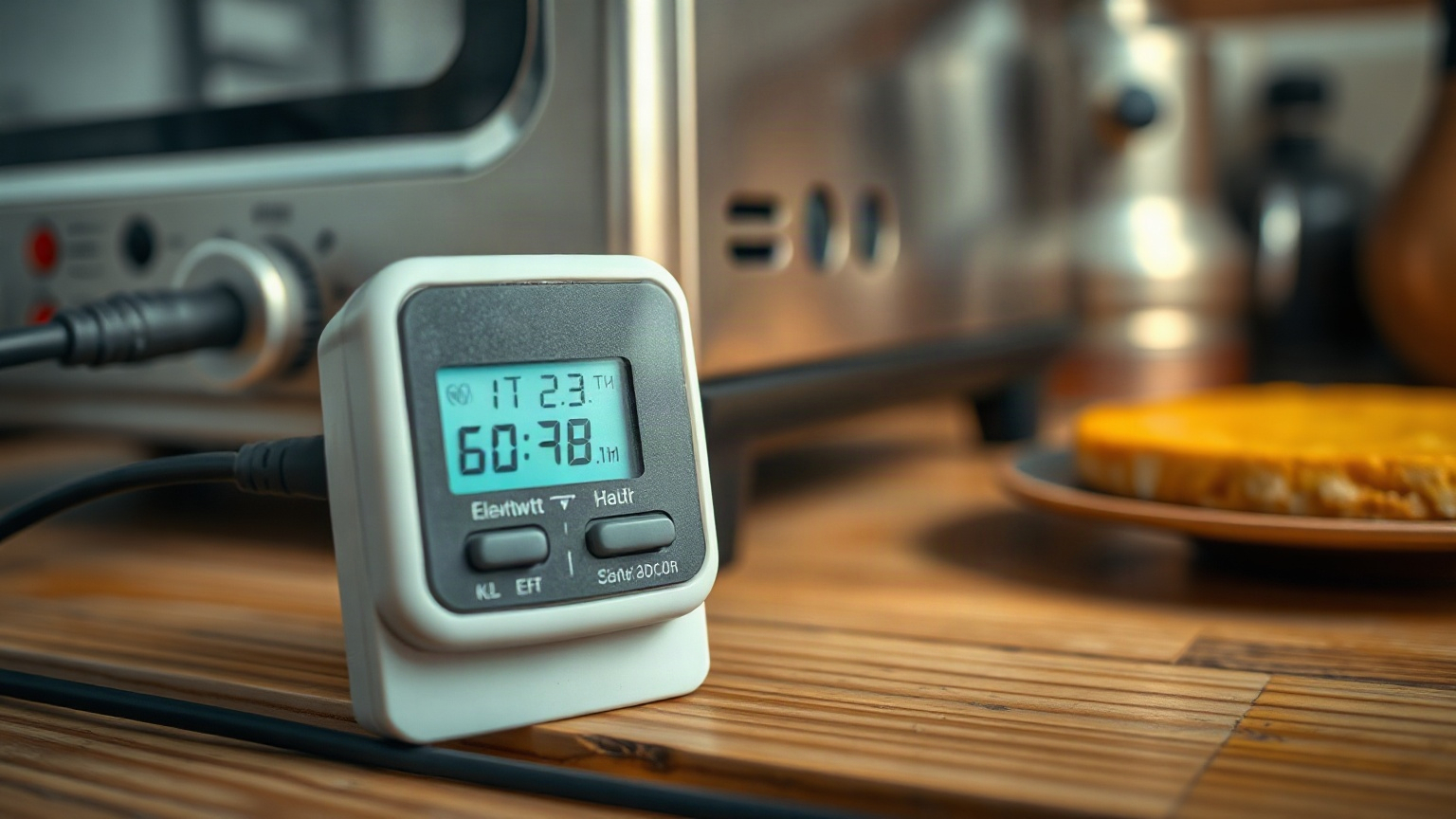
The formula isn’t complicated. You need three numbers: wattage, daily run time in hours, and your electricity rate in dollars per kWh (find it on your utility bill — it’s usually listed as “energy charge” or “rate per kWh”).
Formula: (Watts ÷ 1,000) × Hours Per Day × Days Per Month × $/kWh = Monthly Cost
So for a 1,200W oven running 15 minutes (0.25 hours) every day for 30 days at $0.17/kWh:
(1,200 ÷ 1,000) × 0.25 × 30 × $0.17 = $1.53/month
Simple enough. The part people get wrong is underestimating daily run time. A “15-minute” cook session often includes a 3–5 minute preheat on top of the actual cook time. I didn’t account for preheat the first few months I tracked my own usage, and my estimates were consistently low.
Monthly Cost by Wattage and Usage — Real Numbers
Here’s the full breakdown. I’ve used $0.17/kWh as the base rate (close to the 2024–2025 U.S. residential average), and I’ve also added columns for high-rate states like California (~$0.30/kWh) and low-rate states like Louisiana (~$0.11/kWh).
| Wattage | Daily Use | Monthly kWh | @ $0.11/kWh | @ $0.17/kWh | @ $0.30/kWh |
|---|---|---|---|---|---|
| 800W (compact) | 15 min | 6.0 | $0.66 | $1.02 | $1.80 |
| 1,200W (standard) | 15 min | 9.0 | $0.99 | $1.53 | $2.70 |
| 1,200W (standard) | 30 min | 18.0 | $1.98 | $3.06 | $5.40 |
| 1,500W (large/air fryer) | 20 min | 15.0 | $1.65 | $2.55 | $4.50 |
| 1,800W (high-end convection) | 20 min | 18.0 | $1.98 | $3.06 | $5.40 |
| 1,800W (heavy daily use) | 45 min | 40.5 | $4.46 | $6.89 | $12.15 |
That last row is the edge case most articles skip: someone who genuinely replaces their full oven with a toaster oven, cooking dinner every night. 45 minutes a day at 1,800 watts in California? You’re paying over $12/month. Still cheaper than running a full electric range oven — but not trivial.
What “Standard Use” Actually Looks Like
Most usage estimates assume about 15 minutes per day. That’s one piece of toast, maybe some reheated leftovers. Honestly, I’d say 20–25 minutes is more realistic for someone actually cooking with their toaster oven — once you factor in reheating food in a toaster oven, the occasional batch of roasted vegetables, or frozen pizza on a weeknight.
Bump to 25 minutes/day on a 1,200W oven at $0.17/kWh and you’re at $2.55/month. Still cheap. But now you know the real number instead of the optimistic one.
How Toaster Ovens Compare to Full-Size Ovens on Cost
A standard electric oven element runs at around 2,400–5,000 watts depending on whether it’s the bake or broil element, plus the preheat cycle. For a typical 30-minute bake session that starts from cold, you’re realistically consuming 1.5–2.0 kWh. At $0.17/kWh, that’s $0.26–$0.34 per session, or roughly $7–$10/month if you’re using it daily.
A 1,200W toaster oven doing the same 30-minute job uses 0.6 kWh — about $0.10 per session. That’s a real difference, and it compounds fast. The energy savings can be 50–75% per cooking session for smaller meals, which lines up with what Serious Eats and others have noted when writing about kitchen efficiency.
Gas ovens? Harder to compare directly because gas prices vary more than electricity and are measured in therms, not kWh. But the general consensus is a toaster oven still runs cheaper per session for small jobs — not because gas is expensive, but because a full-size oven wastes a lot of energy heating a large cavity for a small piece of food.
Wattage Varies More Than You’d Expect — Check Your Label
Not all “toaster ovens” are created equal, and the wattage range is surprisingly wide. A basic 2-slot-sized countertop unit might pull only 700–900 watts. A full-featured toaster oven with air fry, convection, and broil? Often 1,500–1,800W, sometimes pushing 2,000W at max settings.
Find your model’s wattage on the sticker on the back or bottom of the unit, or in the manual. Don’t guess. I’ve seen compact-looking ovens rated at 1,500W that surprised me, and large ones rated at 1,200W. The size of the oven doesn’t always predict the wattage.
If you’re shopping for a new one and energy cost matters to you, check out some of our picks for best mini toaster ovens — several of the smaller models in that list run at 1,000W or under, which keeps monthly costs at or below $1 for light use. You can also find energy-efficient 1,000W toaster ovens on Amazon that are worth a look if you’re watching your electricity bill.
Does the Air Fry Function Cost More?
Yes, a little. The air fry mode on most toaster ovens runs the heating elements and the convection fan simultaneously, often at higher sustained wattage than a standard bake cycle. It also typically runs at higher temperatures (375–425°F is common) which keeps elements on more of the time.
In practice, though, air fry cook times are shorter — 15 minutes of air frying versus 25 minutes of conventional baking for the same chicken thighs. So the per-session cost difference tends to be small. A few cents, not dollars.
Tips to Actually Lower Your Monthly Toaster Oven Cost
These aren’t revolutionary. But they add up.
- Skip unnecessary preheat. For toast and thin items, there’s no reason to preheat. I never preheat for reheating leftovers either — I just add a couple of minutes to the cook time and it’s fine.
- Match the oven size to the job. If your toaster oven is a 1,800W convection beast but you’re making one piece of toast, you’re burning energy for nothing. A compact 1,000W model handles toast and snacks more efficiently.
- Don’t open the door mid-cook. Every time you open it, the oven drops temperature and the elements kick back on hard to recover. It seems minor but it noticeably extends cook time.
- Use the right pan. A properly sized toaster oven baking pan promotes even heat distribution, which means shorter cook times. Using an oversized pan that reflects heat weirdly is something I did for an embarrassingly long time before I bought a proper fitted one.
- Check your electricity rate. This is honestly the biggest variable. If you’re in California or Hawaii, your toaster oven costs 2–3x what it costs someone in a low-rate state. Worth knowing.
It’s also worth understanding how hot a toaster gets at different settings — running at 350°F rather than 450°F for tasks that don’t need high heat means the elements cycle less, which nudges efficiency up slightly.
The Edge Case: Using a Toaster Oven as Your Primary Oven
Some people — particularly in small apartments or studio setups — use a toaster oven as their only oven. I’ve done this myself for a stretch, and it changes the math considerably.
If you’re cooking a full dinner every night — roasting vegetables, baking a chicken breast, maybe finishing a casserole — you could easily hit 45–60 minutes of active run time daily. At 1,500W and $0.17/kWh, 60 minutes/day works out to about $4.59/month. That’s not bad at all compared to running a full range oven daily, which would run $8–$15/month depending on the oven.
The other edge case worth mentioning: leaving the toaster oven on standby or in clock/display mode. Most modern digital models draw 1–5 watts in standby, 24/7. At 3W continuous, that’s 2.16 kWh/month, or about $0.37/month you’re paying for nothing. Not huge, but if you’re not using the oven every day, unplugging it makes sense. For specific energy data by appliance type, the U.S. Department of Energy’s appliance estimator is a genuinely useful resource.
The Bottom Line
For most people doing normal daily use — 15 to 25 minutes a day on a 1,200-watt oven — expect to pay somewhere between $1.50 and $3.00 per month. If you’re in a high-rate state and using it heavily, it can climb toward $5–$12/month, but you’re still almost certainly spending less than you would on a full-size oven for the same tasks.
The honest answer is that toaster oven electricity costs are genuinely low. They’re not worth stressing over. What’s worth knowing is your actual wattage (check the label), your actual electricity rate (check your bill), and whether you’re accounting for preheat time in your estimates. Plug in the numbers, and you’ll know exactly what you’re paying — no guessing required.
Frequently Asked Questions
How much electricity does a toaster oven use per month?
A standard 1,200-watt toaster oven running 15 minutes per day uses about 9 kWh per month. At the U.S. average electricity rate of roughly $0.17/kWh, that works out to about $1.53/month. Actual usage varies based on your oven’s wattage, how long you run it, and your local electricity rate.
Is it cheaper to use a toaster oven or a regular oven?
Yes, a toaster oven is significantly cheaper to run for small cooking jobs. A full-size electric oven uses 2,400–5,000 watts and heats a much larger cavity, consuming 1.5–2.0 kWh for a 30-minute bake. A toaster oven doing the same job uses roughly 0.6 kWh — about one-third the energy for comparable small meals.
How much does it cost to run a toaster oven for an hour?
At 1,200 watts and $0.17/kWh, running a toaster oven for one full hour costs about $0.20. At 1,800 watts, that rises to around $0.31 per hour. Most cooking sessions don’t last a full hour, so typical per-session costs are in the $0.05–$0.15 range.
Does leaving a toaster oven plugged in use electricity?
Digital toaster ovens with clocks or displays draw 1–5 watts in standby, even when not in use. At 3 watts continuous, that adds roughly $0.37/month to your bill — not a lot, but worth unplugging if the oven sits unused for days at a time.
What is the monthly running cost of a toaster oven in California?
California’s residential electricity rate is around $0.28–$0.33/kWh — among the highest in the country. A 1,200W toaster oven running 15 minutes/day would cost roughly $2.52–$2.97/month there, compared to about $1.53/month at the national average rate. Heavy daily use at 1,800W could push costs to $8–$12/month in California.

Written by
Emma founded Toastera to turn vague appliance advice into clear, researched, safety-first guidance on toasters and toaster ovens.
Free: the Toaster Oven Cheat Sheet
Get the printable cheat sheet (temps, cook times & safety tips) plus new recipes. No spam, unsubscribe anytime.