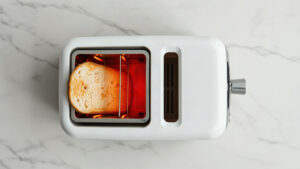
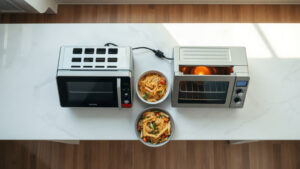
A toaster runs between 300°F and 450°F and reheats thin, dry foods like bread or pizza in under 3 minutes — but it’s a one-trick pony. A toaster oven reaches similar or higher temperatures with far more control, making it better for most leftover situations, especially anything with moisture, cheese, or thickness. If raw speed on toast-like foods is all you need, the toaster wins; for everything else, the toaster oven is the smarter, cheaper long-term tool.
Safety First: Both toasters and toaster ovens produce exposed heating elements that reach temperatures well above 300°F. Never leave either appliance unattended while reheating food with added oil, cheese, or sauces — these can drip onto heating elements and ignite. Keep the crumb tray on your toaster empty and clean, and always place your toaster oven on a heat-safe surface with at least 4 inches of clearance on all sides. If you smell burning, switch it off at the outlet immediately — don’t just hit the lever or the cancel button.
Quick Facts: Toaster vs Toaster Oven for Leftovers
- A standard toaster operates between 300°F–450°F but can’t control exact temperature — you’re guessing based on shade settings.
- Toaster ovens typically draw 1,200–1,800 watts; most pop-up toasters use 800–1,200 watts — the energy difference per use is real but small.
- For pizza, chicken, french fries, or anything you want crispy on the outside but warm in the middle, a toaster oven at 350°F for 8–12 minutes beats every other method.
- Toasters are faster for the specific job of browning bread — usually 1.5 to 3 minutes versus 4–6 in a toaster oven.
- Over a year of regular use, a toaster oven will save you money versus using a full-size oven to reheat single servings.
The Speed Question: Which Actually Heats Food Faster?
Okay, let’s be real about what “faster” means here. Faster at what, exactly?
If you’re dropping two slices of bread in and walking away, a pop-up toaster wins. No preheating, no waiting for a cavity to come up to temperature. You push the lever, it’s done in roughly two minutes. I’ve timed it. My old Cuisinart 2-slice would have toast ready in about 90 seconds on setting 4, which is what I’d use for leftover garlic bread or an English muffin.
But the moment you’re reheating anything with real substance — a slice of cold pizza, a piece of roast chicken, leftover stuffed peppers — the toaster can’t even participate in that conversation. You’d be cramming food into a slot designed for flat things and either starting a small fire or just eating cold food with warm edges. Neither is good.
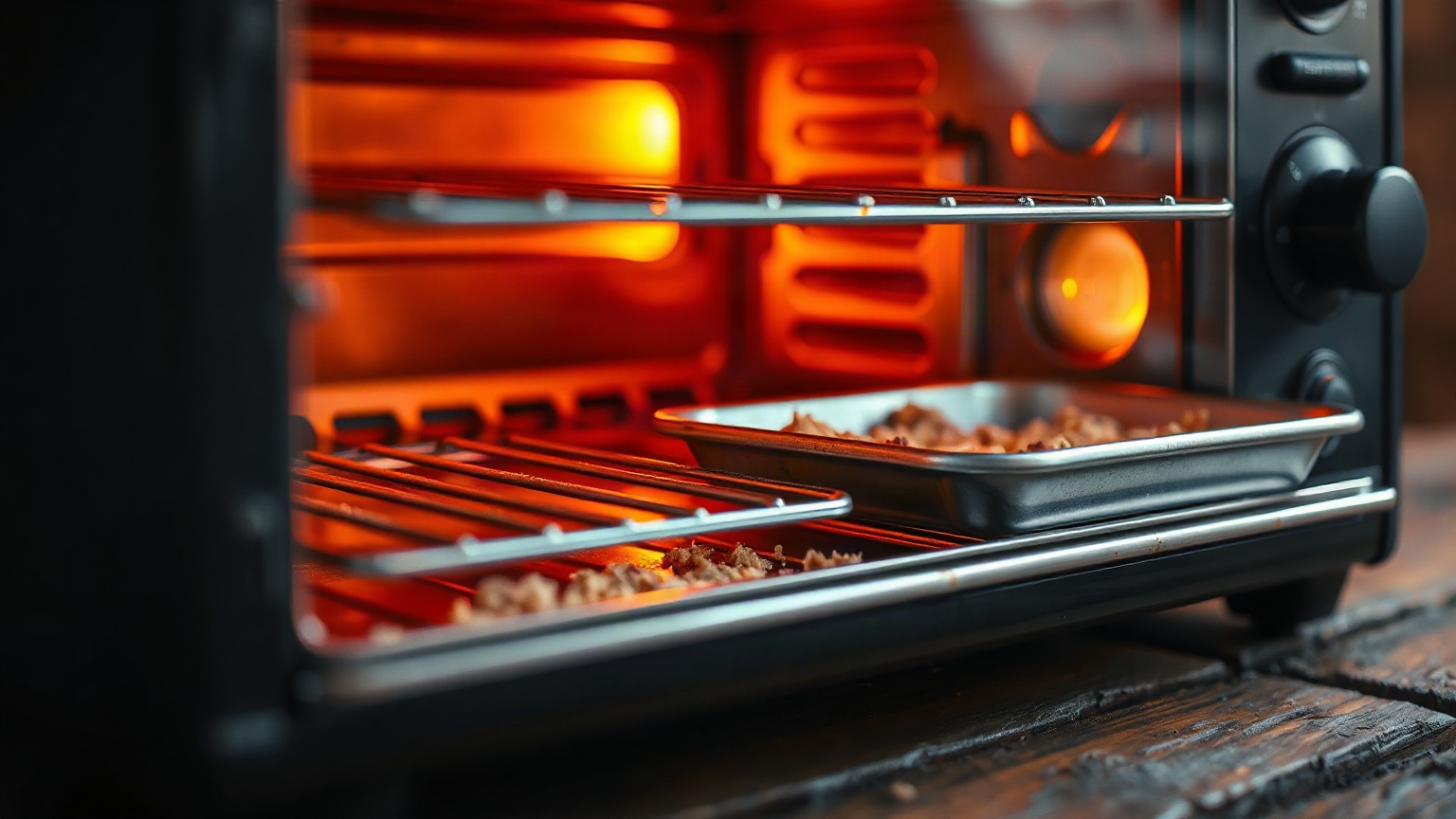
A toaster oven does need a few minutes to preheat. That’s the honest downside. Most models I’ve tested take 4–6 minutes to hit 350°F, though the Breville Smart Oven models are faster than budget units. So your total reheating time for a chicken thigh might be 14 minutes including preheat. But the food actually comes out hot all the way through, with a crust that’s crispy again rather than rubbery. Worth it.
When the Toaster Actually Wins on Speed
Frozen waffles. Leftover toast. Bagels. Thin naan that you just want warm. These are genuinely better in a pop-up toaster because the radiant heat hits both sides simultaneously and you don’t lose five minutes to preheat. There’s a reason toasters still exist — they do that specific job faster than anything else on your counter.
But I’d push back on the idea that this makes a toaster “faster for reheating leftovers” in any general sense. Most leftovers aren’t bread-shaped. That’s just the truth.
The Cost Question: Energy Use, Real Numbers
This is where it gets genuinely interesting, and also where I see a lot of oversimplified takes online.
A pop-up toaster uses roughly 800–1,200 watts and runs for 2–3 minutes. Do the math: that’s about 0.03–0.06 kWh per use. At the US average electricity rate of around $0.16/kWh, each toast cycle costs you less than a penny. A toaster oven at 1,500 watts running for 12 minutes uses about 0.3 kWh — roughly 5 cents.
So per session, yes, the toaster is cheaper. But compare both to a full-size oven. A standard electric oven at 2,500–5,000 watts, preheated for 15 minutes and running for 20, can cost 15–25 cents per session. For single-serving reheating, the toaster oven is dramatically cheaper than the big oven. That’s the comparison that actually matters for most households.
If you’re currently reheating yesterday’s pasta bake in your full-size oven, switching to a toaster oven will save you noticeable money over a year. The toaster wins on pure energy cost, but only if you’re comparing apples to apples — bread-to-bread situations where it can actually do the job.
| Appliance | Wattage | Avg. Session Time | Est. Energy/Session | Approx. Cost/Session |
|---|---|---|---|---|
| Pop-Up Toaster | 800–1,200W | 2–3 min | 0.03–0.06 kWh | <$0.01 |
| Toaster Oven | 1,200–1,800W | 10–15 min | 0.2–0.45 kWh | ~$0.03–0.07 |
| Full-Size Electric Oven | 2,500–5,000W | 30–40 min total | 1.25–3.3 kWh | ~$0.20–0.53 |
Energy cost estimates are based on the US average residential electricity rate (~$0.16/kWh as of 2024). Your actual rate will vary.
Which Appliance Is Actually Better for Specific Leftovers?
I’ve reheated a lot of food in both. Here’s what I’ve actually found, not what the product listings say.
Pizza
Toaster oven. Every time. 375°F for 8–10 minutes on a wire rack (not a tray — this matters, the bottom crust gets crispier with airflow underneath). I tried the microwave for years and it’s genuinely bad. I tried the stovetop trick and it works but requires babysitting. The toaster oven is hands-off and consistent. You can find a decent toaster oven wire rack for a few dollars and it makes a real difference.
Fried Foods (Fries, Wings, Egg Rolls)
Toaster oven again, ideally with a convection setting if yours has one. I do fries at 400°F for 6–8 minutes, spread out on a small toaster oven baking pan. They won’t be quite as crispy as fresh-fried, but they’ll be dramatically better than anything a microwave does. Wings at 375°F for 10–12 minutes come out genuinely good.
Bread, Toast, Bagels, Waffles
Pop-up toaster, no question. Faster, more even browning, and you don’t heat up your whole toaster oven for 90 seconds of work. The toaster is built for exactly this.
Casseroles, Pasta, Soups
Microwave, honestly. The toaster oven isn’t great at reheating things with a lot of liquid content uniformly. You can do it in an oven-safe dish at 325°F covered with foil, and it works fine, but it takes 20–25 minutes. Sometimes the microwave is just the right tool. I know that’s not a hot take, but it’s true. You can read more about reheating food in a toaster oven to get a fuller breakdown of what works and what doesn’t.
Counter Space and the Real Practical Tradeoff
A pop-up toaster takes up almost nothing — maybe 7 by 10 inches for a 2-slice model. A toaster oven is typically 16–20 inches wide and 10–14 inches deep. That’s not nothing. In a small apartment kitchen, it genuinely is a tradeoff.
My personal take: if you’re debating whether to have both or just one, get a toaster oven and ditch the pop-up toaster. Modern toaster ovens with a toast function are genuinely decent at making toast — not quite as even as a dedicated toaster, but good enough. And then you gain everything else: pizza, roasted vegetables, reheated casseroles, even small batch baking.
The one exception is if you make toast every single morning and nothing else. Then keep the toaster. It’s faster, it’s reliable, and there’s something satisfying about a machine that does one thing extremely well.
If you’re shopping for a compact unit, our guide to the best mini toaster ovens covers some solid options that won’t swallow your entire counter.
Specific Models Worth Knowing About
Not all toaster ovens are equal at reheating. Here are four I’d actually recommend (and one I’d skip for this specific use case):
The Breville Smart Oven Air Fryer Pro is genuinely excellent. Preheat is fast, temperature accuracy is good, and the convection setting is consistent. It’s premium-priced, and the footprint is large — not a small kitchen appliance. But for reheating leftovers specifically, the results are hard to beat.
The Cuisinart TOA-70 is a solid mid-range pick. Good capacity, air fryer function that works well for fries and wings, and it doesn’t take forever to heat up. I’d call it the practical choice for most people.
The Ninja Foodi digital air fry oven is worth mentioning because it folds flat — genuinely clever if storage is tight. Performance is good, especially for air-fry reheating.
Hamilton Beach makes budget-friendly toaster ovens that work fine for basic reheating. Don’t expect precise temperature control or even browning, but for under $50, they do the job.
My honest verdict: for reheating leftovers specifically, the Cuisinart TOA-70 hits the best balance of performance, price tier, and counter footprint. The Breville is better but costs significantly more. If the Breville’s price doesn’t make you wince, get the Breville. If it does, the Cuisinart is not a compromise — it’s a genuinely good appliance.
| Model | Price Tier | Capacity | Air Fry? | Best For |
|---|---|---|---|---|
| Hamilton Beach (basic) | Budget | Small–Medium | No | Occasional simple reheating |
| Cuisinart TOA-70 | Mid-Range | Medium–Large | Yes | Everyday reheating + air frying |
| Ninja Foodi Digital Air Fry | Mid-Range | Large | Yes | Small kitchens, fold-flat storage |
| Breville Smart Oven Air Fryer Pro | Premium | Large–XL | Yes | Performance-first buyers |
So Which Should You Actually Use?
The honest answer is that both appliances have their lane, and trying to force one to do the other’s job is where people get frustrated.
Use a toaster for bread-based foods when speed matters. Use a toaster oven for essentially everything else you’re reheating. And if you’re asking which is cheaper to run — the toaster costs slightly less per session, but the toaster oven saves you far more money versus using a full-size oven. That’s the comparison that actually moves the needle on your electricity bill.
If you only have room or budget for one? Get the toaster oven. It does both jobs adequately, and it handles the full range of leftover situations that a pop-up toaster simply can’t touch. For a deeper look at how hot a toaster gets versus a toaster oven, that’s worth a read too — the temperature ranges explain a lot about why each appliance behaves differently.
The Serious Eats pizza reheating guide is also worth bookmarking — they tested a lot of methods and the toaster oven results lined up pretty closely with what I’ve found on my own. And the FDA’s guidelines on leftover food safety are a good reminder that reheating to 165°F internally isn’t optional — regardless of which appliance you use.
Frequently Asked Questions
How hot does a toaster get compared to a toaster oven?
A pop-up toaster’s heating elements can reach between 300°F and 450°F, but you can’t set an exact temperature — the shade dial controls time, not heat level. A toaster oven lets you dial in a specific temperature, typically between 150°F and 450°F depending on the model. That control is what makes a toaster oven more versatile for reheating foods that need gentle or precise heat.
Is a toaster oven cheaper to run than a regular oven for reheating?
Yes, significantly. A toaster oven uses roughly 1,200–1,800 watts versus 2,500–5,000 watts for a full-size electric oven, and it preheats much faster — cutting your total energy use per session by 50–75%. For single-serving reheating, using your full oven is genuinely wasteful. A toaster oven is the smarter choice for anything you’re not cooking in bulk.
Can you reheat pizza in a toaster?
Not really — standard pop-up toasters aren’t designed for pizza slices, and attempting it creates a fire risk from dripping cheese and grease landing on heating elements. A toaster oven at 375°F for 8–10 minutes on a wire rack is the best method for reheating pizza without a sogged-out crust. Some toasters do sell a “toaster bag” accessory that technically works for flat slices, but results are inconsistent.
How long does it take to reheat leftovers in a toaster oven?
It depends on what you’re reheating. Pizza and fried foods typically take 8–12 minutes at 350–375°F. Thicker items like chicken pieces or casseroles in an oven-safe dish may take 15–20 minutes at 325–350°F. Add 4–6 minutes for preheat on most toaster oven models. Always check that the internal temperature has reached 165°F before eating reheated meat or poultry.
Is it safe to leave a toaster oven on while reheating food unattended?
It’s generally safer to stay nearby, especially when reheating foods with cheese, oil, or sauces that can drip and potentially smoke or burn. Most toaster ovens have auto-shutoff timers, which help, but they’re not a substitute for keeping an eye on what’s inside. If you smell anything burning, turn the appliance off at the outlet, not just with the controls, and wait for it to cool before opening.

Written by
Emma founded Toastera to turn vague appliance advice into clear, researched, safety-first guidance on toasters and toaster ovens.
Free: the Toaster Oven Cheat Sheet
Get the printable cheat sheet (temps, cook times & safety tips) plus new recipes. No spam, unsubscribe anytime.