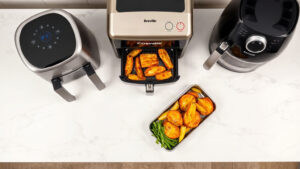
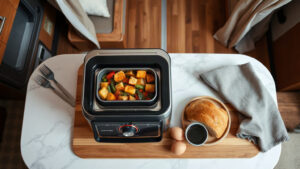
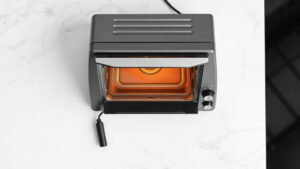
Most standard toaster ovens will not fit a 9×13 pan — you need an extra-large or countertop convection oven with an interior cavity of at least 19–20 inches wide and 13–14 inches deep to get a full-size 9×13 baking dish in with enough clearance to actually cook properly. The pan might technically slide in on some mid-size models, but with zero airflow around the edges, your casserole is going to cook unevenly and you’ll probably burn your knuckles getting it out. If a 9×13 pan is non-negotiable for you, you’re shopping in a pretty specific category — and not every “large” toaster oven on the market actually qualifies.
Safety First: Extra-large toaster ovens run hot on the exterior — the top and sides of units like the Breville Smart Oven Air Fryer can exceed 200°F during high-heat baking. Keep at least 4 inches of clearance on all sides and never place anything on top of the unit while it’s running. Use oven mitts rated for high heat when handling a 9×13 pan, since the full weight plus a hot, narrow interior makes burns a real risk.
Quick Facts: 9×13 Pans and Toaster Oven Size
- A standard 9×13 pan measures approximately 13 inches long × 9 inches wide × 2 inches deep — but with handles, the actual footprint is often 14.5–15 inches.
- You need a toaster oven interior of at least 19 inches wide to fit the pan and allow meaningful air circulation.
- Compact and mid-size toaster ovens (under 1,500 watts, interiors under 16 inches wide) won’t cut it for a 9×13 pan — period.
- Several extra-large countertop ovens do fit a 9×13 pan: the Breville Smart Oven Air Fryer Pro, Cuisinart TOA-70, and Ninja Foodi XL Pro are the most commonly recommended.
- Even if the pan fits, check rack position — you need at least 1.5 inches of clearance above the pan surface to the top heating element.
Why Pan Size Is Trickier Than It Sounds
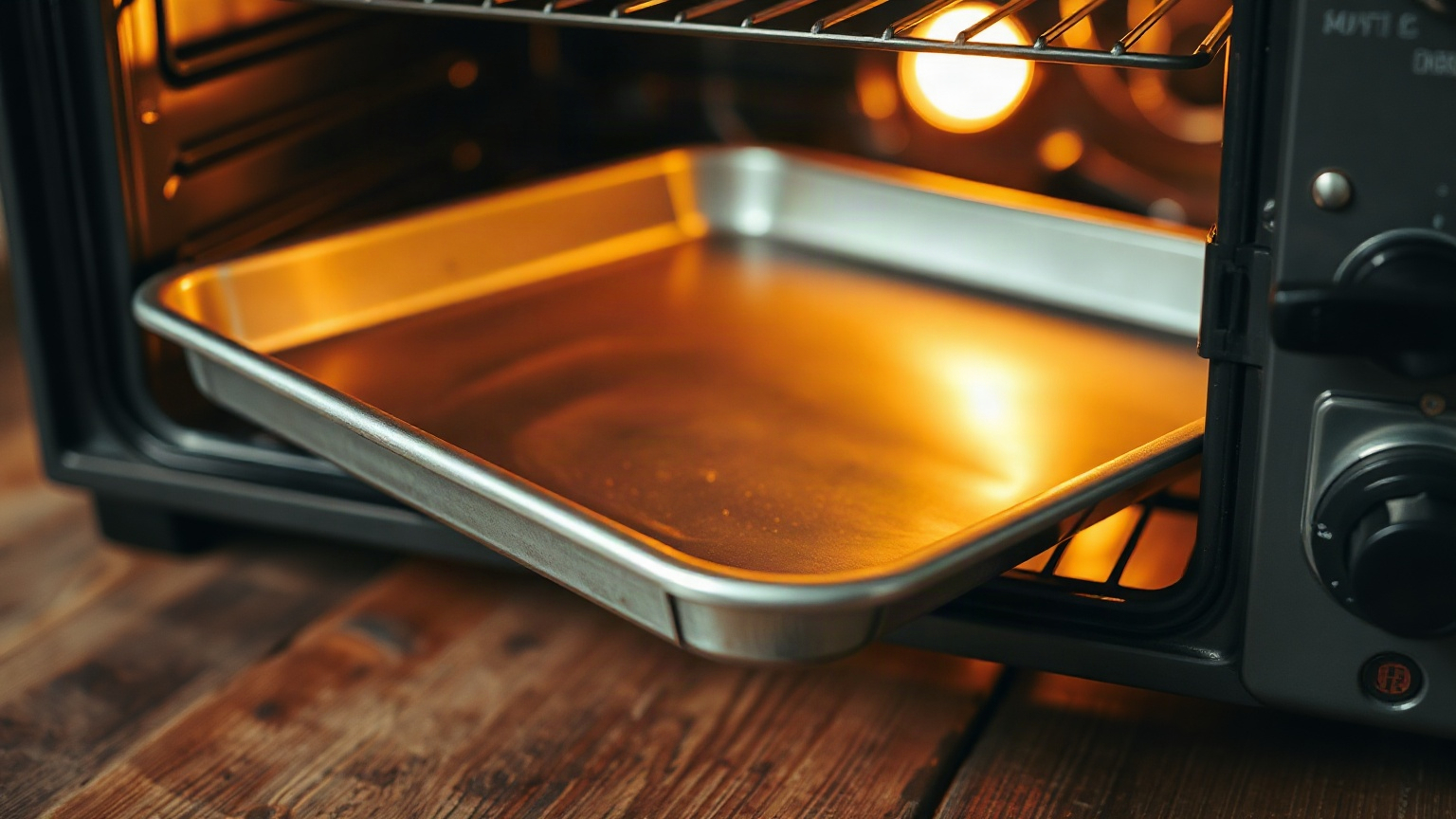
Here’s the thing that burned me the first time I tried this. I measured my toaster oven’s interior — it was listed as “fits a 12-inch pizza” — and I thought, okay, 12 inches is bigger than 9, so surely a 9×13 pan works, right? Wrong. The 12-inch pizza claim refers to the diagonal width of a round pizza. A 9×13 pan is 13 inches on its longest dimension, plus whatever the handles add. It’s a completely different shape, and it needs clearance on the sides, not just the front-to-back measurement.
The other thing nobody talks about: even if the pan slides in, that doesn’t mean it fits in any useful sense. I’ve seen people post triumphantly that their 9×13 pan “fits” in their mid-size oven, and then complain that the edges of their lasagna are overcooked and the center is cold. That’s what happens when the pan is essentially touching the sides and there’s no room for heat to circulate. Convection fans are useless if there’s no space for air to actually move.
The Interior Dimensions You Actually Need
Let me give you the numbers that actually matter — not marketing copy.
Minimum Interior Dimensions for a 9×13 Pan
For the pan to sit on the rack without touching the walls, you need an interior width of at least 15 inches. But for real airflow, especially if you’re using convection, aim for 19+ inches wide. Interior depth (front to back) should be at least 13.5 inches — 14+ is better. And height matters more than people expect: you want at least 4–5 inches of usable interior height so there’s room for a 2-inch deep pan plus the contents, plus clearance from the top element.
The ovens that consistently meet this threshold are in the extra-large or “countertop oven” category. These are physically big appliances. We’re talking footprints of 20–22 inches wide on your counter. If counter space is tight, you need to decide whether a 9×13 pan is a frequent necessity or an occasional want — because the oven required to handle it isn’t small.
The Pan Handle Problem
This is an edge case that almost nobody mentions. Glass baking dishes — the kind you’d use for a 9×13 casserole — often don’t have handles that extend the total length. But metal baking pans, particularly the ones with rolled handles or silicone-grip handles, can add 1.5–2 inches on each end. That pushes the total length to 16 or 17 inches. Check the specific pan you plan to use, not just the nominal “9×13” label.
I found this out the hard way with a Nordic Ware pan that had slightly wider-than-normal handles. It didn’t fit in a toaster oven that technically had “fits 9×13” in the product description. The oven itself wasn’t lying — a standard glass 9×13 Pyrex dish did fit. But my preferred metal pan didn’t. So. Measure your pan before you buy the oven.
Specific Models That Actually Work (and What to Expect)
I’ve used or tested several of these in real cooking situations — not just slid a cold empty pan in and called it a day. Here’s my honest take on the main contenders.
| Model | Interior Width (approx.) | Fits 9×13? | Convection? | Price Tier |
|---|---|---|---|---|
| Breville Smart Oven Air Fryer Pro (BOV900BSS) | ~18.5 in | Yes (Pyrex; check metal pans) | Yes, super convection | Premium |
| Cuisinart TOA-70 | ~17 in | Tight fit, works | Yes | Mid-range |
| Ninja Foodi XL Pro Air Fry Oven (SP351) | ~19 in | Yes, with clearance | Yes | Mid-range |
| Hamilton Beach 31107D | ~18 in | Yes | No | Budget |
| Cuisinart TOB-260N1 | ~19 in | Yes, comfortably | Yes | Mid-range/Premium |
Breville Smart Oven Air Fryer Pro
This is the one I’d buy if I were starting fresh and wanted to genuinely replace a full-size oven for most tasks. The Breville Smart Oven Air Fryer Pro has a genuinely large cavity, super convection that actually works (the fan is more powerful than most competitors), and the temperature calibration is accurate — something I can’t say for every toaster oven I’ve tested. At 425°F on convection bake, a chicken thigh casserole in a standard Pyrex 9×13 came out evenly browned across the whole dish. No hot spots at the back, which is the usual failure mode. It’s a premium price, but it earns it.
Cuisinart TOA-70 and TOB-260N1
The Cuisinart TOA-70 is a solid mid-range pick. It fits a 9×13 pan, though barely — there’s maybe half an inch of clearance on each side with a standard Pyrex. It works. The convection bake function is reliable, and for the price, it’s genuinely good value. The TOB-260N1 is roomier and closer to premium territory. If you’re regularly cooking for a crowd and want that extra clearance without paying Breville prices, the TOB-260N1 is worth a look.
Ninja Foodi XL Pro
The Ninja is physically wide and handles a 9×13 pan with noticeably more room than the Cuisinart TOA-70. Honestly, I find the control interface a bit fiddly — there are a lot of presets and the manual temperature mode takes more button presses than it should. But the cooking performance is excellent, especially for air frying and roasting. The bake setting at 400°F does a respectable job on sheet cakes and casseroles. Good pick if you want the air fry capability plus 9×13 capacity without spending Breville money.
Hamilton Beach 31107D
Budget option. It fits a 9×13 pan and it bakes, but it doesn’t have convection — which means cooking times are longer and you’ll need to rotate the pan halfway through. For someone who mostly wants to reheat big dishes or do occasional baking without a full oven, it’s functional. I wouldn’t choose it for anything that needs precise, even heat. But it’s cheap and it works, and that’s genuinely useful information for some people. Check it out on Amazon here.
Cooking in a Toaster Oven vs. a Full-Size Oven: What Changes
Even in the best extra-large toaster ovens, cooking with a 9×13 pan works a bit differently than your conventional oven. The cavity is smaller, so it preheats faster — usually 5–8 minutes compared to 15 for a standard oven. That’s genuinely nice. But the smaller space also means heat fluctuates more, and the top heating element is closer to your food.
For anything with cheese or a breadcrumb topping, I drop the temperature by 25°F and check 10 minutes earlier than the recipe says. Toaster ovens brown faster on top. If I’m making a lasagna at 375°F in my regular oven, I’ll set the toaster oven to 350°F and tent with foil for the first two-thirds of the cooking time. Serious Eats has covered how convection changes baking times really well if you want the full technical breakdown — the short version is convection reduces your bake time by roughly 25%.
Also worth reading: our guide on reheating food in a toaster oven — it covers rack position and temperature settings in a lot more detail.
Rack Position Is Not Optional
This tripped me up early on. The rack position in an extra-large toaster oven matters enormously because the top element is so close to the food. For a 9×13 pan with a tall-ish dish (think mac and cheese, lasagna), use the lowest rack position to maximize distance from the top element. For something flatter — roasted vegetables, sheet pan chicken — the middle rack is fine. The manual for your specific oven will show rack positions, but honestly, I’ve found starting at the lowest position and adjusting from there is the safer default.
My Actual Recommendation
If you cook for four or more people and regularly need a 9×13 pan, buy the Breville Smart Oven Air Fryer Pro. It’s expensive. It’s also the most reliable, most accurate, and most genuinely capable appliance in this category. I’ve used it to bake brownies, roast a whole chicken, and reheat a giant pan of lasagna — all with results I’d serve to guests without anxiety.
If the Breville price is a hard stop, the Ninja Foodi XL Pro is my second pick. It has more internal width than the Cuisinart TOA-70, the convection performance is solid, and the air fry function actually works well. The interface is annoying but you get used to it.
If you’re cooking alone or for two and the 9×13 pan need is occasional, reconsider whether you need this size oven at all. A smaller unit will do most things better for a one-person household — faster, more efficient, and without taking over your entire counter. Take a look at our best mini toaster ovens list to see what’s possible in a smaller footprint.
One more thing: whatever you buy, pick up a proper toaster oven-compatible 9×13 baking pan — the kind without large external handles. It’ll save you a lot of frustration with clearance issues and it usually fits more reliably than whatever random pan you’ve got in the cabinet.
Wrapping Up
Getting a 9×13 pan into a toaster oven is doable — but only with the right oven, and there are fewer of them than the marketing language implies. The critical numbers are interior width (19+ inches ideal), depth (13.5+ inches), and top-of-rack clearance. The Breville Smart Oven Air Fryer Pro is the clear best-in-class for this. The Ninja Foodi XL Pro and Cuisinart TOB-260N1 are legitimate alternatives that cost less. Measure your actual pan, including handles, before you commit to anything. And remember that even a toaster oven that fits a 9×13 pan will behave differently than your full-size oven — usually hotter on top and faster overall, so adjust your recipes accordingly.
For more on how these ovens handle temperature across different settings, our breakdown of how hot a toaster gets is worth a read — it covers heating elements and temperature ranges in detail.
Frequently Asked Questions
What size toaster oven do I need for a 9×13 pan?
You need an extra-large toaster oven with an interior width of at least 15 inches (19+ inches for comfortable clearance and proper airflow), and an interior depth of at least 13.5 inches. Models marketed as “fits a 9×13 pan” include the Breville Smart Oven Air Fryer Pro, Ninja Foodi XL Pro, and Cuisinart TOB-260N1 — but always measure your specific pan, including handles, before purchasing.
Can a standard toaster oven fit a 9×13 pan?
No. Standard and mid-size toaster ovens — the kind that fit on most kitchen counters without dominating them — have interior widths of 12–16 inches, which isn’t enough for a 9×13 pan to sit properly. You’ll need an extra-large countertop oven, which typically has a significantly larger footprint (20–22 inches wide on your counter).
What is the best toaster oven that fits a 9×13 pan?
The Breville Smart Oven Air Fryer Pro (BOV900BSS) is the best overall toaster oven for fitting and actually cooking well with a 9×13 pan — its convection system is the most even and powerful in this category. The Ninja Foodi XL Pro is the best mid-range alternative, offering a wider interior than many competitors at a lower price point than the Breville.
How do I adjust cooking times when using a 9×13 pan in a toaster oven?
Lower your temperature by 25°F compared to a conventional oven recipe, and start checking for doneness 10–15 minutes earlier than the recipe suggests. Toaster ovens brown food faster on top due to the proximity of the heating element, so tent your pan with foil for the first two-thirds of the cook time for dishes like casseroles or lasagna.
Will a 9×13 Pyrex dish fit in a toaster oven differently than a metal pan?
Yes, and this matters more than most people expect. A standard Pyrex 9×13 glass dish typically has a smaller total footprint than a metal baking pan with rolled or silicone handles, which can add 1.5–2 inches to the total length. If a toaster oven claims to fit a 9×13 pan, it’s usually referring to a standard glass dish — always measure your specific metal pan before assuming it’ll fit.

Written by
Emma founded Toastera to turn vague appliance advice into clear, researched, safety-first guidance on toasters and toaster ovens.
Free: the Toaster Oven Cheat Sheet
Get the printable cheat sheet (temps, cook times & safety tips) plus new recipes. No spam, unsubscribe anytime.