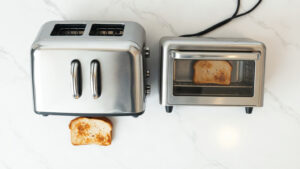
The best 4-slice toaster for most large families is the Cuisinart CPT-435 — it’s consistent, wide-slot, and genuinely easy to live with every morning. The Breville BTA840XL edges it out on browning precision if you care deeply about even colour across every slice, but it costs noticeably more. The KitchenAid KMT423 looks stunning on a counter and performs well, but it’s the one I’d pick last of the three for a household that just needs reliable speed at breakfast.
Safety First: All three toasters run heating elements that reach internal temperatures well above 300°F. Never operate any of them near curtains or under overhead cabinets without adequate clearance (at least 4 inches on all sides). Don’t leave them unattended when toasting anything with a high sugar content — glazed bread and sweet pastries can scorch and smoulder faster than plain bread. Always unplug before clearing the crumb tray. And don’t ever shake crumbs out over the sink — water and exposed heating elements are a genuinely bad combination.
Key Takeaways
- The Cuisinart CPT-435 is the best all-rounder for large families: wide slots, consistent toast, mid-range price tier, and a crumb tray that actually slides out without a fight.
- The Breville BTA840XL has the most precise browning control of the three — its “A Bit More” button is genuinely useful, not a gimmick — but you pay a premium for it.
- The KitchenAid KMT423 is the prettiest option and handles thick artisan bread well, but its slot width is slightly narrower and shade consistency across all four slots can drift.
- For bagels and English muffins specifically, the Breville’s bagel mode (heats one side only) is noticeably better than the other two.
- All three toasters draw between 1,500–1,800 watts. If you’re running them on a shared kitchen circuit with a coffee maker, check your breaker capacity first.
How I Actually Tested These
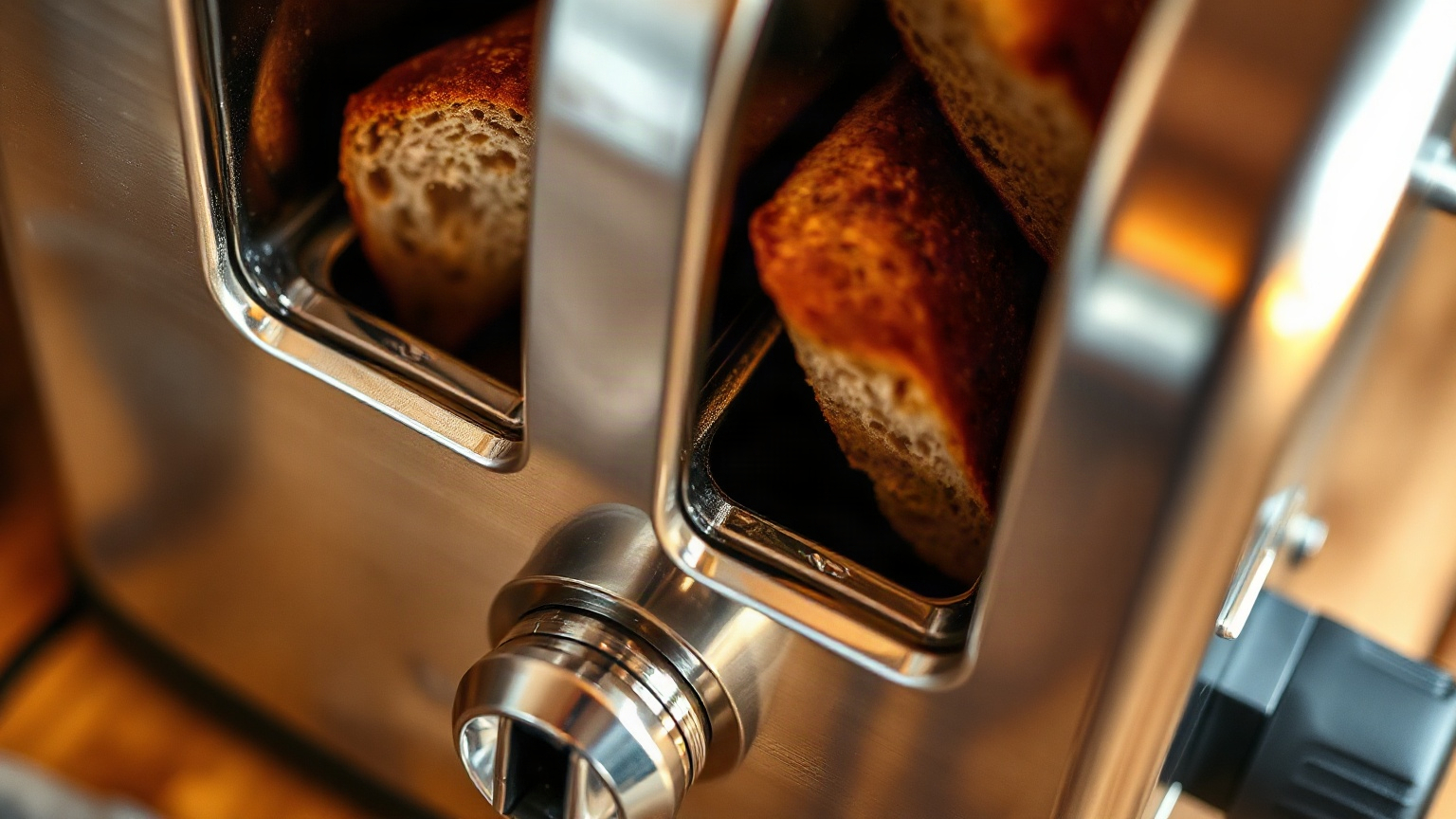
I ran all three toasters through the same sequence over about two weeks. Plain white sandwich bread at shade setting 3 (middle of the dial), then whole wheat at setting 4, then a thick slice of sourdough that was borderline too wide for a standard slot. Bagels. Frozen waffles. And one morning, some fruit loaf I’d made the day before — just to see what happened with something dense and slightly sticky.
I also timed how long each cycle took, checked the toast on all four slots (not just the ones facing front), and paid attention to the small stuff: how loud the lever is, whether the cord is a reasonable length, how much heat radiates off the casing during use. These are the things that matter when you’re using an appliance every single day. If you’re curious about the temperature science, I covered how hot a toaster gets in a separate piece — the short version is that browning starts happening around 310°F through the Maillard reaction, and crispiness follows.
Cuisinart CPT-435: The One That Just Works
This is the toaster I’d buy if I had four kids and no patience for fussy appliances. The slots are extra-wide — 1.5 inches — so it handles thick-cut bread without you having to angle the slice in and hope for the best. All four slots have independent shade controls, which sounds like a minor detail until you’re simultaneously making light toast for a toddler and darker toast for yourself and you realise most toasters don’t do this.
Browning consistency across all four slots was solid. Not perfect — the two inner slots run very slightly hotter than the outer ones, and after about five consecutive rounds I could see a marginal difference. But it’s not something that’ll bother anyone who isn’t doing a controlled test. Toast cycle at setting 3 averaged about 2 minutes 10 seconds for standard sandwich bread.
The crumb tray deserves a mention. I genuinely hate cleaning crumb trays that stick or warp. This one slides out cleanly, lies flat, and can go in the dishwasher. That’s it. That’s the whole selling point right there for anyone who’s dealt with a tray that tips crumbs all over the counter on its way out.
One thing that tripped me up the first time: the shade dial markings are small and the numbers are embossed rather than printed, so they’re hard to read in low morning light. Minor, but annoying.
Breville BTA840XL: The Precision Pick
The BTA840XL is the toaster for people who’ve ever looked at a piece of toast and thought “that’s about 85% of the way there.” The “A Bit More” button adds a short extra burst of heat without you having to restart the whole cycle — sounds small, transformative in practice. First time I used it I was skeptical. By day three it had become a reflex.
Breville uses a “Lift and Look” feature that lets you check browning mid-cycle without cancelling the toast. The slots lower back down when you release. I used it twice in testing and then forgot about it, honestly — but for anyone who’s ever burned good bread because they couldn’t judge by smell alone, it’s a thoughtful feature. The bagel mode is the best of these three by a clear margin: it only activates the inner-facing elements, so the cut side toasts and the crust side just warms. That’s the correct way to do a bagel, and the other two don’t do it as precisely.
Slot width is 1.5 inches, same as the Cuisinart. Shade consistency across all four slots was the best I measured — meaningful if you’re toasting for a crowd and everyone’s getting a plate at the same time. Toast cycle at shade 3 averaged 2 minutes flat, slightly faster.
The price is premium. If your household mostly wants browned bread and you’re not the sort of person who notices subtle shade variation, you might find it hard to justify the extra cost over the Cuisinart. But if you’re serious about breakfast — and some people genuinely are — the Breville earns it.
KitchenAid KMT423: Beautiful, But Not Flawless
I’ll be honest: I wanted to love this one more than I did. It looks genuinely good on a counter, available in a range of colours, and KitchenAid’s build quality is solid. The lever mechanism feels satisfying in a way neither competitor quite matches.
But. Slot width is 1.5 inches nominally, though in practice the slots felt a touch snugger than the Cuisinart’s. My sourdough slice — a chunky one, maybe 1.3 inches thick — went in fine on the Cuisinart and Breville and needed a small adjustment on the KitchenAid. Not a dealbreaker. Just something to know if your household eats a lot of artisan bread.
The bigger issue was shade consistency. When I ran all four slots simultaneously at setting 4, the two slots on the left side came out slightly darker than the right. It wasn’t dramatic — maybe half a shade — but it was repeatable. The Cuisinart and Breville didn’t do this. For a large family where everyone’s toast comes out at the same time, it matters.
That said, the KitchenAid has a High Lift lever that raises the carriage further than standard, which makes getting smaller items out much easier. And it’s the only one of the three I’d recommend purely for a household where counter aesthetics matter. If your kitchen is a certain way, you know what I mean.
Side-by-Side Comparison
| Feature | Cuisinart CPT-435 | Breville BTA840XL | KitchenAid KMT423 |
|---|---|---|---|
| Slot Width | 1.5 in (extra-wide) | 1.5 in (extra-wide) | 1.5 in (slightly snug in practice) |
| Shade Settings | 7 per slot, independent | 9 (single control) | 7 (single control) |
| Avg. Toast Time (Setting 3) | ~2 min 10 sec | ~2 min flat | ~2 min 15 sec |
| Wattage | ~1800W | ~1800W | ~1600W |
| Bagel Mode | Yes (all elements) | Yes (inner elements only) | Yes (all elements) |
| “A Bit More” Feature | No | Yes | No |
| Crumb Tray | Slide-out, dishwasher safe | Slide-out | Slide-out |
| Price Tier | Mid-range | Premium | Mid-to-premium |
| Best For | Large families, daily use | Precision toast lovers, bagel households | Design-conscious kitchens |
The Edge Case Nobody Mentions: Frozen and High-Sugar Items
Every review I’ve read covers bread and bagels. Fair enough. But large families also toast frozen waffles, pop-tarts, cinnamon raisin bread, and the occasional slice of banana bread — things with higher sugar content that behave completely differently under heat.
Sugar browns faster. Much faster. All three toasters have a frozen setting that reduces initial heat to thaw before browning, which helps with waffles. But none of them have a dedicated “high sugar” mode, which means cinnamon raisin on setting 3 will come out darker than plain bread at the same setting on all three. My recommendation: drop one shade setting for anything with added sugar or fruit. Setting 2 on the Cuisinart and Breville gave me consistently good results with sweet breads. The KitchenAid at setting 2 was occasionally under for the same items — worth noting.
Serious Eats has a good breakdown of what actually makes toasters perform differently at a technical level, if you want to go deeper on heating element design and airflow. For most people, the practical upshot is: test one shade lower than you think you need, especially in the first week with a new toaster.
Who Should Buy Which One
If you’re feeding a family of five or more and you just want breakfast handled without drama: Cuisinart CPT-435. Independent slot controls, easy cleanup, consistent results. Check the Cuisinart CPT-435 on Amazon.
If your household is serious about toast quality and eats a lot of bagels: Breville BTA840XL. The precision browning and proper bagel mode make it worth the premium. Check the Breville BTA840XL on Amazon.
If the toaster sits prominently on your counter and appearance matters as much as function: KitchenAid KMT423. It’s good, not great, but it’s the best-looking of the three by some distance.
And if you’ve got a smaller household or limited counter space, it might be worth reading up on the best mini toaster ovens instead — sometimes a compact toaster oven handles family variety better than a dedicated 4-slice unit.
Final Verdict
The Cuisinart CPT-435 is my pick for most large families. It’s not flashy. It doesn’t have a “Lift and Look” feature or nine shade settings. What it has is reliability, independent controls, and a crumb tray that doesn’t make me want to put it in the bin. For a toaster you’ll use 365 mornings a year, that’s what matters.
The Breville BTA840XL is genuinely the better toaster on a technical level — if that’s how you think about breakfast appliances, go for it. The KitchenAid is a solid third, and I don’t want to be too harsh on it, but shade inconsistency across four slots is a real limitation for high-volume use. If you do go the toaster oven route for more flexibility, check out how to get the most out of it by reading about reheating food in a toaster oven.
Frequently Asked Questions
What is the best 4-slice toaster for a large family?
The Cuisinart CPT-435 is the best 4-slice toaster for most large families. It has independent shade controls for each slot, extra-wide 1.5-inch openings, and a dishwasher-safe crumb tray — all practical features that matter when you’re making toast for multiple people every morning. The Breville BTA840XL is a better precision toaster but costs more and suits households where toast quality is a genuine priority.
How wide should a 4-slice toaster slot be for thick bread?
Look for slots that are at least 1.5 inches wide for thick-cut or artisan bread. All three toasters in this comparison — the Cuisinart CPT-435, Breville BTA840XL, and KitchenAid KMT423 — advertise 1.5-inch slots, though in hands-on testing the KitchenAid felt marginally snugger with very thick slices. If you regularly bake your own bread or buy chunky sourdough loaves, the Cuisinart and Breville gave more reliable clearance.
Is the Breville BTA840XL worth the extra cost over the Cuisinart CPT-435?
It depends on how particular you are about toast. The Breville has better shade consistency across all four slots, a more precise bagel mode, and the genuinely useful “A Bit More” feature for those moments when toast comes out slightly underdone. If your household eats toast every day and notices the difference between good and great browning, yes, it’s worth it. If you just need fast and consistent toast without fuss, the Cuisinart does the job for less money.
Can a 4-slice toaster handle frozen waffles and English muffins?
All three toasters have a dedicated frozen setting that extends the cycle to allow thawing before browning — it works well for waffles. English muffins fit easily in the extra-wide slots and toast evenly. The main thing to watch is sugar content: items with raisins, cinnamon, or glaze brown faster than plain bread, so drop one shade setting to avoid over-browning.
How many watts does a 4-slice toaster use?
Most 4-slice toasters draw between 1,500 and 1,800 watts. The Cuisinart CPT-435 and Breville BTA840XL both run at approximately 1,800W; the KitchenAid KMT423 runs slightly lower at around 1,600W. Running a 1,800W toaster alongside a coffee maker on the same 15-amp circuit can trip a breaker, so it’s worth checking your kitchen’s circuit layout if you have multiple appliances running at breakfast time.

Written by
Emma founded Toastera to turn vague appliance advice into clear, researched, safety-first guidance on toasters and toaster ovens.
Free: the Toaster Oven Cheat Sheet
Get the printable cheat sheet (temps, cook times & safety tips) plus new recipes. No spam, unsubscribe anytime.