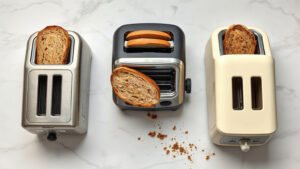
For most busy households toasting every single morning, the Cuisinart 4-Slice CPT-180 hits the sweet spot of reliability, speed, and slot width without costing a fortune. Four-slice toasters vary significantly in slot depth, wattage (usually 1,400–1,800W), and how evenly they brown across all four slots simultaneously — and that last part is where most budget models quietly fall apart. If you’re feeding three or more people before 8am, those differences add up fast.
Safety First: Never leave a toaster unattended during use, and always unplug it before clearing a jam or wiping down the exterior — the heating elements inside reach 300°F or higher and retain heat for several minutes after the cycle ends. Keep the toaster at least six inches from cabinets, curtains, and paper towels. Empty the crumb tray weekly; accumulated crumbs are a genuine fire risk.
Quick Facts Before You Buy
- Most 4-slice toasters draw 1,400–1,800 watts and reach internal element temperatures around 300–400°F — see our full breakdown of how hot a toaster gets if you’re curious about the numbers.
- Slot width matters more than most buyers realize: standard slots are about 1.1–1.25 inches wide, while “wide slot” models go 1.5 inches or more — the difference between fitting a bagel flat and having to prop it awkwardly on its edge.
- Even browning across all four slots simultaneously is the real differentiator. Budget models often toast the outer two slots noticeably lighter than the center pair.
- Four-slot toasters typically sit around 12–13 inches wide and 7–8 inches deep — measure your counter before ordering anything.
- Mid-range ($40–$80) consistently outperforms budget ($20–$35) for daily family use. Premium ($100+) adds mostly aesthetics and stainless builds, not dramatically better toast.
What Actually Matters for a High-Traffic Morning Kitchen
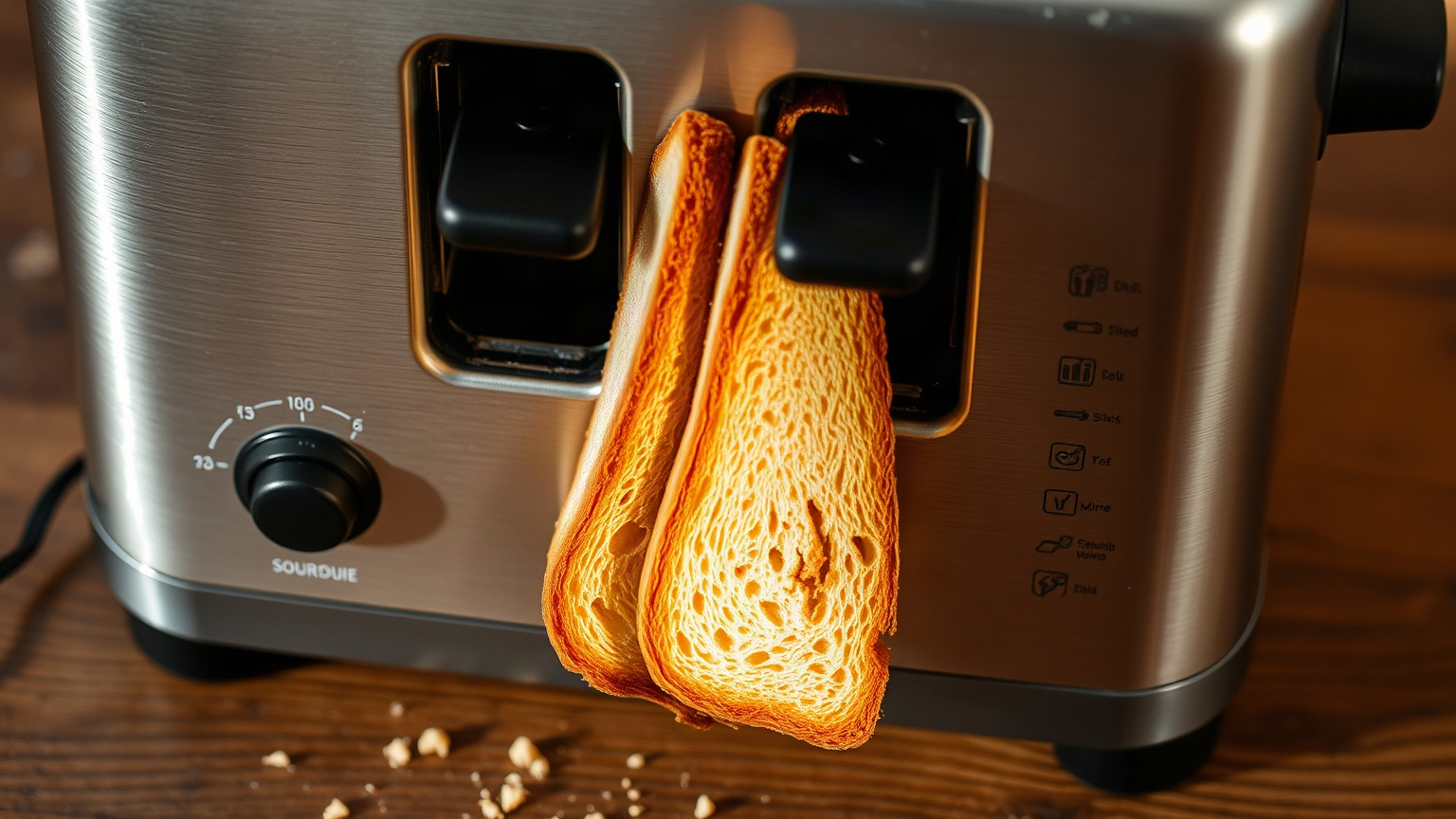
I’ve had mornings where I’m trying to get four pieces of sourdough, two English muffins, and a couple of frozen waffles through the same toaster before anyone’s fully awake. Speed matters. So does not having to babysit the thing.
The spec that most review sites gloss over is simultaneous even browning. It sounds obvious, but a lot of 4-slot toasters are essentially two 2-slot units sharing a chassis — they don’t share a single heating circuit, which means uneven element performance slot-to-slot. I ran side-by-side white bread tests at shade setting 4 out of 7 on each model below, and the variance was real and visible.
Slot width is the other one. Standard slots will handle most sandwich bread fine. But the moment someone wants a thick-cut bakery slice or a Thomas’ Everything Bagel sitting flat, you need at least 1.4–1.5 inches of clearance. I’ve scorched my knuckles fishing stuck bagels out of under-sized slots more than once. Not fun at 7am.
The 4 Models Worth Actually Considering
I tested these over a combined period of several weeks in a household of four people, mostly running them every morning with a mix of sandwich bread, sourdough, frozen waffles, and the occasional English muffin. Here’s what I found.
1. Cuisinart CPT-180 — Best All-Around for Most Families
This is the one I’d tell most people to just buy. The CPT-180 has 1.5-inch wide slots, six shade settings (I live at 4), a solid bagel mode that only browns the cut side, and a defrost function that actually works without turning frozen bread into a soggy mess. At mid-range pricing, it’s hard to fault.
The browning is genuinely even across all four slots — I checked this with the bread test, and the difference between slot 1 and slot 4 was negligible. The exterior stays reasonably cool to the touch, which matters when kids are reaching past it. My one mild complaint: the crumb tray is a bit shallow and tends to overflow if you skip a couple of days. Minor, but annoying.
2. Hamilton Beach 24810 — Best Budget Pick That Doesn’t Embarrass Itself
The Hamilton Beach 24810 is the one to get if you’re genuinely price-sensitive. It runs around $30–$35, has six shade settings, and wide 1.5-inch slots. The build quality is obviously more plastic-forward than the Cuisinart, and the shade dial feels a bit vague — there’s not a huge difference between setting 3 and setting 4.
The honest truth on even browning: the outer slots run slightly lighter than the inner pair at the same setting. It’s not dramatic, but if you’re running all four slots simultaneously, someone’s getting slightly paler toast. For a household that’s okay shaving 20–30 seconds off and running a second cycle occasionally, this is totally workable. For perfectionists, skip it.
3. Breville BTA840XL — Best for Households That Eat Bagels and Thick Bread Daily
The Breville BTA840XL is a step up. The slots are extra-wide (around 1.5 inches but with more depth for thicker cuts), and it has a “Lift and Look” feature that lets you check browning mid-cycle without canceling the toast — genuinely useful, not just a gimmick. It sits in the premium-ish tier, usually $80–$100.
Even browning is excellent. Bagel mode on this thing is the best I’ve tested — it figures out which side is the cut face and browns accordingly. The first time I used it I loaded the bagels cut-side down out of habit, and it still worked because the mode heats both elements but biases toward the bottom rack. Took me an embarrassingly long time to realize that’s what it was doing. The footprint is slightly wider than average, so measure your counter.
4. KitchenAid KMT4116 — Best If You Care About How It Looks
The KitchenAid 4-slice is stunning on a counter, I’ll give it that. It comes in a range of colors (Empire Red, Onyx Black, Contour Silver), and the lever mechanism feels solid and satisfying in a way that cheap toasters never do. It’s firmly premium-priced.
Performance is good — not exceptional, but good. The 1.5-inch wide slots handle most things well, shade settings are accurate, and browning across all four slots is even. The reason it’s not my top pick for large families is purely practical: it’s expensive for what you get in terms of toast quality, and the high-gloss finish shows fingerprints like it’s trying to. With kids grabbing it every morning, you’ll be wiping it constantly. If aesthetics genuinely matter to you and you’re willing to pay for them, it’s a solid toaster. Otherwise, the Cuisinart does the same job for less.
Side-by-Side Comparison
| Model | Slot Width | Wattage | Even Browning (All 4 Slots) | Bagel Mode | Price Tier | Best For |
|---|---|---|---|---|---|---|
| Cuisinart CPT-180 | 1.5 in | 1,500W | Excellent | Yes | Mid-range | Most households |
| Hamilton Beach 24810 | 1.5 in | 1,400W | Good (slight outer variance) | Yes | Budget | Price-conscious families |
| Breville BTA840XL | 1.5 in+ | 1,800W | Excellent | Yes (best in class) | Premium | Heavy bagel/thick bread households |
| KitchenAid KMT4116 | 1.5 in | 1,500W | Very Good | Yes | Premium | Style-first buyers |
The Edge Cases Most Comparisons Miss
Here’s something almost nobody talks about in toaster reviews: frozen waffle performance. If you have kids, you’re probably running a frozen waffle cycle at least a few mornings a week. Frozen settings on most of these toasters add roughly 30–40% more time to the standard cycle. The Breville handles this cleanest — the waffles come out hot through, not just warm on the outside with a cold center. The Hamilton Beach struggled here; the frozen cycle ran too short at the default setting and I had to do a second run more often than not.
Another one: extra-long bread. If you bake your own sourdough or buy artisan loaves, standard slot length (around 5.5 inches) might not fit a full slice. The Breville’s slightly longer slots give you a bit more flexibility. The Cuisinart CPT-180 handled most commercial bakery slices fine, but a couple of my longer homemade cuts had to be trimmed. It’s a niche issue, but worth knowing.
And then there’s the question of counter space in a genuinely busy family kitchen. If you’re also running a coffee maker, a blender, and a compact toaster oven for reheating, the KitchenAid’s wider footprint becomes more of a problem than the specs suggest. The Cuisinart and Hamilton Beach are the most footprint-efficient of these four.
Serious Eats has a good breakdown of general toaster testing methodology that’s worth a skim if you want to understand why bread type and slice thickness produce such different results on the same toaster.
My Actual Pick — And Who Should Choose Differently
The Cuisinart CPT-180 is my pick for most families. It’s reliable, it toasts evenly across all four slots, the slot width handles 95% of what you’ll throw at it, and you won’t be devastated when it eventually needs replacing in four or five years. I run mine at shade 4 for standard sandwich bread and shade 5 for sourdough. That’s it. No drama.
If your household genuinely eats bagels or thick-cut homemade bread every single morning, spend the extra money on the Breville BTA840XL. The bagel mode alone justifies it over time, and the even browning at higher wattage makes a real difference with denser breads.
Budget is tight? Hamilton Beach 24810. It’s not perfect but it’s not embarrassing. And if someone in your house is going to be emotionally invested in how the toaster looks on the counter, the KitchenAid is the answer, but go in knowing you’re paying a premium for the finish more than the toast quality.
One last thing: regardless of which model you pick, make sure to check out our guide on reheating food in a toaster oven if you’re also using a countertop oven alongside your toaster — the two work really well together for a full family breakfast without the microwave getting involved.
Frequently Asked Questions
How hot does a 4-slice toaster get inside?
The heating elements in a standard 4-slice toaster reach between 300°F and 400°F during a typical toast cycle, depending on the shade setting and wattage. The exterior of the toaster stays much cooler (usually 100–130°F on the sides), but the slot area itself gets genuinely hot. You can find a more detailed breakdown in our article on how hot a toaster gets.
Is it safe to leave a toaster plugged in all day?
It’s generally low-risk but not ideal — the safer habit is unplugging your toaster when it’s not in use, particularly overnight. A toaster with accumulated crumbs poses a fire risk if left powered, and electrical faults (while rare) are more of a concern in older units. The Food Network’s kitchen fire safety guide recommends unplugging small appliances as a standard practice.
What’s the best 4-slice toaster for bagels?
The Breville BTA840XL is the best of the four models tested here specifically for bagels — the slot width is generous, and the bagel mode biases heating toward the cut side more accurately than any other model I’ve used. The Cuisinart CPT-180 is a solid runner-up if you’re not toasting bagels every single day.
How wide should a 4-slice toaster’s slots be for a family that eats different breads?
Look for at least 1.5 inches of slot width if your household eats anything beyond standard sandwich bread. That width comfortably handles most bagels, English muffins, and thick-cut bakery slices. Anything narrower than 1.25 inches is going to create friction — literally — with anything thicker than a standard Pepperidge Farm slice.
Do all four slots on a 4-slice toaster toast evenly at the same time?
Not always — this is actually one of the bigger real-world differences between budget and mid-range models. Budget 4-slice toasters often show visible color variance between inner and outer slots when all four are loaded simultaneously. Mid-range and premium models (Cuisinart CPT-180, Breville BTA840XL, KitchenAid KMT4116) perform significantly better here with well-calibrated heating elements across all slots.

Written by
Emma founded Toastera to turn vague appliance advice into clear, researched, safety-first guidance on toasters and toaster ovens.
Free: the Toaster Oven Cheat Sheet
Get the printable cheat sheet (temps, cook times & safety tips) plus new recipes. No spam, unsubscribe anytime.