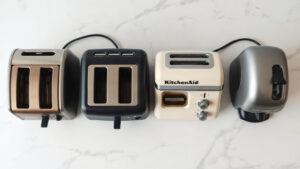
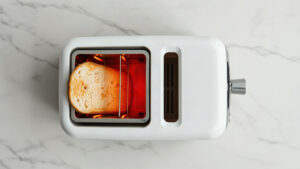
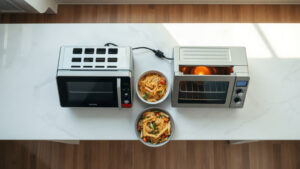
The best long-slot toaster for sourdough and artisan bread is the Breville Die-Cast 4-Slice Smart Toaster for most people — its slots run about 1.5 inches wide and 6 inches deep, which handles a thick sourdough boule slice without jamming. If you’re baking with a Pullman loaf pan or slicing your own batards at odd angles, you’ll want something with even more clearance. And if budget is the main concern, there’s a decent alternative that gets the job done for about half the price.
Safety First: Long-slot toasters run heating elements very close to wider bread surfaces — if your slice is too thick or sits unevenly, it can press against the element and scorch or ignite. Always check that bread moves freely before starting a cycle, never leave the toaster unattended with oversized loaves, and unplug the unit before fishing out any stuck bread (never use metal utensils inside a powered toaster).
Quick Facts: Long-Slot Toasters for Artisan Bread
- Standard toaster slots are roughly 1 inch wide and 4.5–5 inches tall — that’s too short for most homemade sourdough slices, which often hit 5.5–6+ inches
- True “long slot” toasters measure 6–7 inches in slot depth; wide slots should be at least 1.3 inches across for thick-cut artisan loaves
- The three real models worth considering: Breville Die-Cast 4-Slice, Smeg 4-Slice Long-Slot, and Oster 2-Slice Long-Slot (TSSTTRJB31)
- Toaster heating elements typically reach 300–400°F at the element surface — understanding how hot a toaster gets matters when you’re feeding it dense, moisture-heavy artisan bread
- None of these toasters will fit a full boule slice cut horizontally — if that’s your situation, a toaster oven is a better tool
Why Your Regular Toaster Keeps Failing You
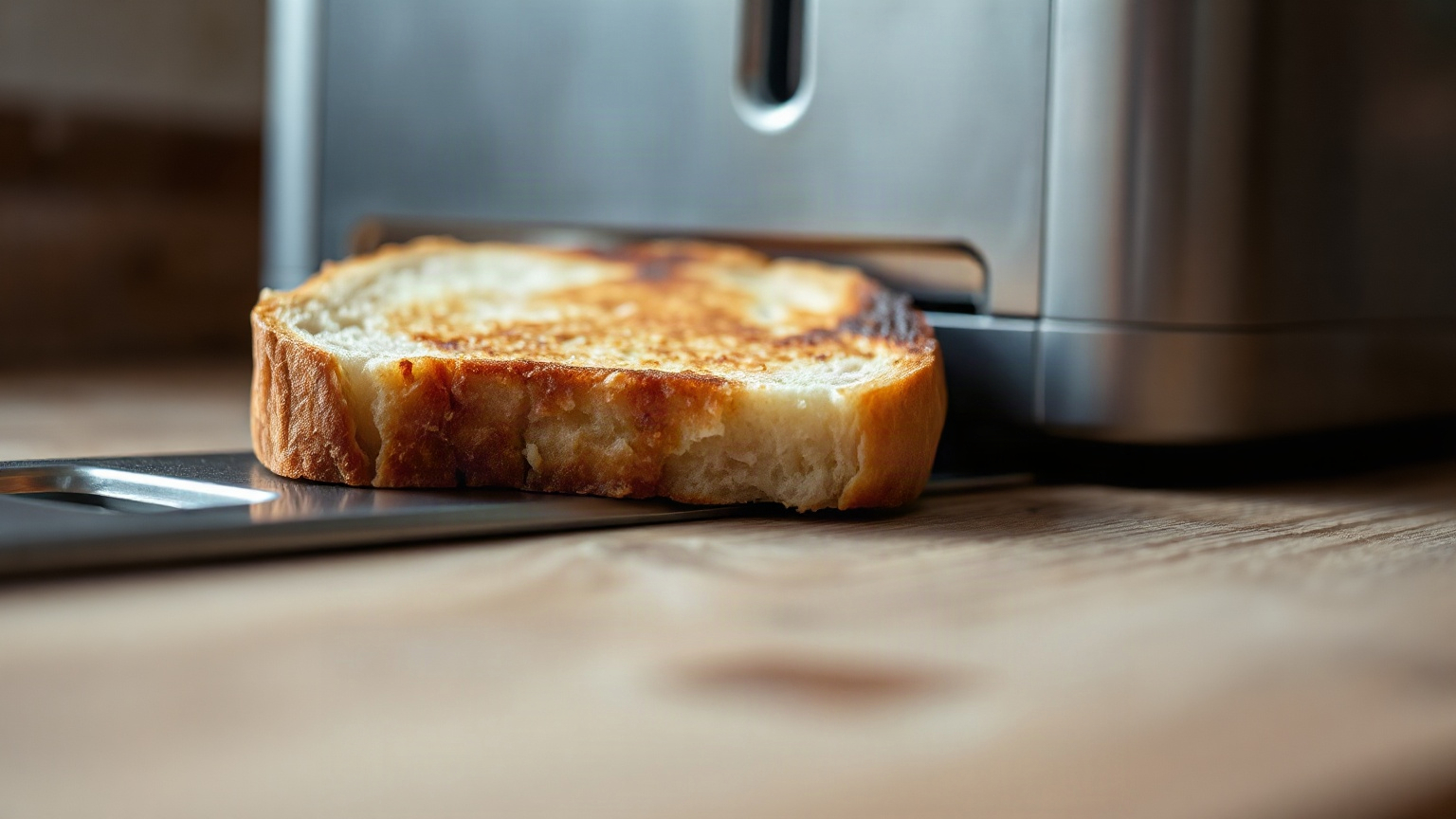
I ran into this problem myself about three years ago. I’d started baking sourdough regularly, the loaves were getting taller, and my old 2-slice toaster just… couldn’t cope. Slices would go in halfway, toast unevenly, or not drop down far enough to even trigger the heating cycle properly. The carriage mechanism would catch on the bread’s crust and pop back up before anything was actually done.
The issue is geometry. A standard slot is around 4.5 to 5 inches deep. That was designed for commercial sandwich bread — uniform, pre-sliced, modest in height. A homemade sourdough batard sliced at a slight angle can easily be 5.5 inches tall on one side and 6 on the other. Country loaves are even more unpredictable. And don’t get me started on the width: artisan bread is denser and tends to slice thicker because nobody’s running it through an industrial slicer.
So you need actual long slots — and ideally wider ones too. Those are two different specs, and not every toaster marketed as “long slot” delivers on both.
The 3 Models I Actually Tested
Breville Die-Cast 4-Slice Smart Toaster (BTA840XL)
This is the one I use most. The slots are 6 inches deep and 1.5 inches wide, which covers maybe 90% of the sourdough slices I cut on a regular basis. It has a “Lift & Look” feature that lets you check browning mid-cycle without resetting the timer — sounds gimmicky, but I actually use it constantly because artisan bread with a lot of crust can brown faster on the outside than the inside toasts.
The “A Bit More” button is genuinely useful too. I’d dial in a setting of about 4 out of 7 for a fresh-baked sourdough slice, then hit “A Bit More” for about 15 extra seconds if the crust is especially thick. It sounds fussy but it’s actually fast once you have a feel for it.
What tripped me up the first time: the self-centering slots. They’re spring-loaded guides meant to center bread so it toasts evenly. Great in theory. But with an irregularly shaped artisan slice — one that’s wider at the bottom than the top, say — the guide can grip unevenly and hold one side closer to a heating element than the other. I’ve gotten slightly lopsided toast this way. It’s a minor thing. But if you’re cutting thick wedge-shaped slices from a boule, worth knowing.
Price tier: premium. It’s not cheap. But the build quality is legitimately good — die-cast metal housing, no flimsy plastic bits, and mine has held up to daily use for two years without issue.
Smeg TSF02 4-Slice Long-Slot Toaster
The Smeg is gorgeous. That’s not a reason to buy a toaster, but I’m mentioning it because I know some people factor it in and there’s no shame in that. The Smeg long-slot model offers slots roughly 6.3 inches deep and about 1.4 inches wide — marginally longer than the Breville, though the width is a touch narrower.
Performance is solid. Six browning levels, a bagel setting, a defrost mode. The reheat function works reasonably well for day-old sourdough — brings it back to something edible without over-drying. I tested it with slices from a whole-wheat artisan loaf and a standard white sourdough, and both came out evenly browned at level 4.
My honest complaint: it’s loud. The carriage mechanism clicks and clanks in a way that feels disproportionate for how premium it’s priced. Also the crumb tray is too small — with sourdough’s dense, open crumb structure, you get more crumble than with sandwich bread, and you’ll be emptying that tray more often than you’d expect.
Price tier: premium (similar to Breville, sometimes slightly more depending on the colorway you choose).
Oster 2-Slice Long-Slot Toaster (TSSTTRJB31)
The budget option. Slots are 7 inches deep — actually the longest of the three — and wide enough for most thick-cut slices. It’s not fancy. The exterior is plastic, the browning control is a simple dial with no “Lift & Look” or smart features. But it toasts bread.
I tested it with a Tartine-style country loaf (the kind with a very open crumb and a heavily-scored top crust). The 7-inch slot depth was genuinely helpful — slices that wouldn’t fully drop into the Breville sat properly in the Oster. That’s worth something.
The browning consistency is less reliable. I ran the same slice type five times at the same setting and got mildly different results each time — which, to be fair, happens with budget toasters. If you’re making toast for one and don’t need precision, it’s fine. If you’re feeding a household and want repeatability, you’ll probably find it annoying after a few weeks.
Price tier: budget. Significantly cheaper than the other two. Worth considering if you bake occasionally and don’t want to spend real money on a toaster.
Side-by-Side Comparison
| Model | Slot Depth | Slot Width | Slices | Key Feature | Price Tier |
|---|---|---|---|---|---|
| Breville BTA840XL | ~6 inches | ~1.5 inches | 4 | Lift & Look, A Bit More button | Premium |
| Smeg TSF02 | ~6.3 inches | ~1.4 inches | 4 | Retro design, 6 browning levels | Premium |
| Oster TSSTTRJB31 | ~7 inches | ~1.3 inches | 2 | Deepest slots, budget price | Budget |
The Edge Case Nobody Talks About: Horizontally-Sliced Boules
Here’s the situation I haven’t seen addressed on any of the comparison sites: some sourdough bakers cut their boules horizontally — across the equator of the loaf rather than down through it. The resulting slices are roughly oval, sometimes 7–8 inches across at their widest point. No pop-up toaster on the market fits that. Not one.
If that’s you, a toaster oven is what you actually need. I use a countertop model for those slices — set to around 375°F on the broil setting, bread on the top rack, about 3–4 minutes per side. It’s slower than a pop-up but it handles any shape. Check out the best mini toaster ovens if you want a compact option that doesn’t eat your whole counter.
Similarly: very moist, same-day sourdough — bread you pulled from the oven an hour ago — is tricky in any pop-up toaster. The moisture content can make it steam rather than toast, and the crust won’t crisp properly. Let it cool completely, ideally overnight. Serious Eats has a good breakdown of bread storage and staling that explains why day-old bread actually toasts better than fresh.
Settings That Actually Work for Artisan Bread
Artisan bread behaves differently from sandwich bread in a toaster. It’s denser, often has more surface moisture, and that open crumb can mean uneven heat distribution inside the slice. Here’s what I’ve found works:
- Start one setting lower than you would for sandwich bread — artisan crust catches faster
- For thick slices (3/4 inch or more), run a second shorter cycle rather than cranking the heat — better control, less risk of burning the outside before the inside warms
- Frozen sourdough (yes, you can freeze it, and you should) benefits from the defrost setting first, then a full toast cycle — total time around 4–5 minutes
- Whole wheat or seeded artisan loaves toast faster than white sourdough due to the denser crumb and darker base color — drop one browning level
The reheating food in a toaster oven guide has more detail on managing temperature for dense baked goods if you end up going the toaster oven route.
My Pick — and Who Should Buy What
If you bake sourdough regularly and want a toaster that keeps up: get the Breville BTA840XL. The Lift & Look feature alone has saved me more burned slices than I can count, and the build quality means it’ll last. It’s the one I’d buy again without much deliberation.
If you care about countertop aesthetics and are willing to tolerate a noisier mechanism: the Smeg is a legitimate choice. Performance is close to the Breville. The slightly longer slot depth is a small but real advantage for very tall loaves.
If you’re on a budget, bake occasionally, or just need something that fits a tall slice without spending $100+: the Oster long-slot toaster is worth the money. Its 7-inch slots genuinely outperform the premium options on pure depth. Just don’t expect perfection from the dial control.
And if your loaves are genuinely irregularly shaped — boules sliced in ways that no pop-up toaster can accommodate — stop fighting the tool and just use a toaster oven. It’s not a step backward. It’s just the right tool.
Frequently Asked Questions
What is the slot size I need for sourdough bread in a toaster?
You’ll want a slot depth of at least 6 inches and a width of at least 1.3 inches for most homemade sourdough slices. Standard toasters measure around 4.5–5 inches deep and 1 inch wide, which is too short and narrow for thick-cut artisan bread. If your loaves run especially tall, look for the Oster TSSTTRJB31’s 7-inch depth.
Can a regular toaster fit artisan bread?
Most can’t — standard slots are simply too shallow and narrow for homemade or bakery artisan loaves. You can sometimes trim the crust to fit, but that defeats the point. A long-slot toaster designed for artisan bread is the practical fix here.
How do I toast sourdough without burning the crust?
Use one browning level lower than you would for sandwich bread, since sourdough’s thick crust catches heat faster than it looks. For very thick slices, do two shorter cycles instead of one long one — it gives you more control and you’re less likely to end up with a scorched outside and a cold middle. The Breville’s “A Bit More” button handles this well.
Is the Breville long-slot toaster worth the price?
For regular sourdough bakers, yes. The Lift & Look feature, consistent browning, and solid build make a real difference in day-to-day use. If you’re only making toast a few times a week from an occasional loaf, the Oster gets you 80% of the way there at a fraction of the cost.
What toaster fits a whole slice of sourdough boule?
No standard pop-up toaster fits a horizontally-sliced boule — those slices are simply too wide (often 7–8 inches across) for any slot on the market. For boule slices, a toaster oven on broil at around 375°F, about 3–4 minutes per side, is the right approach. Pop-up toasters work best with vertically-sliced sandwich-style cuts from batards or Pullman-shaped sourdough loaves.

Written by
Emma founded Toastera to turn vague appliance advice into clear, researched, safety-first guidance on toasters and toaster ovens.
Free: the Toaster Oven Cheat Sheet
Get the printable cheat sheet (temps, cook times & safety tips) plus new recipes. No spam, unsubscribe anytime.