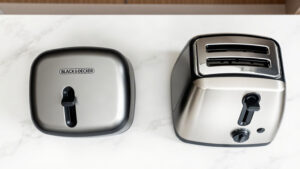
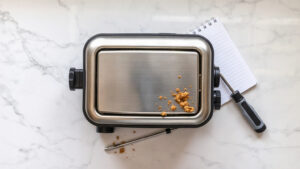
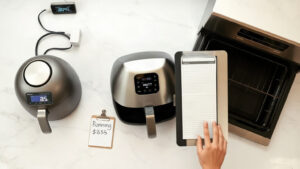
A toaster trips the breaker because it’s drawing more current than the circuit can safely handle — usually caused by a damaged heating element, a crumb-clogged interior creating a short circuit, or a failing internal component that’s pulling abnormal wattage. Most standard pop-up toasters run between 800 and 1,500 watts, so if something goes wrong internally, that power draw can spike fast. Understanding the exact cause usually takes about five minutes of basic troubleshooting, and most of the time you’ll know whether it’s fixable or bin-worthy by the end of it.
Safety First: Before inspecting your toaster for any reason, unplug it from the wall — not just switch it off, but physically remove the plug. Never attempt to open or repair a toaster while it’s connected to power. If you see scorch marks, smell burning plastic, or notice frayed wiring anywhere on the power cord, do not plug it back in under any circumstances. Dispose of it and replace it. Faulty toasters are a genuine fire and electrocution hazard.
Quick Facts
- Standard pop-up toasters draw 800–1,500 watts; toaster ovens often pull 1,200–1,800 watts, which matters a lot on a shared 15-amp circuit.
- The most common cause of a tripping breaker is a short circuit inside the toaster — usually crumbs bridging the heating element to the metal chassis.
- A GFCI outlet tripping is different from a breaker tripping, but both signal the same underlying problem: unwanted current finding an unintended path.
- If your toaster trips the breaker immediately when it’s plugged in (before you even push the lever down), that almost always means an internal short or failed component.
- Any toaster that’s seven or more years old and starts tripping breakers repeatedly is probably not worth repairing.
The Most Likely Culprit: A Damaged Heating Element
This is where I’d start every single time. The heating element in a toaster is essentially a long, tightly coiled resistance wire that gets extremely hot — we’re talking surface temperatures of around 1,100°F (590°C) at peak. You can read more about how hot a toaster gets if that number surprises you, but the short version is: it’s a lot of heat crammed into a small metal box.
When that wire gets damaged — either from physical impact, age, or years of heat cycling — it can start to fail in ways that change its resistance profile. Lower resistance means higher current draw. Higher current draw means your circuit breaker does exactly what it’s supposed to do and cuts the power. That’s not a breaker problem. That’s the breaker working correctly.
If the element is visibly broken, sagging, or touching the metal sides of the toaster chassis, you’ve found your cause. A broken element that’s making contact with the metal body creates a direct short circuit — and a short will trip a breaker almost instantly, often before the toaster even gets warm.
Crumbs. Seriously, Just Crumbs.
This sounds almost too simple, but it’s the second most common cause I’ve seen, and honestly the easiest to fix. Crumbs accumulate in the bottom of your toaster over time and, if they build up enough to physically bridge the gap between the heating element and the metal case, they can create a partial short circuit. Carbon (which is what a burnt crumb basically is) conducts electricity. Not well, but well enough to cause problems.
Pull out the crumb tray. If it’s overflowing, or if you don’t even know where the crumb tray is, that’s your first sign. Give the whole thing a thorough clean — tray out, toaster turned upside down over a bin, gentle shake. Don’t use water inside. Don’t use anything wet inside. A soft pastry brush works well for loosening debris from around the elements without touching them.
I had an older Dualit that started tripping the breaker intermittently a couple of years back. I was halfway through diagnosing the element when I emptied the crumb tray and found a layer of compressed charcoal-colored crumbs sitting right up against the bottom element. Cleaned it out, problem solved. Slightly embarrassing given how long I’d ignored it.
Circuit and Outlet Issues (It’s Not Always the Toaster)
Overloaded Circuit
This is the edge case that most people overlook completely. Your toaster might be perfectly fine. The problem might be that you’re running it on a circuit that’s already near capacity. A 15-amp, 120-volt circuit can handle about 1,800 watts continuously (the safe working limit is 80% of the theoretical max). If you’ve got a toaster pulling 1,200 watts, a microwave on the same circuit, and maybe a coffee maker — you’ve likely exceeded that limit.
Check what else is sharing the circuit. Kitchen circuits are supposed to be dedicated under modern electrical codes, but in older homes? Not always the case. Try running the toaster alone on that outlet, or plug it into a different circuit entirely. If it stops tripping, the toaster is fine and your wiring setup needs attention.
GFCI Outlets and Why They’re Different
A GFCI (Ground Fault Circuit Interrupter) outlet — the kind with the TEST and RESET buttons — trips for a different reason than a standard breaker. It’s monitoring for tiny imbalances in current flow, as small as 5 milliamps. This is specifically designed to prevent electrocution, not just overloads.
If your toaster is tripping a GFCI specifically, it suggests current is leaking somewhere it shouldn’t — possibly through the metal chassis to ground, possibly through moisture inside the toaster. An older toaster with degraded insulation on the internal wiring can cause this even when it seems to work fine otherwise. That one I’d take seriously. A toaster that’s leaking current to its chassis is a shock hazard.
The Power Cord Itself
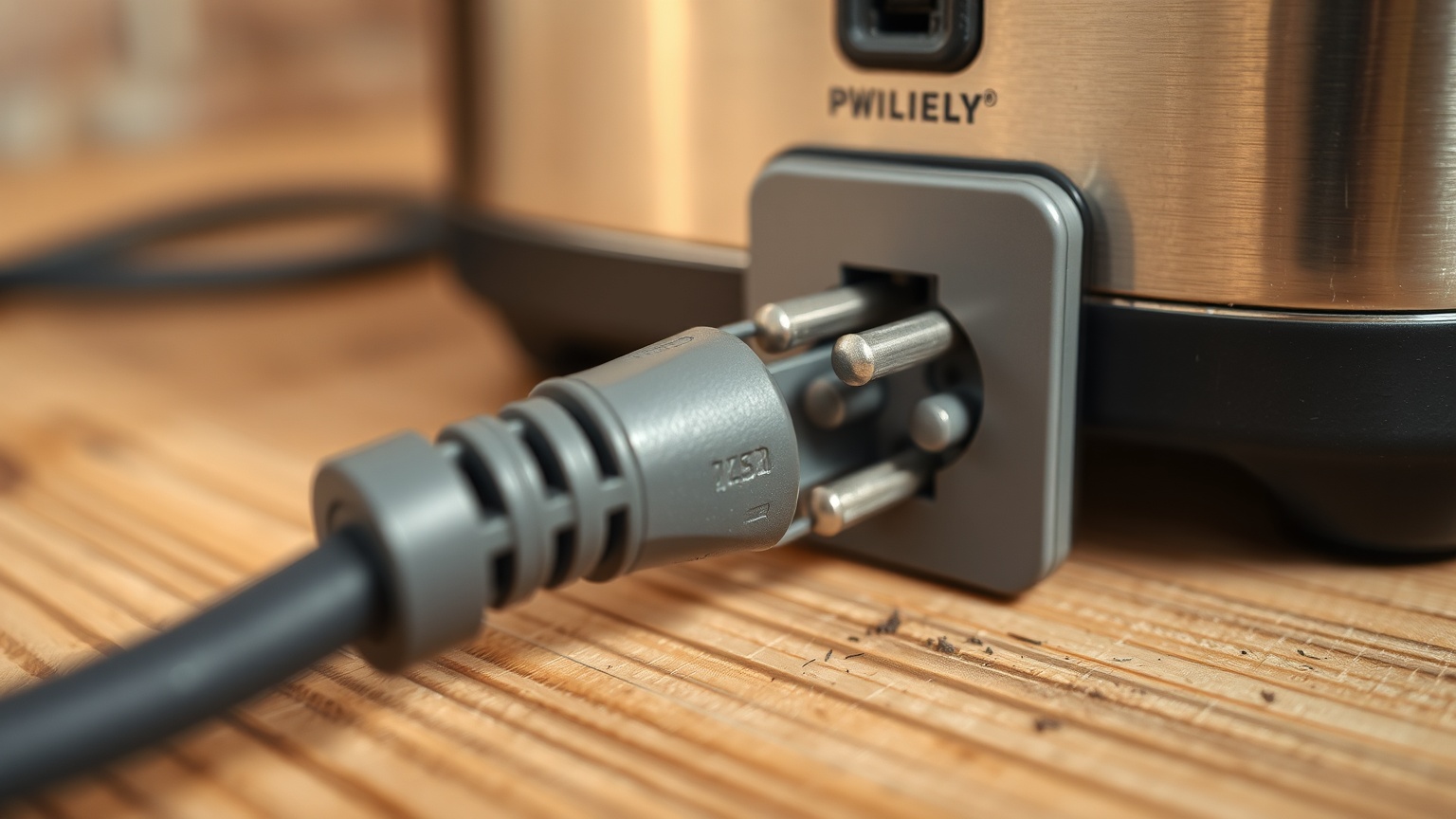
Run your fingers along the full length of the power cord and look for any pinching, cracking, or spots where the outer insulation has worn through. A damaged cord can arc internally, which trips breakers. It can also cause fires. If the cord feels stiff, brittle, or has any visible damage at all — especially near where it exits the toaster body, which is where it always wears first — that toaster needs to go.
Internal Component Failures
Beyond the heating element, toasters have a handful of other components that can fail in ways that cause breaker trips: the thermostat, the browning control mechanism, and in more modern toasters, circuit boards and sensor components.
A failed thermostat can cause the toaster to run continuously at full power rather than cycling, effectively turning it into a sustained high-draw appliance that overwhelms the circuit. This usually announces itself with badly burnt toast before the tripping starts — you’ll notice the toaster isn’t shutting off when it should.
Smart toasters and toaster ovens with electronic controls have an additional failure mode: capacitors and control board components that fail and create shorts. This is what often happens with the Breville smart toasters that people report tripping GFCIs after several years of use. The electronics age, insulation breaks down, and suddenly something that worked perfectly for seven years starts causing grief. These are generally not repairable at home.
Wattage Comparison: What Your Toaster Is Actually Drawing
It helps to know what normal looks like. Here’s a rough breakdown of typical wattage ranges by appliance type — because “my toaster is using too much power” means something very different depending on what kind of toaster you have.
| Appliance Type | Typical Wattage Range | Amps on 120V Circuit |
|---|---|---|
| 2-slice pop-up toaster | 800–1,000W | 6.7–8.3A |
| 4-slice pop-up toaster | 1,200–1,500W | 10–12.5A |
| Compact toaster oven | 1,200–1,400W | 10–11.7A |
| Full-size toaster oven | 1,400–1,800W | 11.7–15A |
| Air fryer toaster oven | 1,500–1,800W | 12.5–15A |
Notice that a full-size toaster oven or air fryer combo can push right up to the limit of a 15-amp circuit on its own. Add anything else to that circuit and you’re asking for trouble. If you’re shopping for a replacement and live with older wiring, a compact 2-slice toaster with lower wattage is a smarter choice than going up in size.
How to Actually Diagnose the Problem: A Step-by-Step
Don’t just swap out the toaster without doing this. Takes five minutes, and it’ll tell you whether the problem is the toaster, the outlet, or the circuit.
- Step 1: Unplug the toaster. Reset the breaker or GFCI. Plug a different, known-working appliance into the same outlet. Does it trip? If yes, the problem is the outlet or circuit, not your toaster.
- Step 2: Take the toaster to a completely different outlet on a different circuit (usually a different room). Plug it in without pushing the lever down. Does it trip immediately? That’s an internal short — element or wiring touching the chassis.
- Step 3: If it doesn’t trip at rest but trips when you push the lever, empty the crumb tray thoroughly and inspect the element visually through the slots with a flashlight. Look for visible breaks, sagging wire, or sections touching the metal walls.
- Step 4: Check the power cord end to end. Any damage, the toaster is done.
- Step 5: If none of the above reveals an obvious cause and it’s still tripping, the internal components have likely failed. At that point, replacement is almost certainly cheaper than any repair.
When to Replace Instead of Fix
Toasters are cheap enough that repair is rarely worth it — and that’s not a controversial take. A basic 2-slice toaster runs $25-$50. Even a solid 4-slice model is $60-$100. A repair that involves an electrician’s time or sourcing specialist parts will cost more than that almost immediately.
Replace it if: the power cord is damaged in any way, you see scorch marks or smell burning plastic, the toaster is more than seven years old and repeatedly tripping, or the heating element is visibly broken. These aren’t fixable at home without electrical training, and the risk isn’t worth it for an appliance this inexpensive.
If you’re moving up to a toaster oven to replace it, check out our guide to the best mini toaster ovens — there are some very capable options in the $60-$80 range that won’t hog your counter. And if you use a toaster oven for more than just toast, the reheating guide is worth a look too.
For a higher-end replacement that’s built to last, a stainless steel 4-slice long-slot toaster is worth the extra spend if you toast a lot. I’ve found the longer slots genuinely useful for sourdough, which tends to run bigger than standard bread slices. The NFPA reports that toasters are among the leading appliances involved in home kitchen fires, so getting this right actually matters.
The One Scenario Everyone Misses
Here’s the edge case I haven’t seen covered anywhere else: a toaster that trips the breaker only when used right after another high-draw appliance on the same circuit — like a microwave or electric kettle — even though neither appliance is running at the same time.
What’s happening is thermal tripping. The breaker has a bimetallic strip inside that heats up with current flow. If the kettle just ran and warmed that strip up, the breaker is already partially “tripped” thermally. Then the toaster adds its load and crosses the threshold, even though in isolation either appliance would be fine. The fix here isn’t a new toaster — it’s spreading your high-draw appliances across different circuits, or waiting a few minutes between them. Sounds obvious but I’ve seen people replace perfectly good toasters because of this exact issue.
The Bottom Line
A tripping breaker is your electrical system doing its job. The question is just identifying what triggered it. Start with crumbs — genuinely the cause more often than it should be — then check the heating element visually, then the power cord, then the circuit load. If it trips the moment it’s plugged in, or if you see any physical damage to the cord or interior, don’t try to fix it. Just replace it. For a $30 appliance, that’s always the right call. For a $200 smart toaster oven that’s only two years old, it might be worth calling the manufacturer first — some brands will replace a unit that develops electrical faults, especially if it’s still within warranty.
Frequently Asked Questions
Why does my toaster trip the breaker as soon as I plug it in?
This almost always means there’s an internal short circuit — typically the heating element has broken and is now making contact with the metal chassis, or internal wiring has failed and is touching grounded metal parts. Unplug it immediately and don’t use it again. This is a fire and shock hazard, and the toaster should be replaced.
Can crumbs really cause a toaster to trip the breaker?
Yes, and it happens more often than people expect. Burnt crumbs are partially carbonized, which makes them slightly conductive. If they build up enough to bridge the gap between the heating element and the metal body of the toaster, they can create a partial short that trips the breaker or GFCI. Emptying and cleaning the crumb tray regularly prevents this entirely.
Is it the toaster or the breaker that’s the problem?
Plug the toaster into a different outlet on a different circuit. If it stops tripping, the issue is with your original circuit — either it’s overloaded or the breaker itself is weak and needs replacing by an electrician. If it trips on the new circuit too, the toaster is the problem.
Why is my toaster tripping the GFCI outlet but not the main breaker?
GFCI outlets detect very small current leaks (as low as 5 milliamps) that a standard breaker won’t catch. If your toaster is tripping a GFCI, current is likely leaking through degraded internal insulation or through moisture in the toaster to the metal chassis. This is a warning sign — it means the toaster could deliver a shock in the right conditions. Replace it.
How many watts does a toaster use, and can it overload a circuit?
A 2-slice pop-up toaster typically draws 800–1,000 watts; a 4-slice model pulls 1,200–1,500 watts. A 15-amp, 120-volt circuit has a safe continuous capacity of about 1,440 watts, so a 4-slice toaster running alongside a coffee maker or microwave on the same circuit can absolutely overload it. Kitchen appliances should ideally run on dedicated circuits for exactly this reason.

Written by
Emma founded Toastera to turn vague appliance advice into clear, researched, safety-first guidance on toasters and toaster ovens.
Free: the Toaster Oven Cheat Sheet
Get the printable cheat sheet (temps, cook times & safety tips) plus new recipes. No spam, unsubscribe anytime.