That sharp click your toaster makes right before the bread launches into the air is caused by a bimetallic strip snapping back to its original shape as it cools — it’s a mechanical release, not an electrical one. The pop sound itself is the spring-loaded carriage releasing under tension, and any buzzing you hear while toasting is just the heating elements drawing current through their nichrome wire coils. Once you understand the three distinct sounds, you’ll know immediately whether your toaster is working normally or quietly heading toward a fault.
Safety First: Never attempt to open or inspect a toaster’s internal mechanism while it’s plugged in — the capacitors and heating elements can hold charge even when the appliance appears off. Always unplug before cleaning, always keep toasters away from water, and never stick anything metal inside the slot to dislodge stuck bread. If your toaster is making grinding, arcing, or continuous buzzing sounds it didn’t make before, unplug it immediately and don’t use it again until it’s been inspected.
Quick Facts: Toaster Sounds at a Glance
- The classic “click” when toast pops up is a bimetallic strip releasing a latch — not a relay or a timer chip firing
- Heating elements in a standard two-slice toaster reach between 700°F and 1,000°F (370°C–540°C) at the wire surface — see our full breakdown of how hot a toaster gets
- The “darkness dial” on most toasters doesn’t control temperature — it adjusts how long the bimetallic strip takes to trip the latch
- A faint hiss or crackle during toasting is nearly always harmless moisture evaporating from the bread
- Continuous clicking after the toast pops up is a red flag — it usually means a latch spring is worn or a crumb is jamming the mechanism
The Main Click: How the Pop-Up Mechanism Actually Works
Most people assume there’s some kind of electronic timer ticking away inside their toaster. There isn’t — at least not in any basic two-slice slot toaster. The whole thing is almost embarrassingly mechanical.
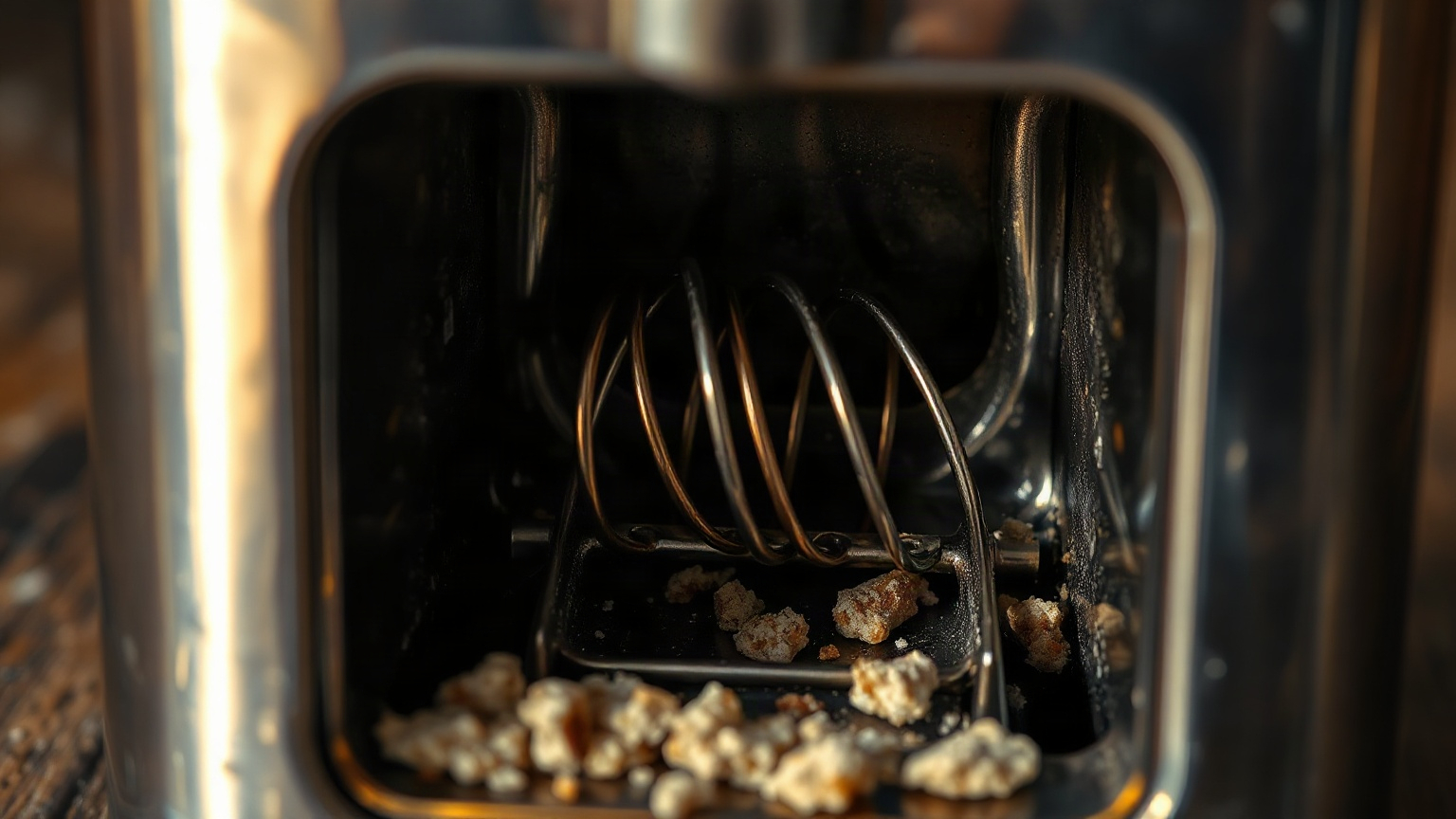
Here’s what’s actually happening. When you push the lever down, you’re compressing a spring and latching the carriage in place. At the same time, you’re closing an electrical circuit that sends current through the nichrome heating elements. There’s a small bimetallic strip — two different metals bonded together — positioned near those elements. As the elements heat up, the strip heats up too. Because the two metals expand at different rates, the strip slowly bends. And when it bends far enough, it trips a latch. The spring releases. The toast flies up. Click.
That click is the latch snapping open under spring tension. It’s purely physical, like a mousetrap going off. The “darkness” dial you’ve been turning just adjusts how close the bimetallic strip sits to the latch contact — closer means it trips sooner (lighter toast), farther means it has to bend more before release (darker toast). No electronics involved.
Why the Click Is So Loud on Some Toasters
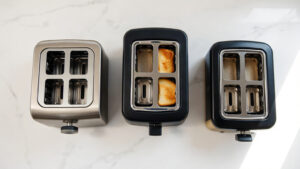
The volume of the click depends almost entirely on spring tension. A stiffer ejection spring means the carriage releases with more force — louder pop, toast goes higher. Cheaper toasters tend to have weaker springs, so you get a dull thunk instead of that satisfying crack. I tested a Dualit-style heavy-duty two-slice toaster alongside a basic drugstore model, and the spring tension difference was genuinely noticeable — the budget one barely cleared the slot lip on thick sourdough.
Old toasters also click louder because springs fatigue over time and occasionally bind before releasing all at once. If your toaster’s click has gotten suddenly more aggressive recently, that’s worth paying attention to.
The Buzzing Sound While Toasting Is Happening
A low, steady hum or buzz while the toaster is running — that’s normal. It’s the electrical current vibrating through the nichrome wire elements at 60Hz (in North America). Nichrome is an alloy of nickel and chromium specifically because it has high resistance and doesn’t oxidize at extreme temperatures. That resistance is what converts electricity into heat. The vibration is almost inaudible on most toasters at low settings, but crank the dial toward “dark” and you may notice it more, simply because more current is running for longer.
Some toasters — particularly older ones or those with carbon buildup on the elements — buzz more noticeably. If the buzz has a crackly, irregular quality to it, that can sometimes indicate a partial short in one of the heating wires. That’s worth taking seriously.
The Hissing and Crackling During the Toast Cycle
Fresh bread — especially anything that went straight from the fridge — will crackle and hiss when you first toast it. That’s moisture turning to steam. It sounds almost like a faint sizzle. Totally harmless. Frozen bread does this even more dramatically; I usually set my toaster one notch darker when I’m toasting straight from frozen because the first minute or so is basically just drying the slice out rather than browning it.
Stale bread, by contrast, toasts almost silently. Less moisture to evaporate. If you want a rough proxy for bread freshness, listen to your toaster.
Sounds That Actually Mean Something Is Wrong
Not every toaster noise is benign. Here’s what to listen for.
Clicking That Continues After the Toast Pops Up
This is the one that trips people up most often, including me the first time it happened. If you hear repeated clicking after the carriage has already released, it usually means the latch isn’t fully clearing — it’s catching and releasing in rapid succession. The most common culprits are a crumb jammed in the mechanism (pull out the crumb tray and give it a good shake, unplugged) or a worn spring that’s lost enough tension that it bounces rather than cleanly releasing.
On a toaster that’s more than five or six years old, this kind of persistent clicking often means the bimetallic strip or latch assembly is worn. Replacement parts exist for a few premium brands, but honestly, for most mass-market toasters it’s not economical to fix.
A Loud Pop or Bang Mid-Cycle
This one is alarming. A single loud bang during toasting — not the normal pop-up click at the end — can be caused by a drop of water reaching a heating element, bread crust cracking suddenly under heat, or in worse cases, a wire element snapping. The first two are harmless. The third isn’t. If you hear a sharp crack mid-cycle and your toast comes out half-done on one side, there’s a good chance a heating element has failed. Unplug it, let it cool, and inspect. A failed element usually shows as a visibly broken wire when you look down into the slot with a flashlight.
Arcing or Buzzing With a Burning Smell
Unplug it. Right now. That combination — irregular buzzing and burning smell — almost always points to a grease fire starting in the crumb tray or an electrical fault. These are not the same problem, but both require the same immediate response: unplug, don’t use again until you’ve cleaned it thoroughly or had it checked. According to the U.S. Fire Administration, toasters and toaster ovens account for roughly 700 home structure fires annually — most of them entirely preventable with regular crumb tray cleaning.
How Toaster Oven Sounds Differ From Slot Toaster Sounds
Toaster ovens are a completely different animal acoustically. They don’t have that satisfying mechanical pop-click at all — instead, you get a bell or buzzer at the end of a timer cycle, a click from a mechanical thermostat, and sometimes a relay click as the heating elements cycle on and off during temperature maintenance.
That thermostat click in a toaster oven is exactly what confuses people who search for oven clicking noises. It’s not a fault. Your toaster oven’s thermostat is constantly cycling the elements to hold the set temperature — clicking on, clicking off, every few minutes. If you’re reheating food in a toaster oven, you’ll hear this cycling more at lower temperatures because the oven reaches the setpoint faster and switches off sooner.
The one sound that is concerning in a toaster oven: a persistent electrical hum or buzz that doesn’t stop, especially at low heat settings. That can point to a failing convection fan motor or a relay that’s sticking.
Toaster Sound Comparison: Normal vs. Concerning
| Sound | When It Happens | Normal or Not? | What To Do |
|---|---|---|---|
| Single sharp click at pop-up | End of toast cycle | Normal | Nothing — that’s the latch releasing |
| Low hum/buzz during toasting | Throughout the cycle | Normal | Nothing — it’s the heating elements drawing current |
| Hissing or crackling | First 30–60 seconds | Normal | Moisture evaporating from bread |
| Repeated clicking after pop-up | After toast has ejected | Concerning | Check crumb tray, inspect spring/latch |
| Loud mid-cycle bang | During toasting | Possibly concerning | Check heating elements for breaks |
| Buzzing + burning smell | Anytime | Problem | Unplug immediately, inspect for grease/fault |
| Thermostat cycling click (toaster oven) | During oven operation | Normal | Nothing — temperature regulation working correctly |
The Edge Case Nobody Talks About: Electronic Toasters
Here’s the thing none of the other articles on this topic bother to mention. Not all toasters use the bimetallic strip method anymore. A small number of higher-end models — including some Breville units and certain Cuisinart designs — use an electronic timer circuit or even a capacitor-based timing system rather than a purely mechanical strip. In those toasters, there’s sometimes an additional small click from a relay or solenoid that releases the carriage electrically rather than purely mechanically.
The original question on Reddit’s ELI5 thread about “why does a toaster click only when connected to power” is specifically about this type — because in an electronic toaster, the release mechanism requires current to fire the solenoid, whereas in a classic bimetallic toaster, the release is purely mechanical heat response. Both are legitimate designs. The electronic ones tend to be more consistent in their toasting results because the timing is less affected by ambient temperature — a bimetallic toaster will behave slightly differently on a cold morning versus a hot summer afternoon.
If you’re in the market for a reliable everyday toaster, check out options in the electronic browning control toaster category — the consistency is noticeably better for things like bagels and thick artisan slices. And if you want a broader look at compact options, our roundup of the best mini toaster ovens covers some models that give you more control than a standard slot toaster anyway.
Wrapping Up
The sounds your toaster makes are mostly telling you it’s working exactly as designed — a satisfying mechanical system that’s barely changed in the last century. The click at pop-up is the bimetallic strip releasing a latch. The buzz is heating elements doing their job. The hiss is your bread losing moisture. None of that is a problem. The things to actually worry about are post-pop clicking that won’t stop, mid-cycle bangs paired with uneven browning, and anything combined with a burning smell. Those are worth acting on quickly. Everything else? Your toaster’s just talking to you.
Frequently Asked Questions
Why does my toaster make a clicking sound when it pops up?
The click is caused by a bimetallic strip — two bonded metals that bend at different rates as they heat up — tripping a mechanical latch that holds the spring-loaded carriage down. When the strip bends far enough, the latch snaps open and the spring releases, sending your toast upward. The click is the latch releasing under tension, not an electrical component firing.
Is it normal for a toaster to buzz while toasting?
Yes, a low hum or buzz during the toast cycle is completely normal. It’s the 60Hz electrical current vibrating through the nichrome heating element wires. The buzz gets slightly louder on higher darkness settings because more current flows for a longer period. An irregular or crackling buzz that’s new is the only version worth investigating.
Why does my toaster keep clicking after the toast pops up?
Repeated clicking after ejection usually means the latch mechanism isn’t fully clearing. Start by unplugging the toaster, removing the crumb tray, and shaking out any debris — a crumb jammed near the latch is the most common cause. If cleaning doesn’t fix it, the spring or latch assembly may be worn, which is especially common in toasters that are several years old.
How hot does a toaster get inside?
The nichrome wire surface inside a typical slot toaster reaches between 700°F and 1,000°F (370°C–540°C) during operation. The air temperature inside the slot is lower, typically 300°F–400°F, which is what actually browns the bread through radiant and convective heat. For a more detailed breakdown, see our article on how hot a toaster gets.
What does it mean if my toaster makes a burning smell with a buzzing noise?
Unplug it immediately — that combination points to either a grease or crumb fire starting in the base or an electrical fault in the wiring. Check the crumb tray first; built-up debris is the most common cause. If the crumb tray is clean and the smell persists on the next use, the toaster has an internal fault and should not be used again.

Written by
Emma founded Toastera to turn vague appliance advice into clear, researched, safety-first guidance on toasters and toaster ovens.
Free: the Toaster Oven Cheat Sheet
Get the printable cheat sheet (temps, cook times & safety tips) plus new recipes. No spam, unsubscribe anytime.