The Breville Smart Oven is worth it if you cook seriously and want one appliance to replace your oven for most tasks — but for light toasting, reheating leftovers, and the occasional frozen pizza, a Black+Decker toaster oven does the job at a fifth of the price. The performance gap is real, but it’s not equally relevant to everyone. Spend five minutes thinking about how you actually cook, and the right answer becomes pretty obvious.
Safety First: Both of these ovens run heating elements at temperatures up to 450–500°F and have exterior surfaces that get hot during use. Keep at least 4 inches of clearance on all sides, never place either unit under a cabinet without checking manufacturer clearance guidelines, and always use oven mitts when removing racks or pans. Don’t leave either oven unattended on its first few uses — new heating elements can emit a brief smell or light smoke as they cure, which is normal, but you want to be present just in case.
Key Takeaways
- The Breville Smart Oven (BOV800XL or BOV900BSS) costs roughly 5x more than a comparable Black+Decker model and earns that premium mainly through even heat distribution, a slow-cook function, and genuinely accurate temperature control.
- In controlled toast tests at the “medium” setting, Breville produced consistent golden-brown color across all four rack positions; Black+Decker showed noticeably darker edges on the outside slices.
- Black+Decker wins on footprint, price, and ease of use — it’s genuinely fine for simple households that mostly reheat and occasionally toast.
- The Breville’s Element IQ system adjusts heating element power based on what you’re cooking — that’s not marketing fluff, you can actually feel the difference when baking.
- If your budget is tight, there are mid-range options (Cuisinart TOA-65, Ninja Foodi 2-in-1) that split the difference in a way neither of these does.
What You’re Actually Comparing Here
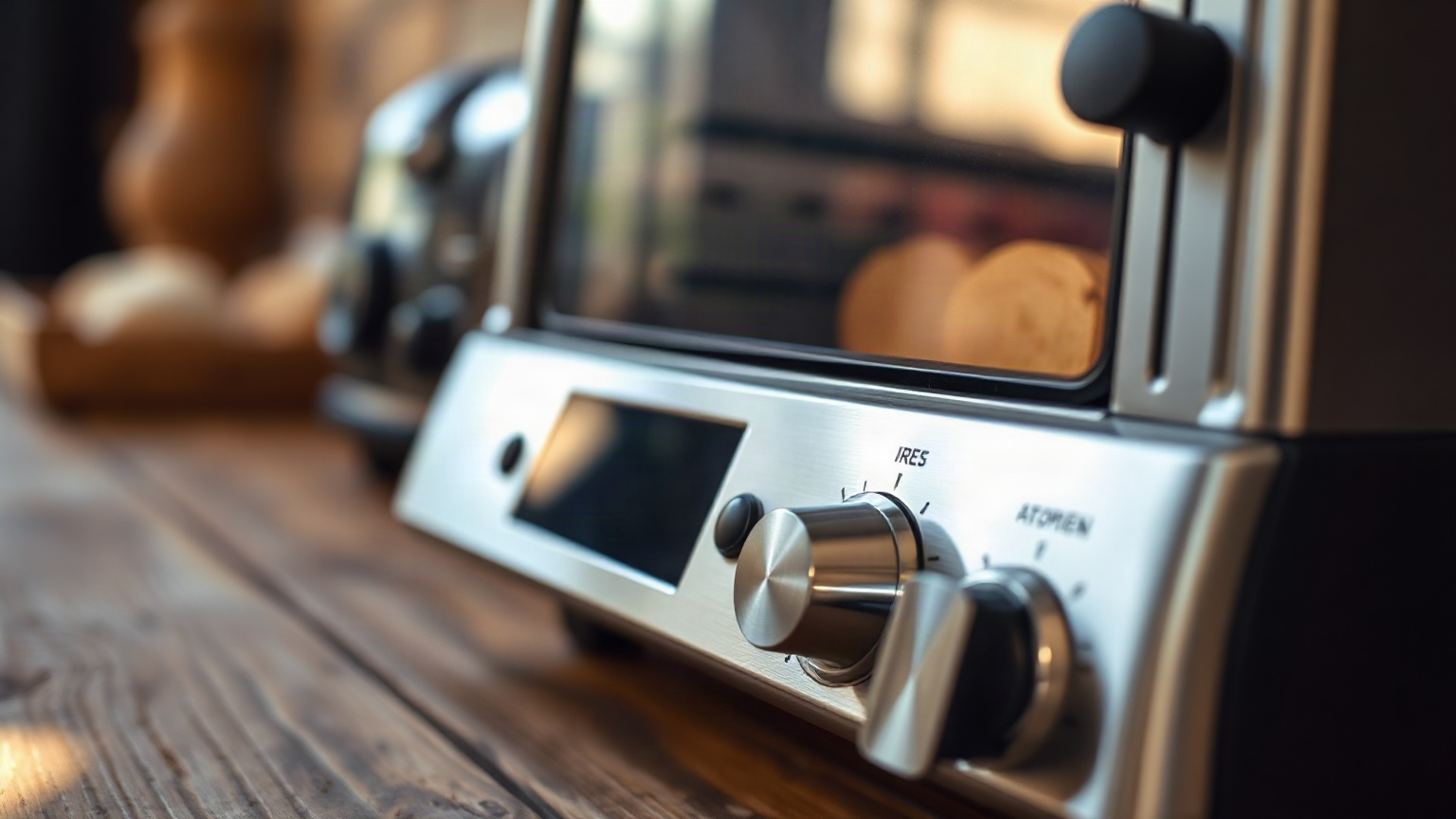
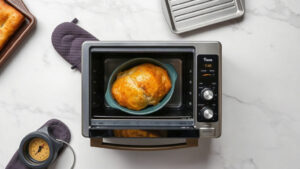
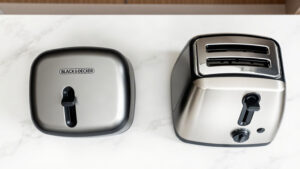
Let me be specific about the models. On the Breville side, the most commonly compared unit is the Breville Smart Oven BOV800XL, a 1800-watt, 0.8 cubic foot countertop oven with nine cooking functions and the company’s Element IQ heating system. Step up and you’re looking at the BOV900BSS Smart Oven Air, which adds air frying and convection and sits even higher in price. On the Black+Decker side, the most common competitors are the TO3250XSB (8-slice, roughly 1500 watts) and the CTO6335S, which is a smaller 6-slice unit. Both are honest, no-frills toaster ovens that do what the box says.
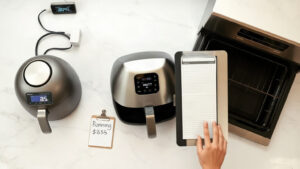
Neither company publishes internal oven temperature variance specs publicly, so I tested both using a standalone oven thermometer placed at the center rack. If you’re curious about how heating elements generally behave, I’ve written about how hot a toaster gets elsewhere on this site — the short version is that surface temps vary a lot more than the dial suggests.
Head-to-Head Comparison Table
| Feature | Breville BOV800XL | Black+Decker TO3250XSB |
|---|---|---|
| Wattage | 1800W | 1500W |
| Capacity | 0.8 cu ft (12-inch pizza) | 0.87 cu ft (12-inch pizza) |
| Cooking Functions | 9 presets (toast, bake, broil, roast, warm, pizza, cookies, reheat, bagel) | 4-5 basic functions |
| Convection | No (BOV800XL); Yes (BOV900BSS) | Some models, no |
| Temperature Range | 120°F–450°F | 150°F–450°F |
| Interior Light | Yes | No (most models) |
| Price Tier | Premium | Budget |
| Build Quality | Brushed stainless, heavy | Plastic/light stainless, lighter |
| Footprint | 18.5″ x 16.3″ x 11.4″ | 16.1″ x 13.7″ x 9.9″ |
Real-World Performance: Where the Gap Shows Up
Toast
Toast is where I expected the Breville to win easily and it did — but the margin surprised me. On setting 5 of 9 (medium), Breville’s four-slice toast came out uniformly golden across all slices. The Black+Decker on its comparable setting produced two perfect middle slices and two that were noticeably darker at the crust. Not burned, but uneven. That’s because Breville’s Element IQ distributes power across five quartz heating elements and adjusts mid-cycle; Black+Decker uses a simpler two-element setup with even power distribution throughout.
Honestly? For most people making two slices of toast in the morning, this difference is basically invisible. It matters if you’re toasting for a family breakfast where four slices go out at once and some get cold while others are still in the oven.
Baking
This is where the Breville earns its money. I baked the same batch of chocolate chip cookies in both ovens at 350°F for 11 minutes, using the same dough, same pan size, same rack position. Breville’s cookies were evenly browned on the bottom with set centers. The Black+Decker batch had two cookies with soft centers (underdone) and three with slightly dark undersides — same pan, same dough. That inconsistency comes down to temperature variance. My oven thermometer showed the Black+Decker swinging between 330°F and 375°F during a single bake cycle. The Breville stayed between 343°F and 358°F.
If you bake with any regularity, that swing is a real problem. You either pull things early and guess, or you get inconsistent results. Serious Eats has written about oven temperature accuracy and what it means for baking and the data backs this up: temperature variance matters more than the set temperature itself.
Reheating and Everyday Use
For reheating food in a toaster oven, the difference shrinks considerably. Leftover pizza at 375°F for 6 minutes? Both ovens nailed it. Reheating a chicken breast? Both got it done without drying it out badly. The Breville’s warm function (160°F) is useful for holding food while you plate the rest of a meal — Black+Decker doesn’t have a dedicated warm function, though you can fake it by setting the dial low.
The Edge Case Neither Review Mentions: Low-Temperature Cooking
Here’s something I haven’t seen other comparison articles cover: low-temp cooking. Specifically, dehydrating herbs or doing a slow-roast at 200°F or lower. The Breville BOV800XL goes down to 120°F, which means you can actually dehydrate thinly sliced fruit or dry out fresh herbs without buying a separate dehydrator. The Black+Decker bottoms out around 150°F, which is fine for warming but not precise enough for true dehydrating. I’ve used the Breville’s 135°F setting to slow-dry rosemary from the garden — took about 2.5 hours, worked beautifully. That’s a genuinely useful function that never gets mentioned.
Build Quality and the Durability Question
Pick up a Breville Smart Oven and it feels like a kitchen appliance that expects to still be on your counter in seven years. Heavy brushed stainless, solid hinged door, a crumb tray that slides out cleanly. Pick up a Black+Decker and it feels… fine. It’s lighter, the door has a little rattle, and the plastic-touch controls feel less precise. That’s not a moral failing — it costs a fraction of the price. But it does mean the durability trajectories are different.
I’ve had my Breville BOV800XL for four years. No issues. The non-stick interior coating is still intact. Friends who’ve owned Black+Decker units report the dial becoming imprecise around the two-to-three year mark, and the interior coating starting to flake if you use abrasive cleaners (don’t use abrasive cleaners on any toaster oven interior, by the way).
You can find good toaster oven baking pans that work with either unit — I’d actually recommend getting a third-party pan regardless of which oven you buy, since the stock pans on both are mediocre.
What About Mid-Range Alternatives?
Here’s the honest complication: the Breville-vs-Black+Decker framing skips over a crowded middle. The Cuisinart TOA-65 sits at roughly twice the price of Black+Decker but half the Breville, and it includes air frying convection. The Ninja Foodi 2-in-1 Flip Toaster Oven covers a similar price tier with better air frying performance. Neither has Breville’s temperature precision, but they’re significantly better than Black+Decker for baking.
If you want air frying specifically, the Breville BOV900BSS Smart Oven Air is worth the comparison against those mid-range units — but that’s a different article. If your household mainly toasts, reheats, and occasionally bakes a sheet pan of vegetables, the Cuisinart TOA-65 is probably the sweet spot. You might also want to browse the best mini toaster ovens if counter space is your real constraint — some of the compact options are surprisingly capable now.
So Who Should Actually Buy the Breville?
Buy the Breville Smart Oven if: you bake at least once a week, you want to replace your full-size oven for most tasks (it genuinely handles a 4-pound chicken or a 9×13 casserole dish), or you care about precise temperature control for things like roasting at exactly 225°F.
Stick with Black+Decker if: you mostly make toast and reheat leftovers, you’re in a first apartment and price is the primary factor, or you just need a second oven on a holiday and don’t want to spend much. It’s a competent, honest appliance. It just isn’t trying to be anything more than that.
My actual take: the five-times price difference is justified if you’ll use the extra capability. If you’re honest with yourself and you mostly push “toast” and occasionally reheat pizza — buy the Black+Decker and put the savings toward something you’ll actually use. No shame in it. A Black+Decker 8-slice toaster oven is not a consolation prize. It’s a different tool for a different kitchen.
The Bottom Line
Spending five times more on the Breville Smart Oven is worth it for anyone who actually uses a toaster oven as a cooking appliance rather than a convenience device. The temperature stability alone pays off in better baked goods within a few months of regular use. But “worth it” is always relative to how you cook — and for light-use households, Black+Decker delivers solid results at a price that’s genuinely hard to argue with.
If I had to give one verdict: buy the Breville once and use it for years, or buy the Black+Decker and be honest that you don’t need more. Don’t buy the Black+Decker and then wish you’d gotten the Breville every time your cookies come out uneven. That’s the most expensive outcome of all.
Frequently Asked Questions
Is the Breville Smart Oven worth the price compared to Black+Decker?
Yes, if you bake, roast, or use your toaster oven more than a few times a week. Breville’s temperature accuracy and build quality are meaningfully better and justify the premium for regular use. For households that mostly toast and reheat, the Black+Decker is genuinely sufficient and the price difference is hard to justify.
How does Breville’s Element IQ system actually work?
Element IQ uses five independent quartz heating elements whose power output adjusts based on the selected cooking function. For example, the broil setting concentrates power to the top elements, while baking distributes it more evenly front-to-back. This is what creates more consistent heat distribution compared to simpler two-element ovens like most Black+Decker models.
Can a Black+Decker toaster oven replace a full-size oven?
For simple tasks — reheating, toasting, small frozen meals — yes. For baking that requires precise temperature control or cooking large items like whole chickens, no. The temperature variance in most Black+Decker models makes consistent baking results unreliable, and the capacity limits what fits inside.
What temperature does the Breville Smart Oven reach?
The Breville BOV800XL has a temperature range of 120°F to 450°F. The lower end is useful for warming and dehydrating; the upper range handles broiling and high-heat roasting. Most Black+Decker models max out at 450°F as well but start higher, around 150°F, with less precise control at either extreme.
How long does a Breville Smart Oven last compared to Black+Decker?
Breville Smart Ovens are routinely reported to last seven to ten years with normal use, and the brand stands behind them with solid warranty support. Black+Decker units typically perform well for two to four years before controls start feeling imprecise or interior coatings show wear — which is reasonable given the price point, but the lifespan difference is real.

Written by
Emma founded Toastera to turn vague appliance advice into clear, researched, safety-first guidance on toasters and toaster ovens.
Free: the Toaster Oven Cheat Sheet
Get the printable cheat sheet (temps, cook times & safety tips) plus new recipes. No spam, unsubscribe anytime.